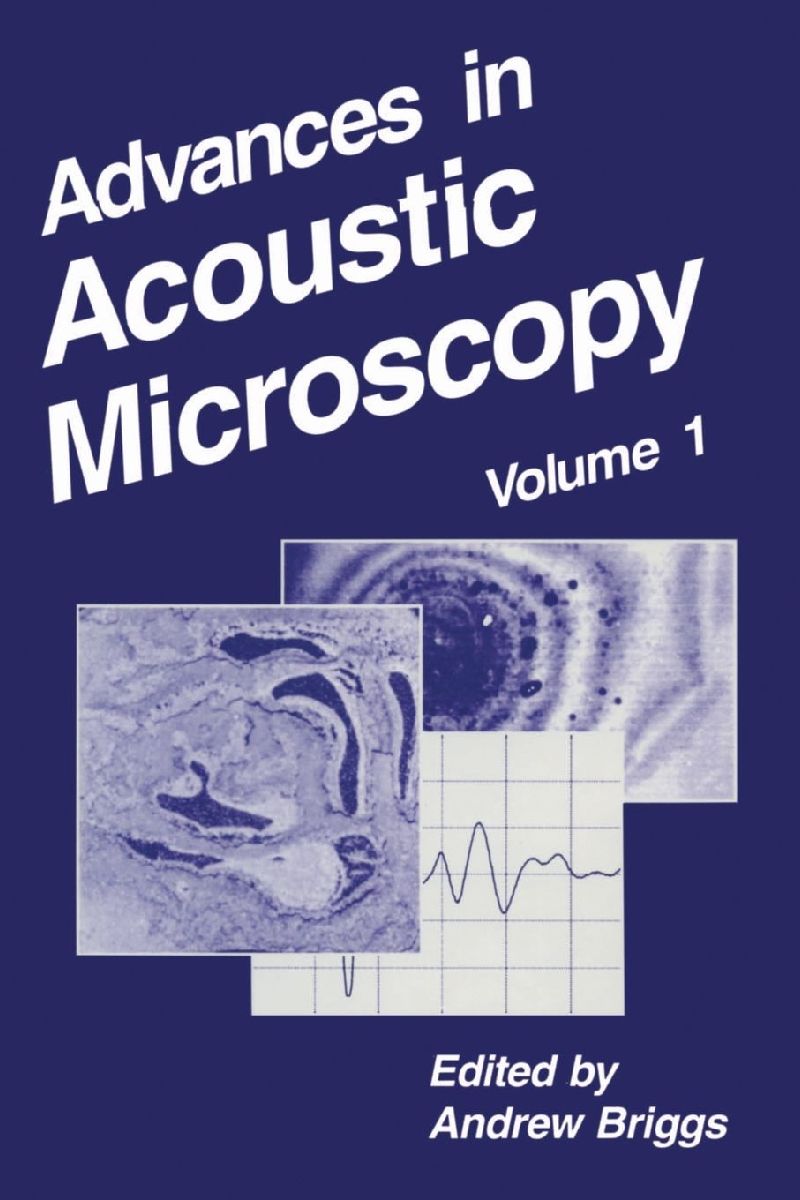
Advances in Acoustic Microscopy
Herausgegeben von: Andrew Briggs
Aus der Reihe Advances in Acoustic Microscopy
- Einband
- Kartoniert
- Seiten
- 388
- Sprache
- Englisch
- Erschienen
- Oktober 2012
- Verlag
- Springer
Buchbeschreibung
In 1992 Acoustic Microscopy was published by Oxford University Press, in the series of Monographs on the Physics and Chemistry of Materials.
Reviews appeared in the Journal of Microscopy [169 (1), 91] and in Contemporary Physics [33 (4), 296].
Ganze Beschreibung lesenWeniger anzeigen
At the time of going to press, it seemed that the field of acoustic microscopy had settled down from the wonderful developments in resolution that had been seen in the late seventies and the early eighties and from the no less exciting developments in quantitative elastic measurements that had followed.
One reviewer wrote, "The time is ripe for such a book, now that the expansion of the subject has perceptively slowed after it was detonated by Lemons and Quate. " [A. Howie, Proc. RMS 27 (4), 280]. In many ways, this remains true. The basic design for both imaging and quantitative instruments is well-established; the upper frequency for routine imaging is the 2 GHz established by the Ernst Leitz scanning acoustic microscope (ELSAM) in 1984. For the most accurate V(z) measurements, the 225-MHz line-focus-beam lens, developed at Tohoku Univer sity a little before then, remains standard.
The principles of the contrast theory have been confirmed by abundant experience; in particular the role of surface acoustic waves, such as Rayleigh waves, dominates the contrast in most high resolution studies of many materials.
Inhaltsverzeichnis
- 1. Acoustic Microscopy Analysis of Microelectronic Interconnection and Packaging Technologies
- 1.1. Introduction
- 1.2. Ceramic Packages
- 1.3. Plastic IC Packages
- 1.4. Die Attach
- 1.5. Multilayer Interconnect
- 1.6. Tape Automated Bonding
- 1.7. Mechanical Properties
Ganzes Inhaltsverzeichnis anzeigen (77 Einträge)Weniger anzeigen
- 1.8. Future Perspectives
- 1.9. Conclusions
- Acknowledgments
- References
- 2. Measuring Short Cracks by Time-Resolved Acoustic Microscopy
- 2.1. Introduction
- 2.2. Short-Pulse System for the SAM
- 2.3. Time-Resolved Measurement Technique
- 2.4. Crack Depth Measurements in Plastic Material
- 2.5. Applying TOFD to Metals
- 2.6. Crack Growth Measurement
- 2.7. Discussion
- 2.8. Summary
- Acknowledgments
- References
- 3. Probing Biological Cells and Tissues with Acoustic Microscopy
- 3.1. Introduction
- 3.2. Probing Cells in Culture
- 3.3. Probing Microspheres and Freshly Isolated Outer Hair Cells
- 3.4. Bone and Other Collagenous Tissues
- 3.5. Model Investigations of Gels and Membranes
- 3.6. Conclusions
- Acknowledgments
- References
- 4. Lens Geometries for Quantitative Acoustic Microscopy
- 4.1. Introduction
- 4.2. Acoustic Lens Geometries
- 4.3. Comparison of Signal Processing Electronics
- 4.4. The V(f) Characterization Method
- 4.5. Accuracy of Velocity Measurement Using the V(z) Method
- 4.6. Conclusions
- Acknowledgments
- References
- 5. Measuring Thin-Film Elastic Constants by Line-Focus Acoustic Microscopy
- 5.1. Overview
- 5.2. Introduction
- 5.3. Measurement Model for V(z) Curves
- 5.4. Measuring and Calculating SAW Velocities
- 5.5. Inverse Method
- 5.6. Elastic Constants of Single-Layer Films
- 5.7. Effective Elastic Constants of Superlattices
- 5.8. Conclusion
- Acknowledgment
- References
- 6. Measuring the Elastic Properties of Stressed Materials by Quantitative Acoustic Microscopy
- 6.1. Introduction
- 6.2. Acoustoelasticity and Surface Waves
- 6.3. Line-Focus Beam Acoustic Microscopy
- 6.4. Determining Materials Properties
- 6.5. Examples
- 6.6. Conclusions
- Acknowledgments
- References
- 7. Surface Brillouin Scattering-Extending Surface Wave Measurements to 20 GHz
- 7.1. Introduction
- 7.2. Kinematics of Brillouin Scattering
- 7.3. Theory of Brillouin-Scattering Cross Section
- 7.4. Surface Brillouin Scattering Setup
- 7.5. Experimental Results
- 7.6. Conclusions
- Acknowledgments
- References
- 8. New Approaches in Acoustic Microscopy for Noncontact
- Measurement and Ultrahigh Resolution
- 8.1. Introduction
- 8.2. Phase Velocity Scanning Method
- 8.3. Atomic Force Microscopy (AFM) with a Vibrating Sample
- Acknowledgement
- References
Details
- Erscheinungstermin
- Oktober 2012
- Kategorie
- Fremdsprachige Bücher
- Einband
- Kartoniert
- Seiten
- 388
- Sprache
- Englisch
- Verlag
- Springer
- Reihe
- Advances in Acoustic Microscopy
- Format
- 22,9 × 15,2 cm
- Dicke
- 2,1 cm
- Gewicht
- 561 g
- EAN / ISBN-13
- 9781461357629
Versand und Rückgabe
Standardversand: 1 bis 3 Werktage, 3,99 €, kostenlos ab 35 €
Liefergebiet: Deutschland
Rücksendung: 14 Tage Widerrufsrecht. Bei einem Widerruf tragen Sie die Kosten der Rücksendung. Bei einer Falschlieferung oder einem Fehler von uns erstatten wir Ihnen das Rückporto. Den Widerruf erklären Sie über den Knopf „Vertrag widerrufen“ im Fuß der Seite.
Hersteller und ProduktsicherheitSpringer Nature Customer Service Center GmbH
Springer Nature Customer Service Center GmbH
Europaplatz 3
69115 Heidelberg
Deutschland
ProductSafety@springernature.com
Mehr von Andrew Briggs




Ähnliche Titel

Far- and Deep-Ultraviolet Spectroscopy
Yukihiro Ozaki (Hrsg.)
Gebunden, Englisch, 2 Ausgaben
ab 53,49 €

Essentials of Pharmaceutical Analysis
Muhammad Sajid Hamid Akash
Gebunden, Englisch, 2 Ausgaben
ab 213,99 €


Bewertungen
Zu diesem Titel gibt es noch keine Bewertung. Bewerten kann, wer ihn bei uns gekauft hat.
So prüfen wir Bewertungen
Eine Bewertung kann bei uns nur abgeben, wer den Titel über sein Kundenkonto bei uns gekauft hat. Jede Bewertung ist fest mit der zugehörigen Bestellung verknüpft; anders kommt sie technisch gar nicht zustande. Deshalb trägt jede angezeigte Bewertung den Hinweis „Verifizierter Kauf". Wir zeigen positive wie negative Bewertungen und löschen nur bei Rechtsverstößen. Für Bewertungen gibt es keine Gegenleistung.
53,49 €Voraussichtlich 1. bis 3. Dez.