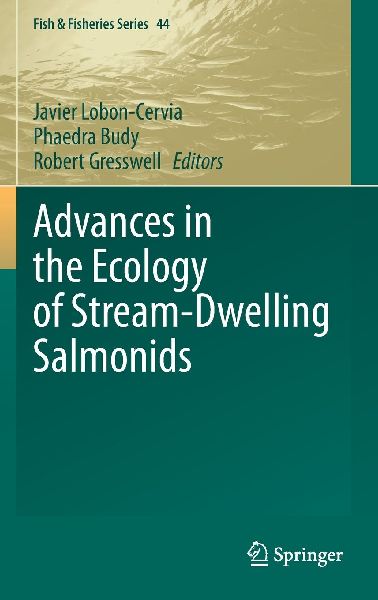
Advances in the Ecology of Stream-Dwelling Salmonids
von Javier Lobon-Cervia (Hrsg.)
Herausgegeben von: Javier Lobon-Cervia, Herausgegeben von: Phaedra Budy, Herausgegeben von: Robert Gresswell
Aus der Reihe Fish & Fisheries Series
- Einband
- Gebunden
- Seiten
- 752
- Sprache
- Englisch
- Erschienen
- März 2024
- Verlag
- Springer
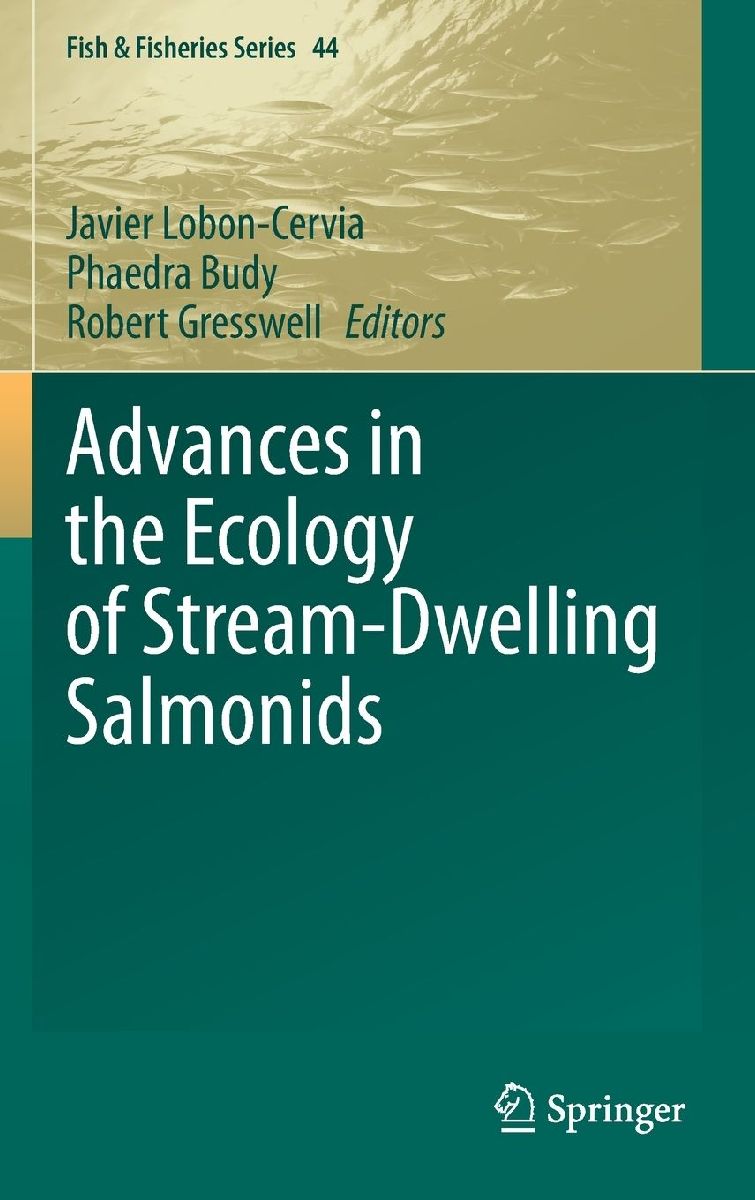
Buchbeschreibung
Many salmonids inhabit streams during the whole, or a substantial part of their lifetime.
Streams, as networks of cold waters running over rifles, pools and tables of gravel, pebble and stony substratum, are fed by rainfall and snowmelt and may be subject to spat es and droughts. Hence, these lotic systems are heterogeneous by nature and vary substantially in temperature and discharge along their environmental gradients.
Ganze Beschreibung lesenWeniger anzeigen
In these habitats, salmonids encounter suitable reproductive and feeding habitats where they exhibit a dizzying array of life¿history traits and an overwhelming variability in size, growth and density. Essentially predators upon organisms drifting across the water column, they become apex piscivores at large sizes.
They may also serve as prey for aquatic macroinvertebrates at the youngest stages, and as they grow, they may become prey for birds and mammals. In addition, many populations play a major role in the recycling of biogeochemical elements critical for the trophic dynamics of their home streams.
Empirical assessment of the ecological functioning of stream salmonids has been a tireless endeavor since the pioneer studies by Allen (1951), Chapman (1966), McFadden (1964) and Northcote (1966) further enhanced by the IBP (1964-1974; Ger king 1967) and extended to experimental approaches during the last decades (Northcote Lobon-Cervia 2010, Lobon-Cervia & Sanz 2017, Kershner et al. 2019). It has become increasingly apparent that streams are severely threatened by human abuse and misuse, including over-extraction, diversion, damming and pollution, in addition to the more recent threat of global warming.
Furthermore, salmonids themselves are threatened by genetic introgressions, diseases, and parasites related to uncontrolled introductions of individuals from aquaculture, and over-exploitation by angling. These threats have triggered important social and political concerns, to the extent of becoming research priorities for major agencies and institutions.
In this context, we attempt to add an overview to this endeavor by updating and summarizing the documented ecology of stream-living salmonids, with reference to the factors and mechanisms underlying the growth, density and life history that interact to determine the size, number, and distribution of individuals encountered in any wild population.
Inhaltsverzeichnis
- Embryo Temperature Has Knock-On Effects on Later Traits in Salmonid Fishes
- Field Observations of Deformed Atlantic Salmon (Salmo Salar) Embryos Incubated in the Hyporheic Zones of Seven Cold Region Rivers
- Environmental Determinants of Spawning Location, and Density and Size of Age-0 Brown Trout Salmo Trutta in a Small Boreal Stream
- Density-Dependent Growth in Salmonids: a Metaanalysis
- The Ghost of Density-Dependence: Environmental (hydrological) Factors Drive the Numerical Changes of Young Migratory Trout Salmo trutta in a Lake District Stream (UK), 1966-1996
- Long-term Recruitment Patterns of 0+ Brown Trout in the River Maine, Northern Ireland
- Spatial Patterns of Synchrony in Recruitment of Trout among Streams
- The Use of Net Energy Intake Models to Predict Microhabitat Selection by Drift-Feeding Fishes: Are Common Assumptions Warranted?
Ganzes Inhaltsverzeichnis anzeigen (29 Einträge)Weniger anzeigen
- Understanding Stream-Resident Salmonid Movements in Groundwater-Fed Streams of the Driftless Area (USA)
- Trophic Flexibility of Stream-Dwelling Salmonids: Disentangling Common Ontogenetic and Seasonal Patterns
- Stream Salmonids on the Cormorant Menu
- Partial Migration in Salmonids: Focusing on Asian Endemic Masu Salmon (Oncorhynchus Masou) and White-Spotted Charr (Salvelinus Leucomaenis)
- The Role of the Soundscape in the Behavioral Ecology of Stream-Dwelling Salmonids
- The Freshwater Pearl Mussel; A Costly Stowaway or an Important Habitat Engineer?
- Habitat Selection and Segregation among Stream Salmonids: The Case of Juvenile Coho Salmon (Oncorhynchus Kisutch) and Steelhead Trout (Oncorhynchus Mykiss Irideus)
- Trout under Drought: A Long-term Study of Annual Growth and Condition of Stream-living Coastal Cutthroat Trout (Oncorhynchus clarkii clarkii)
- Winter Ecology of Salmonids in Boreal Streams under Climate Change
- Components of Brown Trout Age-Class Density Dynamics
- Salmonids in New Zealand - Old Ways in New Lands
- Application of a Fine-Scale Modeling Approach to Assess Broad-Scale Changes in Stream Salmonid Habitat in a Changing Climate
- Determinants of Productive Capacity for Stream Salmonids
- Determinants and Dynamics of Production Rates of Stream-Dwelling Salmonids: The Importance of Intrinsic Factors
- Influence of Streamflow on Productivity of Stream Type Chinook Salmon Populations in the Salmon River Drainage, Idaho
- The Increasing Threat Posed by Nonnative and Hatchery-Reared Salmonids to Japanese Wild Native Salmonids
- Demographic and Genetic Attributes Of Small, Isolated Populations Of Gila Trout - Prospects For Persistence Under A Shifting Climate Regime
- Ecological Ttraits and Fishery of the Upper Limay River, a Key System for Salmonids in the Andean North Patagonia
- Dynamics of a Warmwater-Coldwater Fish Assemblage in a Wildfire Prone Landscape
- The Future of Salmonids in a Rapidly Changing World
- A Short Reflection on Protecting the Remaining Biodiversity of Salmonid Fishes
Details
- Erscheinungstermin
- März 2024
- Kategorie
- Fremdsprachige Bücher
- Einband
- Gebunden
- Seiten
- 752
- Sprache
- Englisch
- Verlag
- Springer
- Reihe
- Fish & Fisheries Series
- Format
- 24,1 × 16,0 cm
- Dicke
- 4,6 cm
- Gewicht
- 1.228 g
- EAN / ISBN-13
- 9783031443886
Über Javier Lobon-Cervia (Hrsg.)
Dr. Javier Lobon-Cervia: - Full-time researcher of the Spanish National Research Council since 1986.- Founder and Editor in chief of the international journal "Ecology of Freshwater Fish", 1992-2016.- …
Mehr über Javier Lobon-Cervia (Hrsg.)Weniger anzeigen
Javier Lobon-Cervia: - Full-time researcher of the Spanish National Research Council since 1986.- Founder and Editor in chief of the international journal "Ecology of Freshwater Fish", 1992-2016.- Major Research: Population and community ecology of stream-dwelling fishes, mostly salmonids and (Neo)tropical fish.- Publications: Over 200 articles in international and national journals; served as editor and author for 4 books and 2 books as single author.
Phaedra Budy is the Unit Leader of the U.S. Geological Society, Utah Cooperative Fish and Wildlife Unit as well as a Professor of fisheries management and aquatic ecology in the Department of Watershed Sciences at Utah State University (USU). She holds aB.S. in Limnology from the University of California, Davis and a PhD in Aquatic Ecology from Utah State University. In conjunction with her research lab, she does research that fits into an overall framework of evaluating the factors that structure and limit fish populations in both lentic and lotic systems, and they also work broadly in conservation biology, invasion ecology, and aquatic food web dynamics. Her current research covers a wide geographical range including most of Utah, as well as parts of New Mexico, Nevada, and Alaska and includes salmonids, many imperiled native desert fishes, and warm water lentic fishes. She is also involved in experimental stream restoration (with beavers) and large river management.
Robert Gresswell is an instructor in the Department of Ecology at Montana State University and Emeritus Research Scientist, U.S. Geological Survey. For over 49 years, he has been studying the factors that influence fish abundance, distribution, and life history within, and among watersheds, and how these relationships change through time. Interest in the role of disturbance in shaping aquatic systems has led to research on the interactions among landscape-scale environmental variables, instream habitat characteristics, and cutthroat trout abundance and distribution. Current investigations are focused on the effects of fire, timber harvest, invasive species, and climate change on persistence of native trout in the western USA.
Versand und Rückgabe
Standardversand: 1 bis 3 Werktage, 3,99 €, kostenlos ab 35 €
Liefergebiet: Deutschland
Rücksendung: 14 Tage Widerrufsrecht. Bei einem Widerruf tragen Sie die Kosten der Rücksendung. Bei einer Falschlieferung oder einem Fehler von uns erstatten wir Ihnen das Rückporto. Den Widerruf erklären Sie über den Knopf „Vertrag widerrufen“ im Fuß der Seite.
Hersteller und ProduktsicherheitSpringer Nature Customer Service Center GmbH
Springer Nature Customer Service Center GmbH
Europaplatz 3
69115 Heidelberg
Deutschland
ProductSafety@springernature.com
Mehr aus der Reihe Fish & Fisheries Series
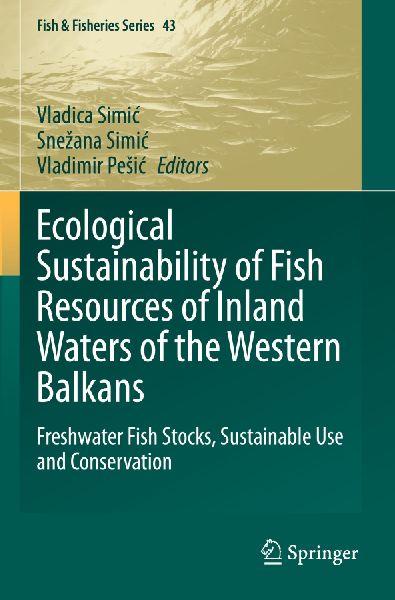
Ecological Sustainability of Fish Resources of Inland Waters of the Western Balkans
Vladica Simi¿ (Hrsg.)
Kartoniert, Englisch, 2 Ausgaben
ab 171,19 €
Yellow Perch, Walleye, and Sauger: Aspects of Ecology, Management, and Culture
John Clay Bruner (Hrsg.)
Gebunden, Englisch, 2 Ausgaben
ab 192,59 €
Ähnliche Titel

Beaver Protection, Management, and Utilization in Europe and North America
Ryszard M. Dzieciolowski (Hrsg.)
Gebunden, Englisch, 2 Ausgaben
ab 160,49 €

Bewertungen
Zu diesem Titel gibt es noch keine Bewertung. Bewerten kann, wer ihn bei uns gekauft hat.
So prüfen wir Bewertungen
Eine Bewertung kann bei uns nur abgeben, wer den Titel über sein Kundenkonto bei uns gekauft hat. Jede Bewertung ist fest mit der zugehörigen Bestellung verknüpft; anders kommt sie technisch gar nicht zustande. Deshalb trägt jede angezeigte Bewertung den Hinweis „Verifizierter Kauf". Wir zeigen positive wie negative Bewertungen und löschen nur bei Rechtsverstößen. Für Bewertungen gibt es keine Gegenleistung.
299,59 €Voraussichtlich 7. bis 9. Dez.