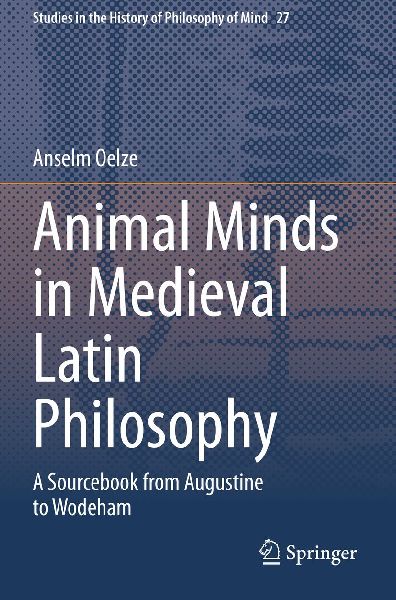
Animal Minds in Medieval Latin Philosophy
A Sourcebook from Augustine to Wodeham
von Anselm Oelze
Aus der Reihe Studies in the History of Philosophy of Mind
- Einband
- Kartoniert
- Seiten
- 224
- Sprache
- Englisch
- Erschienen
- Juni 2022
- Verlag
- Springer
Buchbeschreibung
This sourcebook explores how the Middle Ages dealt with questions related to the mental life of creatures great and small.
It makes accessible a wide range of key Latin texts from the fourth to the fourteenth century in fresh English translations. Specialists and non-specialists alike will find many surprising insights in this comprehensive collection of sources on the medieval philosophy of animal minds.
Ganze Beschreibung lesenWeniger anzeigen
The book's structure follows the distinction between the different aspects of the mental.
The author has organized the material in three main parts: cognition, emotions, and volition. Each part contains translations of texts by different medieval thinkers. The philosophers chosen include well-known figures like Augustine, Albert the Great, and Thomas Aquinas. The collection also profiles the work of less studied thinkers like John Blund, (Pseudo-) Peter of Spain, and Peter of Abano.
In addition, among those featured are several translated here into English for the first time. Each text comes with a short introduction to the philosopher, the context, and the main arguments of the text plus a section with bibliographical information and recommendations for further reading. A general introduction to the entire volume presents the basic concepts and questions of the philosophy of animal minds and explains how the medieval discussion relates to the contemporary debate.
This sourcebook is valuable for anyone interested in the history of philosophy, especially medieval philosophy of mind. It will also appeal to scholars and students from other fields, such as psychology, theology, and cultural studies.
Inhaltsverzeichnis
- Introduction: Animal Minds In Medieval and Modern Philosophy
- Part I - Cognition
- Chapter 1. Perception, Knowledge, and Reason (Augustine, De quantitate animae 25-28)
- Chapter 2. Souls and Discrimination (Adelard of Bath, Quaestiones naturales 13-14)
- Chapter 3. Estimation and Concept Formation (John Blund, Tractatus de anima 19)
- Chapter 4. (a).
- Memory, Learning, and Prudence (Albert the Great, Metaphysica I.1.6)
- (b).
Ganzes Inhaltsverzeichnis anzeigen (35 Einträge)Weniger anzeigen
- Reasoning, Learning, and Language (Albert the Great, De animalibus XXI.1.2-4).
- Chapter 5. Universal Cognition (Pseudo-Peter of Spain, Commentum super libros De animalibus VIII)
- Chapter 6. (a).
- Reasoning and Thinking (Roger Bacon, Perspectiva II.3.9)
- (b).
- Goal-Directed Behaviour (Roger Bacon, Questiones super libros IV Physicorum II)
- Chapter 7. Inner Senses (Thomas Aquinas, Summa theologiae I.78.4)
- Chapter 8. Prudence (John Duns Scotus, Quaestiones super libros Metaphysicorum Aristotelis I.3)
- Chapter 9. Judging and Erring (Gregory of Rimini, Lectura super I Sententiarum III.1 vs.Adam Wodeham, Lectura secunda in I Sententiarum, prol
- 4.8)
- Part II. Emotion
- Chapter 10. Friendship, Enmity, and Fear (Albert the Great, Quaestiones super De animalibus VIII.1-3)
- Chapter 11. (a).
- Lust and Anger (Thomas Aquinas, Summa theologiae I.81.2-3)
- (b).
- Enjoyment (Thomas Aquinas, Summa theologiae I-II.11.2)
- (c).
- Hope (Thomas Aquinas, Summa theologiae I-II.40.3)
- Chapter 12. Happiness and Fun (Peter of Abano, Expositio problematum Aristotelis 28.7)
- Part III. Volition
- Chapter 13. Judging and Free Choice (Albert the Great, De homine I)
- Chapter 14. Free Will (Bonaventure, Commentarius in secundum librum Sententiarum 25.1.1)
- Chapter 15. Instinct and Deliberation (Roger Bacon, Communia naturalium I.2.4.1)
- Chapter 16. (a).
- Free Choice (Thomas Aquinas, Quaestiones disputatae de veritate 24.2)
- (b).
- Choosing and Acting (Thomas Aquinas, Summa theologiae I-II.13.1-2)
Details
- Erscheinungstermin
- Juni 2022
- Kategorie
- Fremdsprachige Bücher
- Einband
- Kartoniert
- Seiten
- 224
- Sprache
- Englisch
- Verlag
- Springer
- Reihe
- Studies in the History of Philosophy of Mind
- Format
- 23,5 × 15,5 cm
- Dicke
- 1,3 cm
- Gewicht
- 347 g
- EAN / ISBN-13
- 9783030670146
Über Anselm Oelze
Anselm Oelze (PhD Humboldt University of Berlin, 2017) worked as postdoctoral researcher at the University of Helsinki and as teaching fellow in philosophy at the LMU Munich.
Mehr über Anselm OelzeWeniger anzeigen
He is author of the book Animal Rationality: Later Medieval Theories 1250-1350 (Brill, 2018) and of articles on animal cognition and animal ethics in the Middle Ages.
Versand und Rückgabe
Standardversand: 1 bis 3 Werktage, 3,99 €, kostenlos ab 35 €
Liefergebiet: Deutschland
Rücksendung: 14 Tage Widerrufsrecht. Bei einem Widerruf tragen Sie die Kosten der Rücksendung. Bei einer Falschlieferung oder einem Fehler von uns erstatten wir Ihnen das Rückporto. Den Widerruf erklären Sie über den Knopf „Vertrag widerrufen“ im Fuß der Seite.
Hersteller und ProduktsicherheitSpringer Nature Customer Service Center GmbH
Springer Nature Customer Service Center GmbH
Europaplatz 3
69115 Heidelberg
Deutschland
ProductSafety@springernature.com
Mehr von Anselm Oelze


Mehr aus der Reihe Studies in the History of Philosophy of Mind
Mind, Soul and the Cosmos in the High Middle Ages
Jack P. Cunningham (Hrsg.)
Gebunden, Englisch, 2 Ausgaben
ab 160,49 €
Aristotle. On Youth and Old Age, Life and Death, and Respiration 1-6
Giouli Korobili
Gebunden, Englisch, 2 Ausgaben
ab 117,69 €
Ähnliche Titel

Bewertungen
Zu diesem Titel gibt es noch keine Bewertung. Bewerten kann, wer ihn bei uns gekauft hat.
So prüfen wir Bewertungen
Eine Bewertung kann bei uns nur abgeben, wer den Titel über sein Kundenkonto bei uns gekauft hat. Jede Bewertung ist fest mit der zugehörigen Bestellung verknüpft; anders kommt sie technisch gar nicht zustande. Deshalb trägt jede angezeigte Bewertung den Hinweis „Verifizierter Kauf". Wir zeigen positive wie negative Bewertungen und löschen nur bei Rechtsverstößen. Für Bewertungen gibt es keine Gegenleistung.
53,49 €Voraussichtlich 1. bis 3. Dez.