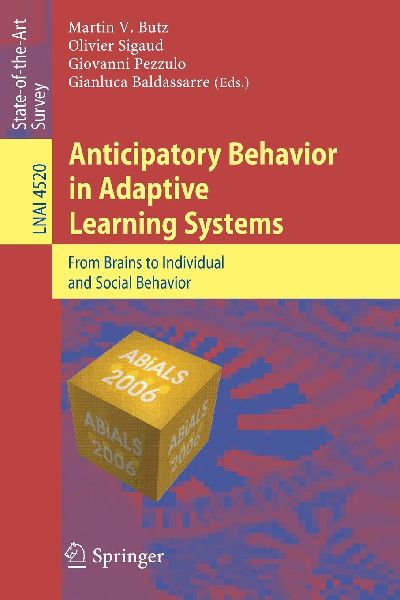
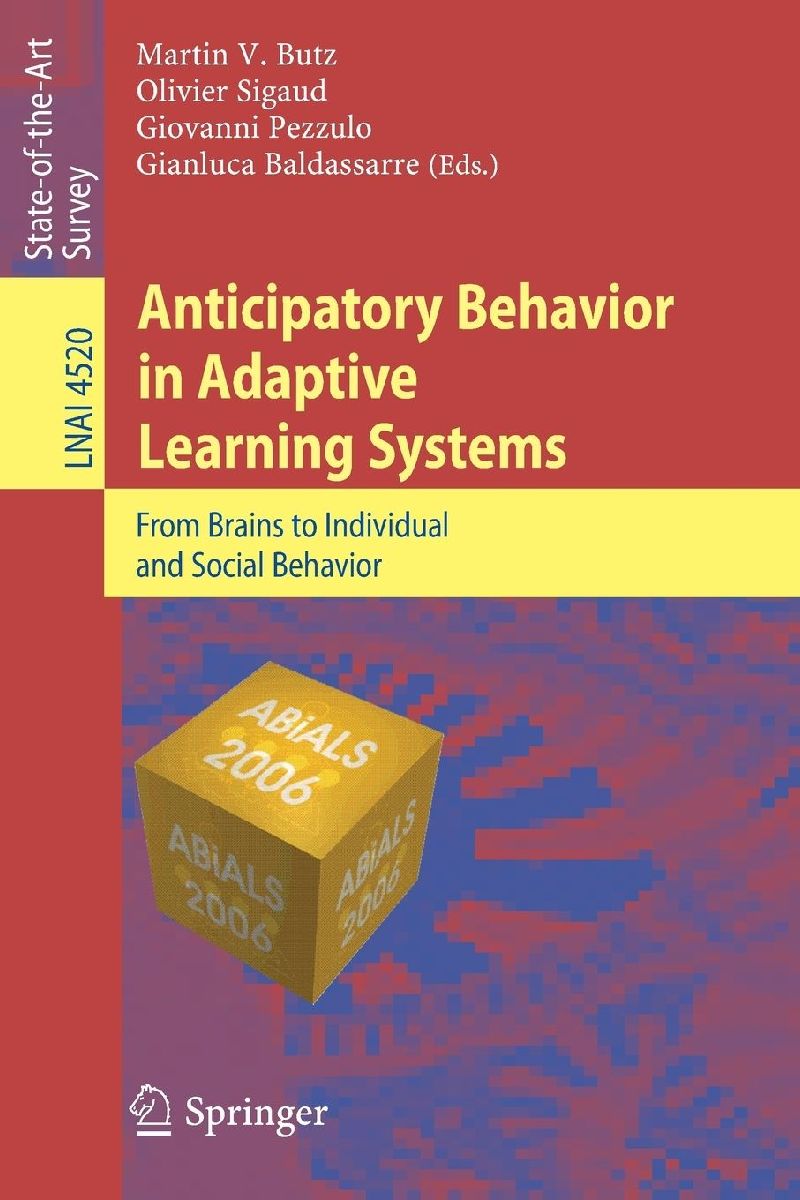
Anticipatory Behavior in Adaptive Learning Systems
From Brains to Individual and Social Behavior
Herausgegeben von: Martin V. Butz, Herausgegeben von: Olivier Sigaud, Herausgegeben von: Giovanni Pezzulo, und weitere
Aus der Reihe Lecture Notes in Computer Science
- Einband
- Kartoniert
- Seiten
- 396
- Sprache
- Englisch
- Erschienen
- August 2007
- Verlag
- Springer
Buchbeschreibung
Anticipatory behavior in adaptive learning systems is steadily gaining the - terest of scientists, although many researchers still do not explicitly consider the actual anticipatory capabilities of their systems.
Similarly to the previous two workshops, the third workshop on anticipatory behavior in adaptive lea- ing systems (ABiALS 2006) has shown yet again that the similarities between di?erent anticipatory mechanisms in diverse cognitive systems are striking.
Ganze Beschreibung lesenWeniger anzeigen
The discussions and presentations on the workshop day of September 30th, 2006, during the Simulation of Adaptive Behavior Conference (SAB 2006), con?rmed that the investigations into anticipatory cognitive mechanisms for behavior and learning strongly overlap among researchers from various disciplines, including the whole interdisciplinary cognitive science area.
Thus, further conceptualizations of anticipatory mechanisms seem man- tory. The introductory chapter of this volume therefore does not only provide an overview of the contributions included in this volume but also proposes a taxonomy of how anticipatory mechanisms can improve adaptive behavior and learning in cognitive systems.
During the workshop it became clear that ant- ipations are involved in various cognitive processes that range from individual anticipatory mechanisms to social anticipatory behavior. This book re?ects this structure by ?rst providing neuro scienti?c as well as psychological evidence for anticipatorymechanismsinvolvedinbehavior, learning, language, and cognition.
Next, individualpredictivecapabilitiesandanticipatorybehaviorcapabilitiesare investigated. Finally, anticipation relevant in social interaction is studied.
Inhaltsverzeichnis
- Anticipations, Brains, Individual and Social Behavior: An Introduction to Anticipatory Systems
- Anticipatory Aspects in Brains, Language, and Cognition
- Neural Correlates of Anticipation in Cerebellum, Basal Ganglia, and Hippocampus
- The Role of Anticipation in the Emergence of Language
- Superstition in the Machine
- Individual Anticipatory Frameworks
- From Actions to Goals and Vice-Versa: Theoretical Analysis and Models of the Ideomotor Principle and TOTE
- Project "Animat Brain": Designing the Animat Control System on the Basis of the Functional Systems Theory
Ganzes Inhaltsverzeichnis anzeigen (25 Einträge)Weniger anzeigen
- Cognitively Inspired Anticipatory Adaptation and Associated Learning Mechanisms for Autonomous Agents
- Schema-Based Design and the AKIRA Schema Language: An Overview
- Learning Predictions and Anticipations
- Training and Application of a Visual Forward Model for a Robot Camera Head
- A Distributed Computational Model of Spatial Memory Anticipation During a Visual Search Task
- A Testbed for Neural-Network Models Capable of Integrating Information in Time
- Construction of an Internal Predictive Model by Event Anticipation
- Anticipatory Individual Behavior
- The Interplay of Analogy-Making with Active Vision and Motor Control in Anticipatory Robots
- An Intrinsic Neuromodulation Model for Realizing Anticipatory Behavior in Reaching Movement under Unexperienced Force Fields
- Anticipating Rewards in Continuous Time and Space: A Case Study in Developmental Robotics
- Anticipatory Model of Musical Style Imitation Using Collaborative and Competitive Reinforcement Learning
- Anticipatory Social Behavior
- An Anticipatory Trust Model for Open Distributed Systems
- Anticipatory Alignment Mechanisms for Behavioral Learning in Multi Agent Systems
- Backward vs. Forward-Oriented Decision Making in the Iterated Prisoner's Dilemma: A Comparison Between Two Connectionist Models
- An Experimental Study of Anticipation in Simple Robot Navigation
Details
- Erscheinungstermin
- August 2007
- Kategorie
- Fremdsprachige Bücher
- Einband
- Kartoniert
- Seiten
- 396
- Sprache
- Englisch
- Verlag
- Springer
- Reihe
- Lecture Notes in Computer Science
- Format
- 23,5 × 15,5 cm
- Dicke
- 2,2 cm
- Gewicht
- 598 g
- EAN / ISBN-13
- 9783540742616
Versand und Rückgabe
Standardversand: 1 bis 3 Werktage, 3,99 €, kostenlos ab 35 €
Liefergebiet: Deutschland
Rücksendung: 14 Tage Widerrufsrecht. Bei einem Widerruf tragen Sie die Kosten der Rücksendung. Bei einer Falschlieferung oder einem Fehler von uns erstatten wir Ihnen das Rückporto. Den Widerruf erklären Sie über den Knopf „Vertrag widerrufen“ im Fuß der Seite.
Hersteller und ProduktsicherheitSpringer Nature Customer Service Center GmbH
Springer Nature Customer Service Center GmbH
Europaplatz 3
69115 Heidelberg
Deutschland
ProductSafety@springernature.com
Mehr von Martin V. Butz



Rule-Based Evolutionary Online Learning Systems
Martin V. Butz
Gebunden, Englisch, 2 Ausgaben
ab 106,99 €
Mehr aus der Reihe Lecture Notes in Computer Science



Ähnliche Titel



Bewertungen
Zu diesem Titel gibt es noch keine Bewertung. Bewerten kann, wer ihn bei uns gekauft hat.
So prüfen wir Bewertungen
Eine Bewertung kann bei uns nur abgeben, wer den Titel über sein Kundenkonto bei uns gekauft hat. Jede Bewertung ist fest mit der zugehörigen Bestellung verknüpft; anders kommt sie technisch gar nicht zustande. Deshalb trägt jede angezeigte Bewertung den Hinweis „Verifizierter Kauf". Wir zeigen positive wie negative Bewertungen und löschen nur bei Rechtsverstößen. Für Bewertungen gibt es keine Gegenleistung.
53,49 €Voraussichtlich 2. bis 4. Dez.