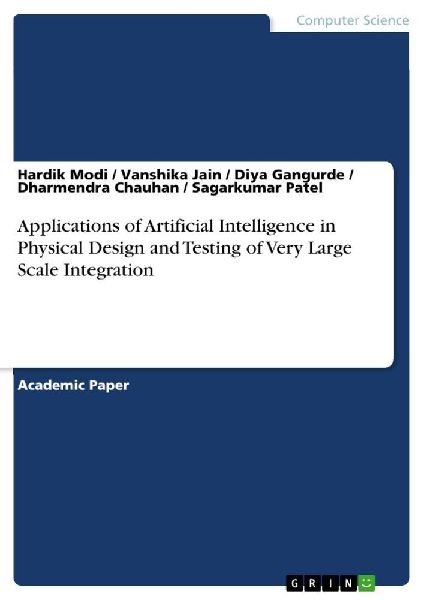
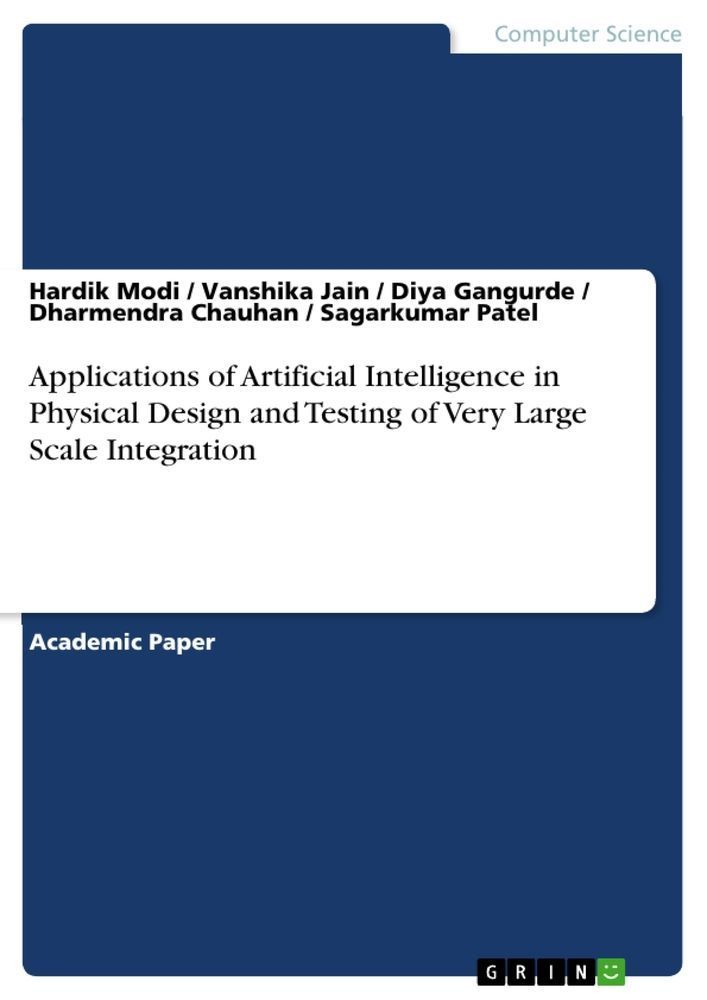
Applications of Artificial Intelligence in Physical Design and Testing of Very Large Scale Integration
von Hardik Modi, Vanshika Jain, Diya Gangurde und 2 weitere
- Einband
- Kartoniert
- Seiten
- 48
- Sprache
- Englisch
- Erschienen
- Oktober 2024
- Verlag
- GRIN Verlag
Buchbeschreibung
Academic Paper from the year 2024 in the subject Computer Sciences - Artificial Intelligence, , language: English, abstract: Our book provides a succinct summary of Artificial Intelligence applications across multiple Very-Large-Scale Integration (VLSI) design flow and testing domains. One technique of fabrication, CMOS technology, is where the evolution of VLSI begins.
Ganze Beschreibung lesenWeniger anzeigen
Complementary Metal Oxide Semiconductor (CMOS) offers numerous advantages but to pack high number of Integrated Circuits (ICs) in compact geometries, VLSI enters into picture. We can design VLSI using Computer Aided Tools like Electronic Design Automation (EDA). VLSI design consists of two primary parts: the front end and the back end.
Fabrication procedures such as Architectural Design, Gate Level Design, Simulation, Hardware Descriptive Language (HDL), Circuit Level Design, Verification, and Fabrication are included at the back end. Descriptive languages for hardware are the main emphasis of front end. HDL is essential to system design use because it enables the behavior of the core system to be verified and modelled prior to the design being converted by synthesis tools into physical hardware, such as gates and wires.
Different chemical and physical processes are needed for the backend operations. It is possible to create Artificial Intelligence algorithms that aid in raising the yield of physical processes. Artificial Intelligence and Machine Learning (AI-ML) algorithms assist in predicting parametric yield at the device level.
Furthermore AI-ML algorithms are implemented at the gate level to analyse the total latency of the gate connection. Also, AI-ML algorithms can be used at the circuit level to maximize the performance of circuits. A combination of AI-ML algorithms in EDA tools allows for the examination of propagation delay, power leakage, etc. During lithography, transfer learning can be used to produce data.
Effective testing becomes a crucial task as electronic systems and components becoming more complex, striking a balance between the need for high quality and cost effectiveness. In spite of its labour-intensive nature, testing has become a critical technique for cutting total costs in the production of electronic systems, boards, and VLSI chips.
It plays a critical role in ensuring that VLSI design satisfy quality requirement by identifying circuit faults. In order to handle the complexity of contemporary systems, recent developments have incorporated machine learning (ML) and artificial intelligence (AI) into established VLSI testing techniques.
Details
- Erscheinungstermin
- Oktober 2024
- Kategorie
- Fremdsprachige Bücher
- Einband
- Kartoniert
- Seiten
- 48
- Sprache
- Englisch
- Verlag
- GRIN Verlag
- Format
- 21,0 × 14,8 cm
- Dicke
- 0,4 cm
- Gewicht
- 84 g
- EAN / ISBN-13
- 9783389077535
Versand und Rückgabe
Standardversand: 1 bis 3 Werktage, 3,99 €, kostenlos ab 35 €
Liefergebiet: Deutschland
Rücksendung: 14 Tage Widerrufsrecht. Bei einem Widerruf tragen Sie die Kosten der Rücksendung. Bei einer Falschlieferung oder einem Fehler von uns erstatten wir Ihnen das Rückporto. Den Widerruf erklären Sie über den Knopf „Vertrag widerrufen“ im Fuß der Seite.
Hersteller und ProduktsicherheitGRIN Publishing GmbH
Mehr von Hardik Modi
Ähnliche Titel


Computational Science and Its Applications - ICCSA 2026
Osvaldo Gervasi (Hrsg.)
Kartoniert, Englisch
79,17 €

Computational Science and Its Applications - ICCSA 2026 Workshops
Osvaldo Gervasi (Hrsg.)
Kartoniert, Englisch
139,09 €

Bewertungen
Zu diesem Titel gibt es noch keine Bewertung. Bewerten kann, wer ihn bei uns gekauft hat.
So prüfen wir Bewertungen
Eine Bewertung kann bei uns nur abgeben, wer den Titel über sein Kundenkonto bei uns gekauft hat. Jede Bewertung ist fest mit der zugehörigen Bestellung verknüpft; anders kommt sie technisch gar nicht zustande. Deshalb trägt jede angezeigte Bewertung den Hinweis „Verifizierter Kauf". Wir zeigen positive wie negative Bewertungen und löschen nur bei Rechtsverstößen. Für Bewertungen gibt es keine Gegenleistung.
27,95 €Voraussichtlich 1. bis 3. Dez.