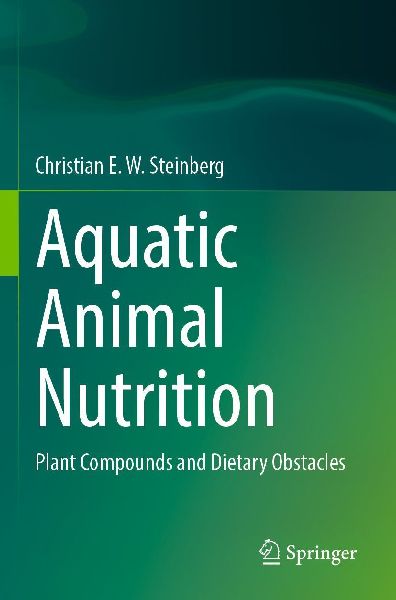
Aquatic Animal Nutrition
Plant Compounds and Dietary Obstacles
- Einband
- Kartoniert
- Seiten
- 668
- Sprache
- Englisch
- Erschienen
- August 2026
- Verlag
- Springer
Buchbeschreibung
Based on positive experiences in human nutrition and healthy aging, individual and combined plant secondary metabolites are added to aquafeeds.
The main compounds used are carotenoids, polyphenols, terpenes, and various alkaloids. The pile of supplementation studies with beneficial results is growing rapidly. These benefits include increased immunity, pathogen resistance, or improved gut microbiome diversity. However, a variety of adverse results cannot be ignored.
Ganze Beschreibung lesenWeniger anzeigen
Overall, in Aquatic Animal Nutrition research, this is another area of that is still in its early stages: as with supplementation of plant preparations (Aquatic Animal Nutrition – Plant Preparations), a robust and guiding hypothesis for supplementation is not apparent, and graded dosing is rarely used, especially in the low-dose range.
Often, the high doses used lead to the classification of various compounds as anti-nutritional. However, appropriate low-dose supplementation demonstrates that and how aquatic animals can cope with ‘anti-nutritional’ factors within their adaptive response, indicating that even these compounds may have some nutritional value.
In addition, knowledge of the underlying mechanisms of the adaptive response may provide physiological, transcriptomic, and epigenetic means to more sustainably utilize even this ‘worthless’ food source. The importance of the intestinal microflora is becoming increasingly clear and points to the imperative need to include gut microbiota in replacement studies.
Based on the few epigenetic studies currently available, the importance of these processes is demonstrated. The need to integrate such approaches into future studies is emphasized. The so-called hologenomics approach is inevitable. Supplementing aquafeed with terrestrial plant material can introduce toxins and endocrine disruptors.
The addition of adsorptive compounds (clay minerals) or functional feed ingredients (prebiotics, probiotics) can at least partially mitigate the adverse effects.
Inhaltsverzeichnis
- Chapter 1. Plant Compounds, Structures, Visions: ‘Only for Vegetarians?’
- Chapter 2. Carotenoids: ‘Only for Beauty Fans?’
- Chapter 3. Phenolic Compounds: ‘More than Longevity Drugs?’
- Chapter 4. Alkaloids: ‘Dope or Medication?’
- Chapter 5. Selected Terpenes and More: ‘Again Dope or Medicine?’
- Chapter 6. How Phytochemicals Work ¿ A Brief Overview: ‘Don’t Care About Details if Eating Pleases’
- Chapter 7. Phyto- and Mycosterols: 'Benefit or Risk?’
- Chapter 8. Cyanobacteria and the Food Chain: 'Cyanobacteria are Also Not Eaten with Pleasure’
- Chapter 9. Mycotoxins: ‘Another Noli Me Tangere’
Details
- Erscheinungstermin
- August 2026
- Kategorie
- Fremdsprachige Bücher
- Einband
- Kartoniert
- Seiten
- 668
- Sprache
- Englisch
- Verlag
- Springer
- Format
- 23,5 × 15,5 cm
- Dicke
- 3,6 cm
- Gewicht
- 996 g
- EAN / ISBN-13
- 9783031979903
Über Christian E. W. Steinberg
Christian E.W. Steinberg, educated as ecologist, is interested in pure and applied limnology, particularly aquatic organisms and their nutrition as well as the action of natural aquatic xenobiotic substances.
Mehr über Christian E. W. SteinbergWeniger anzeigen
Particularly, humic substances and their long-term impact in entire lake systems as well as their short-term and transgenerational effect in fishes and aquatic invertebrates have been and continue to be studied. Consequently, in 2003, he published the highly acclaimed Ecology of Humic Substances in Freshwater with Springer. The continuation of this research interest led to the identification of beneficial effects of natural mild environmental stresses, for instance, by dissolved humic substances, as ecological driving force and the publication of the 2012 Springer book Stress Ecology. In 2018, he began publishing the Aquatic Animal Nutrition series with Springer with "AMechanistic Perspective from Individuals to Generations" (2018), "Organic Macro- and Micro-Nutrients" (2022), and "Plant Preparations" (2024). In 1995, he was appointed chairholder of freshwater ecology at Humboldt University in Berlin and, for 10 years, director of the Leibniz Institute of Freshwater Ecology and Inland Fisheries, Berlin, Germany. He has published more than three hundred papers in peer-reviewed journals and was frequently appointed guest professor at Salzburg University (Austria), Universidade Federal do Rio de Janeiro (Brazil), Huazhong Agricultural University Wuhan (China), and, since 2009 permanently, Kunming University of Science and Technology (China).
Versand und Rückgabe
Standardversand: 1 bis 3 Werktage, 3,99 €, kostenlos ab 35 €
Liefergebiet: Deutschland
Rücksendung: 14 Tage Widerrufsrecht. Bei einem Widerruf tragen Sie die Kosten der Rücksendung. Bei einer Falschlieferung oder einem Fehler von uns erstatten wir Ihnen das Rückporto. Den Widerruf erklären Sie über den Knopf „Vertrag widerrufen“ im Fuß der Seite.
Hersteller und ProduktsicherheitSpringer Nature Customer Service Center GmbH
Springer Nature Customer Service Center GmbH
Europaplatz 3
69115 Heidelberg
Deutschland
ProductSafety@springernature.com
Mehr von Christian E. W. Steinberg
Ähnliche Titel
Biotechnological Tools in Fisheries and Aquatic Health Management
Bijay Kumar Behera (Hrsg.)
Gebunden, Englisch, 2 Ausgaben
ab 192,59 €
Bewertungen
Zu diesem Titel gibt es noch keine Bewertung. Bewerten kann, wer ihn bei uns gekauft hat.
So prüfen wir Bewertungen
Eine Bewertung kann bei uns nur abgeben, wer den Titel über sein Kundenkonto bei uns gekauft hat. Jede Bewertung ist fest mit der zugehörigen Bestellung verknüpft; anders kommt sie technisch gar nicht zustande. Deshalb trägt jede angezeigte Bewertung den Hinweis „Verifizierter Kauf". Wir zeigen positive wie negative Bewertungen und löschen nur bei Rechtsverstößen. Für Bewertungen gibt es keine Gegenleistung.
139,09 €Voraussichtlich 1. bis 3. Dez.