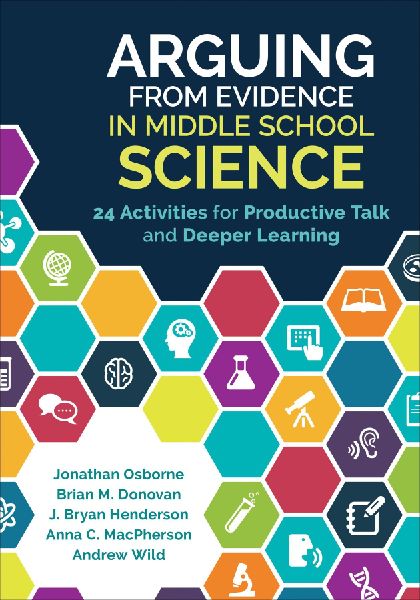
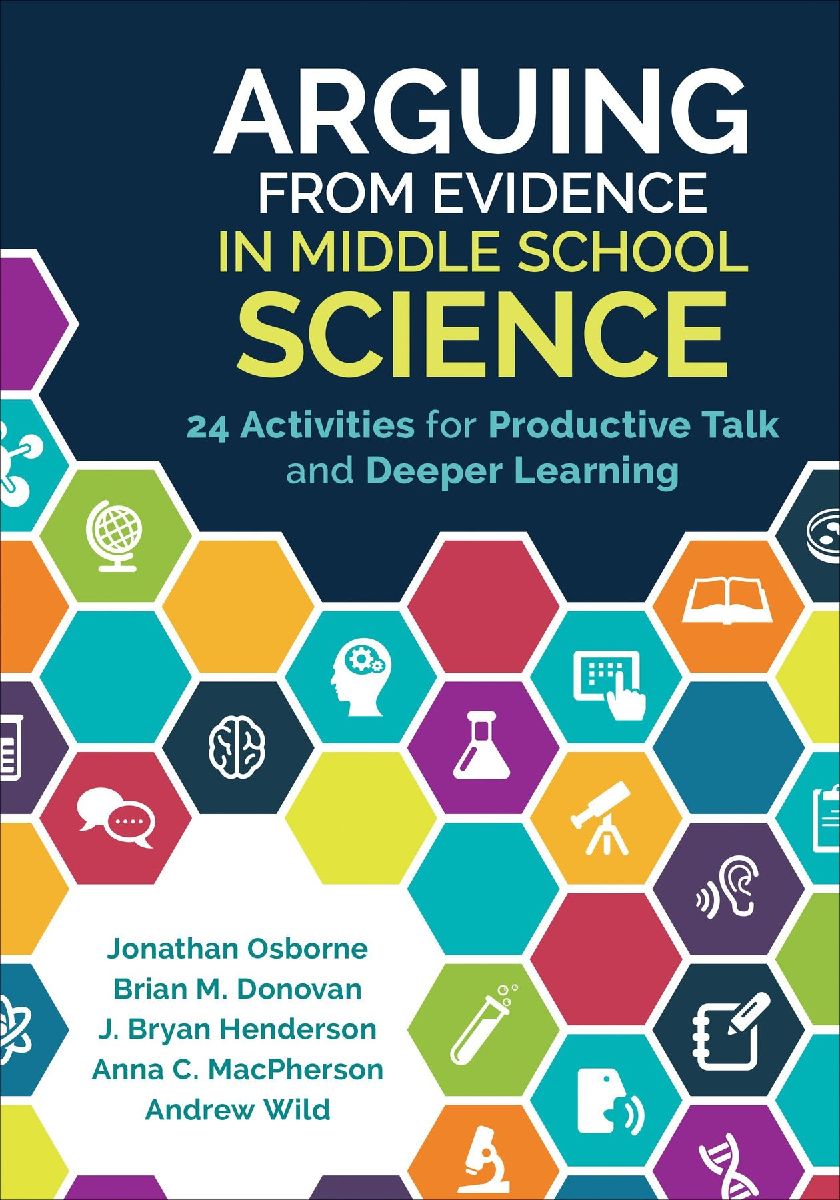
Arguing From Evidence in Middle School Science
24 Activities for Productive Talk and Deeper Learning
von Jonathan Osborne, Brian M. Donovan und J. Bryan Henderson
- Einband
- Kartoniert
- Seiten
- 282
- Sprache
- Englisch
- Erschienen
- September 2016
- Verlag
- Corwin
Buchbeschreibung
Teaching your students to think like scientists starts here!
Use this straightforward, easy-to-follow guide to give your students the scientific practice of critical thinking today's science standards require. Ready-to-implement strategies and activities help you effortlessly engage students in arguments about competing data sets, opposing scientific ideas, applying evidence to support specific claims, and more.
Ganze Beschreibung lesenWeniger anzeigen
Use these 24 activities drawn from the physical sciences, life sciences, and earth and space sciences to: Engage students in 8 NGSS science and engineering practices Establish rich, productive classroom discourse Extend and employ argumentation and modeling strategies Clarify the difference between argumentation and explanation Stanford University professor, Jonathan Osborne, co-author of The National Resource Council’s A Framework for K-12 Science Education—the basis for the Next Generation Science Standards—brings together a prominent author team that includes Brian M. Donovan (Biological Sciences Curriculum Study), J. Bryan Henderson (Arizona State University, Tempe), Anna C. MacPherson (American Museum of Natural History) and Andrew Wild (Stanford University Student) in this new, accessible book to help you teach your middle school students to think and argue like scientists!
Inhaltsverzeichnis
- Preface
- Acknowledgments
- PART 1- UNDERSTANDING AND TEACHING FOR ARGUMENTATION
- Chapter 1- What Is Argumentation and Why Does It Matter in the Teaching of Science?
- Chapter 2- How Can I Support Scientific Argumentation in My Classroom?
- Chapter 3- How Can I Make Argumentation in the Classroom Productive and Support Deeper Learning?
- PART 2- CLASSROOM ACTIVITIES FOR SCIENTIFIC ARGUMENTATION
- Chapter 4- Earth and Space Sciences
Ganzes Inhaltsverzeichnis anzeigen (37 Einträge)Weniger anzeigen
- 1. What's the Difference Between One Rock and Another?
- 2. Were the Continents Once One?
- 3. What Has Caused Global Warming?
- 4. Why Does the Moon Appear to Change Shape?
- 5. Can the Sun or Moon Disappear?
- 6. Why Is It Warmer in Summer and Cooler in Winter?
- 7. How Big and Far Away Are the Planets?
- 8. Why Do Planets Orbit the Sun?
- Chapter 5- Life Sciences
- 9. Why Are Do Leaves Have Different Shapes?
- 10. What Is Happening to Pteropods?
- 11. What Factors Affect the Number of Moose on Isle Royale?
- 12. Should We Reintroduce the Wolf to Isle Royale?
- 13. Is Rotifer Reproduction Sexual or Asexual?
- 14. Why Don't Lions Have Stripes?
- 15. How Do You Design a Test of Evolutionary Theory?
- 16. What Is Killing the Cats in Warner County?
- Chapter 6- Physical Sciences
- 17. How Do Forces Affect the Way an Object Moves?
- 18. Is There Gravity Beyond the Earth?
- 19. What Has Energy Got to Do With Movement?
- 20. If You Fall From a Plane, Will You Go Faster and Faster?
- 21. Two Models to Explain the Behavior of Matter-Which Is the Best?
- 22. What Particle Model for Boiling Water Fits Best With the Evidence?
- 23. Is Matter Always Conserved?
- 24. Where Oh Where Have the Atoms Gone?
- References and Further Resources
- Index
- About the Authors
Details
- Erscheinungstermin
- September 2016
- Kategorie
- Fremdsprachige Bücher
- Einband
- Kartoniert
- Seiten
- 282
- Sprache
- Englisch
- Verlag
- Corwin
- Format
- 28,0 × 21,6 cm
- Dicke
- 1,5 cm
- Gewicht
- 717 g
- EAN / ISBN-13
- 9781506335940
Über Jonathan Osborne
Jonathan Osborne holds the The Kamalachari Professor of Science Education endowed chair in the Graduate School of Education, Stanford University.
Mehr über Jonathan OsborneWeniger anzeigen
Brian Donovan is the John Evans Gessford Stanford Interdisciplinary Graduate Fellow in K-12 Education. Prior to his time at Stanford he worked as a middle school science teacher for seven years and has worked as a science teacher educator for the last six years.
Dr Anna MacPherson is currently the Manager of Educational Research and Evaluation at the American Museum of Natural History in New York City. She received her Ph. D. from Stanford University in science education.
Dr J. Bryan Henderson is an Assistant Professor at Arizona State University. His classroom-based research on peer learning intersects with multiple years of experience studying science argumentation with Dr Osborne.
Andrew Wild is a PhD Candidate in Science Education. Prior to graduate school, he taught high school chemistry and conceptual physics in the San Francisco Bay Area.
Versand und Rückgabe
Standardversand: 1 bis 3 Werktage, 3,99 €, kostenlos ab 35 €
Liefergebiet: Deutschland
Rücksendung: 14 Tage Widerrufsrecht. Bei einem Widerruf tragen Sie die Kosten der Rücksendung. Bei einer Falschlieferung oder einem Fehler von uns erstatten wir Ihnen das Rückporto. Den Widerruf erklären Sie über den Knopf „Vertrag widerrufen“ im Fuß der Seite.
Hersteller und ProduktsicherheitCorwin
Corwin
Europaallee 1
36244 Bad Hersfeld
Deutschland
gpsr@libri.de
Verantwortliche Person in der EU
Libri GmbHEuropaallee 1
36244 Bad Hersfeld
Deutschland
gpsr@libri.de
Ähnliche Titel
Bewertungen
Zu diesem Titel gibt es noch keine Bewertung. Bewerten kann, wer ihn bei uns gekauft hat.
So prüfen wir Bewertungen
Eine Bewertung kann bei uns nur abgeben, wer den Titel über sein Kundenkonto bei uns gekauft hat. Jede Bewertung ist fest mit der zugehörigen Bestellung verknüpft; anders kommt sie technisch gar nicht zustande. Deshalb trägt jede angezeigte Bewertung den Hinweis „Verifizierter Kauf". Wir zeigen positive wie negative Bewertungen und löschen nur bei Rechtsverstößen. Für Bewertungen gibt es keine Gegenleistung.
39,70 €Voraussichtlich 2. bis 4. Dez.