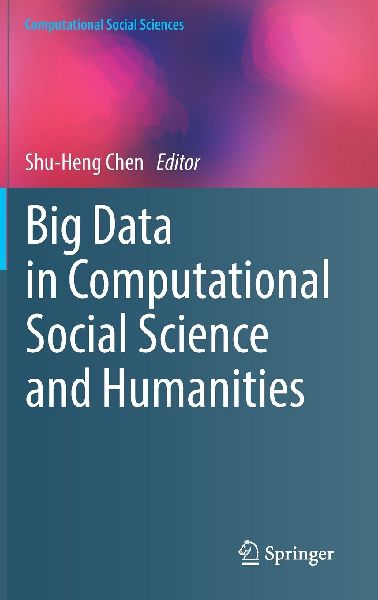
Big Data in Computational Social Science and Humanities
Herausgegeben von: Shu-Heng Chen
Aus der Reihe Computational Social Sciences
- Einband
- Gebunden
- Seiten
- 404
- Sprache
- Englisch
- Erschienen
- November 2018
- Verlag
- Springer International Publishing
Buchbeschreibung
This edited volume focuses on big data implications for computational social science and humanities from management to usage.
The first part of the book covers geographic data, text corpus data, and social media data, and exemplifies their concrete applications in a wide range of fields including anthropology, economics, finance, geography, history, linguistics, political science, psychology, public health, and mass communications.
Ganze Beschreibung lesenWeniger anzeigen
The second part of the book provides a panoramic view of the development of big data in the fields of computational social sciences and humanities. The following questions are addressed: why is there a need for novel data governance for this new type of data?, why is big data important for social scientists?, and how will it revolutionize the way social scientists conduct research?
With the advent of the information age and technologies such as Web 2.0, ubiquitous computing, wearable devices, and the Internet of Things, digital society has fundamentally changed what we now know as "data", the very use of this data, and what we now call "knowledge". Big data has become the standard in social sciences, and has made these sciences more computational.
Big Data in Computational Social Science and Humanities will appeal to graduate students and researchers working in the many subfields of the social sciences and humanities.
Inhaltsverzeichnis
- Big Data in Computational Social Sciences and the Humanities: An Introduction
- Part I: Practice
- Application of Citizen Science and Volunteered Geographic Information (VGI): Tourism Development for Rural Communities
- Telling Stories Through R: Geo-temporal Mappings of Epigraphic
- Expressing Dynamic Maps through 17th-Century Taiwan Dutch Manuscripts
- Has Homo economicus Evolved into Homo sapiens from 1992 to 2014?: What Does Corpus Linguistics Say?
- Big Data and FinTech
- Health in Biodiversity-Related Conventions: Analysis of a Multiplex Terminological Network (1973-2016)
Ganzes Inhaltsverzeichnis anzeigen (21 Einträge)Weniger anzeigen
- How Does Linguistic Complexity in Shakespeare's Plays Relate to the Production History of a Commercial American Theatre?
- Language Communities, Corpora, and Cognition
- From Naive Expectation to Realistic Progress - Government Applications of Big Data to Public Opinions Mining
- Understanding "the User-Generated": The Construction of the "ABC model" and the Imagination of "Digital Humanities"
- Part II: Survey and Challenges
- Big Data Finance and Financial Markets
- Applications of Internet Methods in Psychology
- Spatial Humanities: An Integrated Approach to Spatiotemporal Research
- Cloud Computing in the Social Sciences and Humanities
- Analysis of Social Media Data: An Introduction to the Characteristics and Chronological Process Spatial Humanities
- Big Data and Research Opportunities Using HRAF Databases
- Computational History: From Big Data to Big Simulations
- A Posthumanist Reflection on the Digital Humanities and Social Sciences
Details
- Erscheinungstermin
- November 2018
- Kategorie
- Fremdsprachige Bücher
- Einband
- Gebunden
- Seiten
- 404
- Sprache
- Englisch
- Verlag
- Springer International Publishing
- Reihe
- Computational Social Sciences
- Format
- 24,1 × 16,0 cm
- Dicke
- 2,8 cm
- Gewicht
- 718 g
- EAN / ISBN-13
- 9783319954646
Über Shu-Heng Chen (Hrsg.)
Shu-Heng Chen is a Taiwanese economist and currently a Distinguished Professor at the Department of Economics at National Chengchi University. He is also the founder and Director of the AI-ECON Research Center at the National Chengchi University.
Mehr über Shu-Heng Chen (Hrsg.)Weniger anzeigen
His contributions are in the area of computational approaches to understanding economic and finance problems, in particular, the use of heterogeneous agent-based approach and genetic programming in economics. He is considered one of the pioneers in the field of agent-based computational economics and the first to introduce genetic programming to ACE. He takes a biologically-inspired approach in modeling the boundedly rational behavior of agents and is influenced by the work of Herbert A. Simon.
Versand und Rückgabe
Standardversand: 1 bis 3 Werktage, 3,99 €, kostenlos ab 35 €
Liefergebiet: Deutschland
Rücksendung: 14 Tage Widerrufsrecht. Bei einem Widerruf tragen Sie die Kosten der Rücksendung. Bei einer Falschlieferung oder einem Fehler von uns erstatten wir Ihnen das Rückporto. Den Widerruf erklären Sie über den Knopf „Vertrag widerrufen“ im Fuß der Seite.
Hersteller und ProduktsicherheitSpringer Nature Customer Service Center GmbH
Springer Nature Customer Service Center GmbH
Europaplatz 3
69115 Heidelberg
Deutschland
ProductSafety@springernature.com
Mehr von Shu-Heng Chen


Advances in Computational Social Science
Shu-Heng Chen (Hrsg.)
Gebunden, Englisch, 2 Ausgaben
ab 160,49 €


Evolutionary Computation in Economics and Finance
Shu-Heng Chen
Gebunden, Englisch, 2 Ausgaben
ab 160,49 €
Mehr aus der Reihe Computational Social Sciences


Simulating Transitions to Agriculture in Prehistory
Salvador Pardo-Gordó (Hrsg.)
Gebunden, Englisch, 2 Ausgaben
ab 117,69 €
Pathways Between Social Science and Computational Social Science
Tamás Rudas (Hrsg.)
Kartoniert, Englisch, 2 Ausgaben
ab 69,54 €
Bewertungen
Zu diesem Titel gibt es noch keine Bewertung. Bewerten kann, wer ihn bei uns gekauft hat.
So prüfen wir Bewertungen
Eine Bewertung kann bei uns nur abgeben, wer den Titel über sein Kundenkonto bei uns gekauft hat. Jede Bewertung ist fest mit der zugehörigen Bestellung verknüpft; anders kommt sie technisch gar nicht zustande. Deshalb trägt jede angezeigte Bewertung den Hinweis „Verifizierter Kauf". Wir zeigen positive wie negative Bewertungen und löschen nur bei Rechtsverstößen. Für Bewertungen gibt es keine Gegenleistung.
181,89 €Voraussichtlich 4. bis 8. Dez.