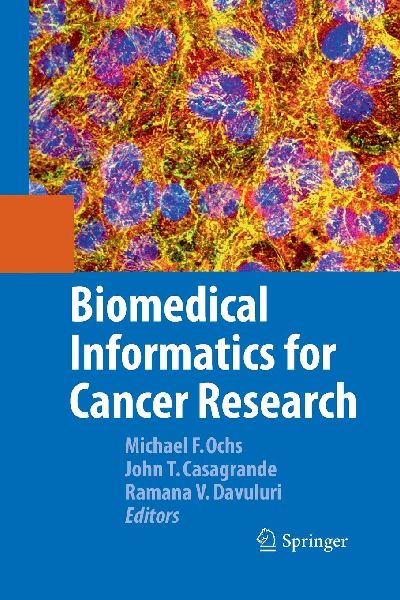
Biomedical Informatics for Cancer Research
Herausgegeben von: Michael F. Ochs, Herausgegeben von: John T. Casagrande, Herausgegeben von: Ramana V. Davuluri
- Einband
- Kartoniert
- Seiten
- 372
- Sprache
- Englisch
- Erschienen
- November 2014
- Verlag
- Copernicus
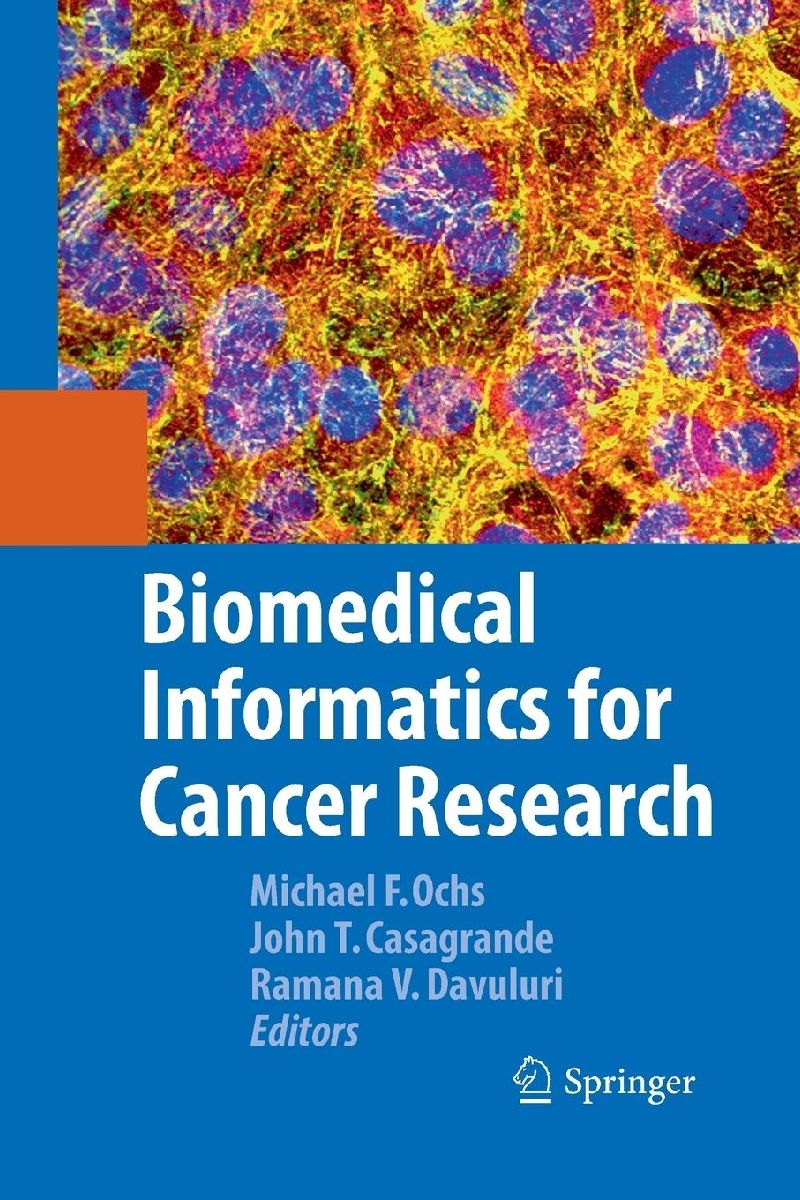
Buchbeschreibung
view, showing that multiple molecular pathways must be affected for cancer to develop, but with different specific proteins in each pathway mutated or differentially expressed in a given tumor (The Cancer Genome Atlas Research Network 2008; Parsons et al. 2008). Different studies demonstrated that while widespread mutations exist in cancer, not all mutations drive cancer development (Lin et al. 2007).
Ganze Beschreibung lesenWeniger anzeigen
This suggests a need to target only a deleterious subset of aberrant proteins, since any tre- ment must aim to improve health to justify its potential side effects.
Treatment for cancer must become highly individualized, focusing on the specific aberrant driver proteins in an individual. This drives a need for informatics in cancer far beyond the need in other diseases.
For instance, routine treatment with statins has become widespread for minimizing heart disease, with most patients responding to standard doses (Wilt et al. 2004). In contrast, standard treatment for cancer must become tailored to the molecular phenotype of an individual tumor, with each patient receiving a different combination of therapeutics aimed at the specific aberrant proteins driving the cancer.
Tracking the aberrations that drive cancers, identifying biomarkers unique to each individual for molecular-level di- nosis and treatment response, monitoring adverse events and complex dosing schedules, and providing annotated molecular data for ongoing research to improve treatments comprise a major biomedical informatics need.
Inhaltsverzeichnis
- Section 1: Concepts, Issues, and Approaches
- 1. Biomedical Informatics for Cancer Research: Introduction
- Michael F. Ochs, John T. Casagrande, Ramana V. Davuluri
- 2. Clinical Research Systems and Integration with Medical Systems
- Joyce C. Niland, Layla Rouse
- 3. Data Management, Databases and Warehousing
- Waqas Amin, Hyunseok Peter Kang, Michael J. Becich
- 4. Middleware Architecture Approaches for Collaborative Cancer Research
Ganzes Inhaltsverzeichnis anzeigen (41 Einträge)Weniger anzeigen
- Tahsin Kurc, Ashish Sharma, Scott Oster, Tony Pan, Shannon Hastings, Stephen Langella, David Ervin, Justin Permar, Daniel Brat, TJ Fitzgerald ,James Purdy, Walter Bosch, Joel Saltz
- 5. Federated Authentication
- Frank J. Manion,, William Weems, and William McNamee
- 6. Genomics Data Analysis Pipelines
- Michael F. Ochs
- 7. Mathematical Modeling in Cancer Robert A. Gatenby
- 8. Reproducible Research Concepts and Tools for Cancer Bioinformatics
- Vincent J Carey, Victoria Stodden
- 9. The Cancer Biomedical Informatics Grid (caBIG®): An Evolving Community for Cancer ResearchJ. Robert Beck
- Section 2: Tools and Applications
- 10. The caBIG® Clinical Trials Suite
- John Speakman
- 11. The CAISIS Research Data System
- Paul Fearn, Frank Sculli
- 12. A Common Application Framework that is Extensible: CAF--ÉRichard Evans, Mark DeTomaso, Reed Comire, Vaibhav Bora, Jeet Poonater, Aarti Vaishnav, Scott Catherall, John T. Casagrande
- 13. Shared Resource Management (SRM)Matt Stine, Vicki Beal, Nilesh Dosooye, Yingliang Du, Rama Gundapaneni, Andrew Pappas, Srinivas Raghavan, Sundeep Shakya, Roshan Shrestha, Momodou Sanyang, Clayton Naeve
- 14. The caBIG® Life Science Distribution
- Juli Klemm, Anand Basu, Ian Fore, Aris Floratos, George Komatsoulis
- 15. MeV: Multi
- Experiment Viewer
- Eleanor Howe, Kristina Holton, Sarita Nair, Daniel Schlauch, Raktim Sinha and John Quackenbush
- 16. Authentication and Authorization in Cancer Research Systems
- Stephen Langella, Shannon Hastings, Scott Oster, Philip Payne, Frank Siebenlist
- 17. Caching and Visualizing Statistical Analyses
- Roger D. Peng, Duncan Temple Lang
- 18. Familial Cancer Risk Assessment Using Bayes
- Mendel
- Amanda Blackford, Giovanni Parmigiani
- 19. Interpreting and Comparing Clustering Experiments through Graph Visualization and Ontology Statistical Enrichment with the Clutr
- Free Package
- Ghislain Bidaut
- 20. Enhanced Dynamic Documents for Reproducible Research
- Deborah Nolan, Roger D. Peng, Duncan Temple Lang.
Details
- Erscheinungstermin
- November 2014
- Kategorie
- Fremdsprachige Bücher
- Einband
- Kartoniert
- Seiten
- 372
- Sprache
- Englisch
- Verlag
- Copernicus
- Format
- 23,5 × 15,5 cm
- Dicke
- 2,1 cm
- Gewicht
- 563 g
- EAN / ISBN-13
- 9781489984517
Versand und Rückgabe
Standardversand: 1 bis 3 Werktage, 3,99 €, kostenlos ab 35 €
Liefergebiet: Deutschland
Rücksendung: 14 Tage Widerrufsrecht. Bei einem Widerruf tragen Sie die Kosten der Rücksendung. Bei einer Falschlieferung oder einem Fehler von uns erstatten wir Ihnen das Rückporto. Den Widerruf erklären Sie über den Knopf „Vertrag widerrufen“ im Fuß der Seite.
Hersteller und ProduktsicherheitSpringer Nature Customer Service Center GmbH
Springer Nature Customer Service Center GmbH
Europaplatz 3
69115 Heidelberg
Deutschland
ProductSafety@springernature.com
Mehr von Michael F. Ochs


Ähnliche Titel


Bewertungen
Zu diesem Titel gibt es noch keine Bewertung. Bewerten kann, wer ihn bei uns gekauft hat.
So prüfen wir Bewertungen
Eine Bewertung kann bei uns nur abgeben, wer den Titel über sein Kundenkonto bei uns gekauft hat. Jede Bewertung ist fest mit der zugehörigen Bestellung verknüpft; anders kommt sie technisch gar nicht zustande. Deshalb trägt jede angezeigte Bewertung den Hinweis „Verifizierter Kauf". Wir zeigen positive wie negative Bewertungen und löschen nur bei Rechtsverstößen. Für Bewertungen gibt es keine Gegenleistung.
117,69 €Voraussichtlich 1. bis 3. Dez.