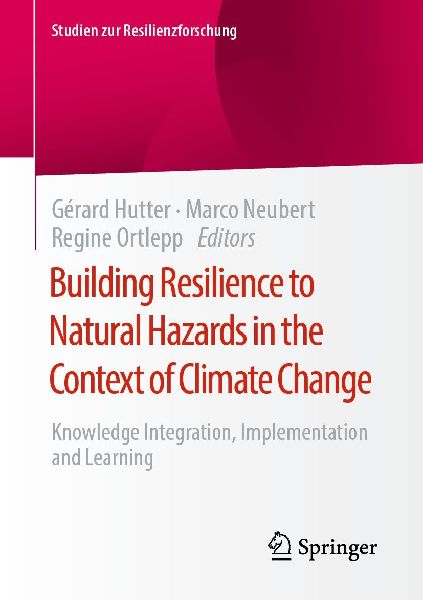
Building Resilience to Natural Hazards in the Context of Climate Change
Knowledge Integration, Implementation and Learning
Herausgegeben von: Gérard Hutter, Herausgegeben von: Marco Neubert, Herausgegeben von: Regine Ortlepp
Aus der Reihe Studien zur Resilienzforschung
- Einband
- Kartoniert
- Seiten
- 264
- Sprache
- Englisch
- Erschienen
- Juli 2021
- Verlag
- Springer VS
Buchbeschreibung
Urban resilience and building resilience are "hot topics" of research and practice on sustainability in the context of climate change.
The edited volume advances the "state of art" of urban resilience research through focusing on three important processes of building resilience: knowledge integration, implementation, and learning. In the volume, knowledge integration primarily refers to the combination of specialized knowledge domains (e.g., flood risk management and urban planning).
Ganze Beschreibung lesenWeniger anzeigen
Implementation refers to realized specific changes of the building stock and related green, blue and grey infrastructures at local level (e.g., for dealing with rising temperatures and heat waves at the neighborhood scale in cities). Learning requires moving beyond single projects and experiments of resilience to enhance sustainability at city and regional scale.
The editors adopt an interdisciplinary approach to this volume of the Springer series on resilience. The volume includes contributions from civilengineering, physical geography, the social sciences, and urban planning.
Inhaltsverzeichnis
- 1. Building resilience to natural hazards in the context of climate change - Introducing the focus and agenda of the edited volume
- 2. Knowledge integration for building resilience - The example of flood risk maps
- 3. Justice and resilience in flood risk management: What are the socio-political implications?
- 4. House lifting to improve flood resilience in settlement are-as - An example of the Elbe village Brockwitz (Saxony)
- 5. Sustainability and resilience - A practical approach to assessing sustainability in innovative infrastructure projects
- 6. Building heat-resilient neighborhoods - Testing the implementation on buildings and in open spaces in two sample quarters Dresden and Erfurt
- 7. The Impulse Project Stuttgart - Stimulating resilient urban development through blue-green infrastructure
- 8. Participation for building urban climate resilience? Results from four cities in Germany
- 9. Building resilience in the context of multi-level governance - Insights from a living lab in the Ruhr
- 10. Project-based learning for building urban resilience - Reflecting on project examples of climate change adaptation in the Dresden region
Details
- Erscheinungstermin
- Juli 2021
- Kategorie
- Fremdsprachige Bücher
- Einband
- Kartoniert
- Seiten
- 264
- Sprache
- Englisch
- Verlag
- Springer VS
- Reihe
- Studien zur Resilienzforschung
- Format
- 21,0 × 14,8 cm
- Dicke
- 1,5 cm
- Gewicht
- 346 g
- EAN / ISBN-13
- 9783658337018
Über Gérard Hutter (Hrsg.)
Dr. Gerard Hutter: Since 1996 employee, since 2001 project manager at the Leibniz Institute of Ecological Urban and Regional Development (IOER), Dresden; scientific focus: Strategic planning for …
Mehr über Gérard Hutter (Hrsg.)Weniger anzeigen
Gerard Hutter: Since 1996 employee, since 2001 project manager at the Leibniz Institute of Ecological Urban and Regional Development (IOER), Dresden; scientific focus: Strategic planning for environmental risk reduction and climate change adaptation, urban resilience, in particular social resilience.
Dr. Marco Neubert: Since 2000 employed at the Leibniz Institute of Ecological Urban and Regional Development (IOER), Dresden, since 2007 project manager; scientific focus: Vulnerability and risk analyses, impact modelling, resilience, climate change impacts, adaptation to climate change, applied geoinformatics (Geographic Information Systems, modelling, remote sensing), landscape ecology and landscape planning.
Dr.-Ing. habil. Regine Ortlepp: Since 2013 employed, since 2017 Head of Research Department at the Leibniz Institute of Ecological Urban and Regional Development (IOER), Dresden; scientific focus: Resource efficiency, circular economy, sustainable construction, adaptation measures to climate change, risk assessment, technical and ecological resilience.
Versand und Rückgabe
Standardversand: 1 bis 3 Werktage, 3,99 €, kostenlos ab 35 €
Liefergebiet: Deutschland
Rücksendung: 14 Tage Widerrufsrecht. Bei einem Widerruf tragen Sie die Kosten der Rücksendung. Bei einer Falschlieferung oder einem Fehler von uns erstatten wir Ihnen das Rückporto. Den Widerruf erklären Sie über den Knopf „Vertrag widerrufen“ im Fuß der Seite.
Hersteller und ProduktsicherheitSpringer Nature Customer Service Center GmbH
Springer Nature Customer Service Center GmbH
Europaplatz 3
69115 Heidelberg
Deutschland
ProductSafety@springernature.com
Mehr aus der Reihe Studien zur Resilienzforschung
Ähnliche Titel

Understanding Emotion in Chinese Culture
Louise Sundararajan
Kartoniert, Englisch, 2 Ausgaben
ab 69,54 €


Psychosocial Perspectives on Peacebuilding
Brandon Hamber (Hrsg.)
Gebunden, Englisch, 2 Ausgaben
ab 106,99 €
Bewertungen
Zu diesem Titel gibt es noch keine Bewertung. Bewerten kann, wer ihn bei uns gekauft hat.
So prüfen wir Bewertungen
Eine Bewertung kann bei uns nur abgeben, wer den Titel über sein Kundenkonto bei uns gekauft hat. Jede Bewertung ist fest mit der zugehörigen Bestellung verknüpft; anders kommt sie technisch gar nicht zustande. Deshalb trägt jede angezeigte Bewertung den Hinweis „Verifizierter Kauf". Wir zeigen positive wie negative Bewertungen und löschen nur bei Rechtsverstößen. Für Bewertungen gibt es keine Gegenleistung.
74,89 €Voraussichtlich 2. bis 4. Dez.