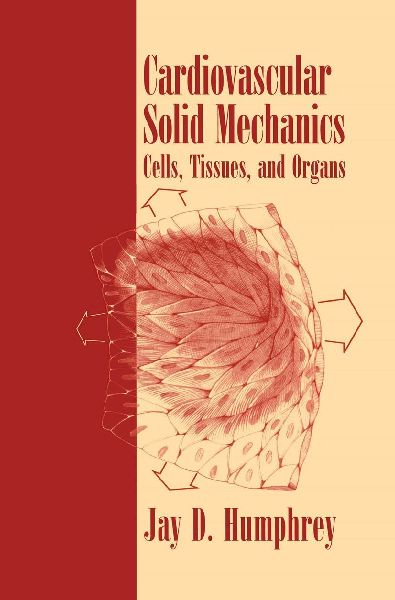
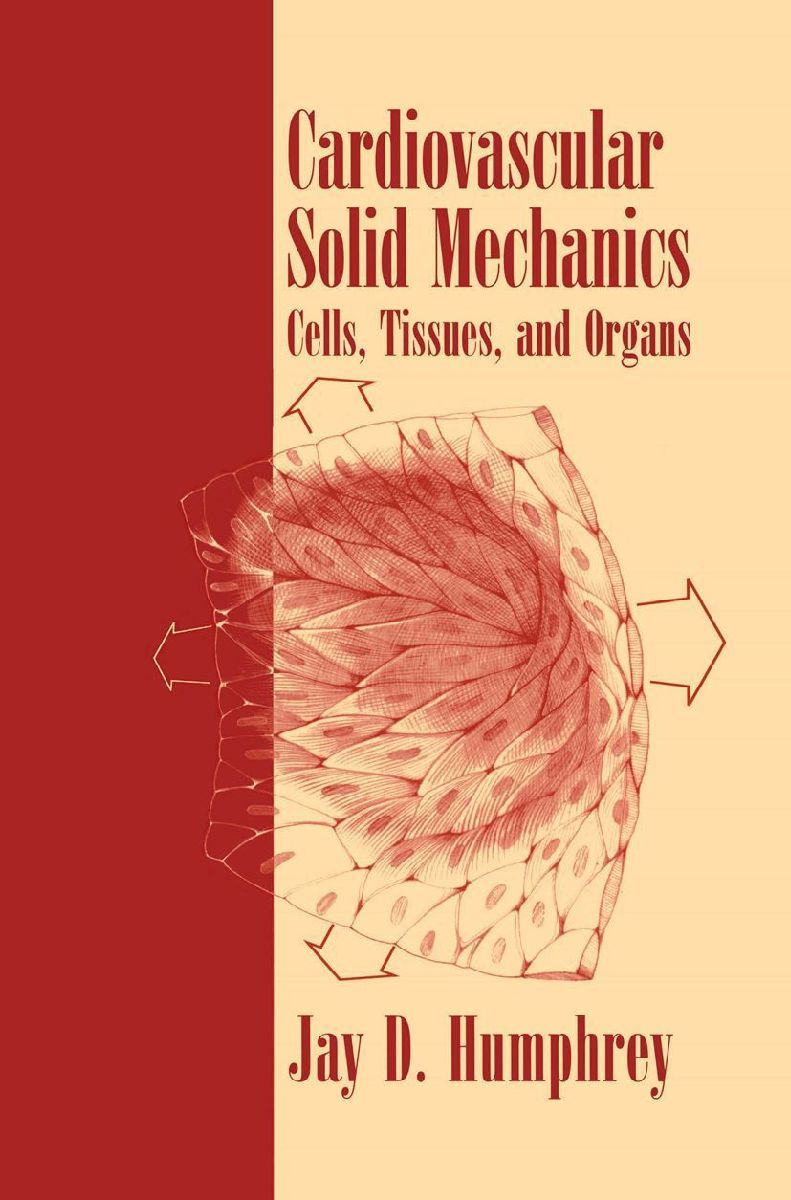
Cardiovascular Solid Mechanics
Cells, Tissues, and Organs
von Jay D. Humphrey
- Einband
- Kartoniert
- Seiten
- 776
- Sprache
- Englisch
- Erschienen
- Dezember 2010
- Verlag
- Springer
Buchbeschreibung
The vitality of the cardiovascular system, which consists of the heart, vas culature, and blood, depends on its response to a host of complex stimuli, including biological, chemical, electrical, mechanical, and thermal.
The focus of this book, however, is on the response of the heart and arteries to mechanical loads from the perspective of nonlinear solid mechanics.
Ganze Beschreibung lesenWeniger anzeigen
Through my own research in this field, I have come to realize that study ing the complex responses of cardiovascular cells, tissues, and organs nec essarily requires a combined theoretical, experimental, and computational approach.
Theory is needed to guide the performance and interpretation of experiments as well as to synthesize the results; experiment is needed to study the responses of the system to well-controlled loads and to test can didate hypotheses and theories; and due to the geometric and material non linearities inherent to cardiovascular mechanics, computation is needed to analyze data as well as to solve boundary and initial value problems that correspond to either experimental or in vivo conditions.
One of the primary goals of this book is to introduce together basic analytical, experimental, and computational methods and to illustrate how these methods can and must be integrated to gain a more complete understanding of the bio mechanics of the heart and vasculature. Despite the focus on cardiovascu lar mechanics, the fundamental methods, indeed many of the specific results, are generally applicable to many different soft tissues.
Inhaltsverzeichnis
- 1. INTRODUCTION.1.1 Historical Prelude, 1.2 Basic Cell Biology, 1.3 The Extracellular Matrix, 1.4 Soft Tissue Behavior, 1.5 Needs and General Approach, 1.6 Exercises, 1.7 References
- 2. MATHEMATICAL PRELIMINARIES2.1 A Direct Tensor Notation, 2.2 Cartesian Components, 2.3 Further Results in Tensor Calculus, 2.4 Orthogonal Curvilinear Components, 2.5 Matrix Methods, 2.6 Exercises, 2.7 References
- 3. CONTINUUM MECHANICS3.1 Kinematics, 3.2 Forces, Tractions and Stresses, 3.3 Balance Relations, 3.4 Constitutive Formulations, 3.5 Boundary and Initial Conditions, 3.6 Exercises, 3.7 References
- 4. FINITE ELASTICITY4.1 Introduction, 4.2 Incompressible Isotropic Elasticity, 4.3 Solutions in 3-D Incompressible Elasticity, 4.4 Compressible Isotropic Elasticity, 4.5 Membrane Hyperelasticity, 4.6 Exercises, 4.7 References
- 5. EXPERIMENTAL METHODS5.1 General Philosophy, 5.2 Measurement of Strain, 5.3 Measurement of Applied Loads, 5.4 Testing Conditions, 5.5 Parameter Estimation and Statistics, 5.6 Exercises, 5.7 References
- 6. Finite Element Methods6.1 Fundamental Equations, 6.2 Interpolation, Integration, and Solvers, 6.3 An Illustrative Formulation, 6.4 Inflation of a Membrane, 6.5 Inverse Finite Elements, 6.6 Exercises, 6.7 References
- PART II - VASCULAR MECHANICS
- 7. THE NORMAL ARTERIAL WALL7.1 Structure and Function, 7.2 General Characteristics, 7.3 Constitutive Framework, 7.4 Experimental Methods, 7.5 Specific Constitutive Relations, 7.6 Stress Analyses, 7.7 Exercises, 7.8 References
Ganzes Inhaltsverzeichnis anzeigen (17 Einträge)Weniger anzeigen
- 8. VASCULAR DISORDERS8.1 Hypertension, 8.2 Intracranial Aneurysms, 8.3 Atherosclerosis, 8.4 Aortic Aneurysms, 8.5 Additional Topics, 8.6 Exercises, 8.7 References
- 9. VASCULAR ADAPTATION9.1 Mechanical Preliminaries, 9.2 Cellular Responses to Applied Loads, 9.3 Arterial Response to Hypertension, 9.4 Arterial Response to Altered Flow, 9.5 Vessel Response to Injury, 9.6 Veins as Arterial Grafts, 9.7 Aging, 9.8 Exercises, 9.9 References
- PART III CARDIAC MECHANICS
- 10. THE NORMAL HEART10.1 Structure and Function, 10.2 General Characteristics, 10.3 Constitutive Framework, 10.4 Constitutive Relations, 10.5 Stress Analyses, 10.6 Exercises, 10.7 References
- 11. EPILOGUEAPPENDICESI
- Nomenclature, Abbreviations, and ConversionsII
- Results for Curvilinear Coordinates
- III. Material Frame Indifference
- 11. CARDIAC DISORDERS11.1 Ischemia 11.2 Volume Overload11.3 Hypertrophy 11.4 Cardiac Aneurysms11.5 Additional Topics
Details
- Erscheinungstermin
- Dezember 2010
- Kategorie
- Fremdsprachige Bücher
- Einband
- Kartoniert
- Seiten
- 776
- Sprache
- Englisch
- Verlag
- Springer
- Format
- 23,5 × 15,5 cm
- Dicke
- 4,2 cm
- Gewicht
- 1.153 g
- EAN / ISBN-13
- 9781441928979
Versand und Rückgabe
Standardversand: 1 bis 3 Werktage, 3,99 €, kostenlos ab 35 €
Liefergebiet: Deutschland
Rücksendung: 14 Tage Widerrufsrecht. Bei einem Widerruf tragen Sie die Kosten der Rücksendung. Bei einer Falschlieferung oder einem Fehler von uns erstatten wir Ihnen das Rückporto. Den Widerruf erklären Sie über den Knopf „Vertrag widerrufen“ im Fuß der Seite.
Hersteller und ProduktsicherheitSpringer Nature Customer Service Center GmbH
Springer Nature Customer Service Center GmbH
Europaplatz 3
69115 Heidelberg
Deutschland
ProductSafety@springernature.com
Mehr von Jay D. Humphrey
Style and Ethics of Communication in Science and Engineering
Jay D. Humphrey
Gebunden, Englisch, 2 Ausgaben
ab 48,14 €
Ähnliche Titel



Ordered Porous Nanostructures and Applications
Ralf B. Wehrspohn (Hrsg.)
Gebunden, Englisch, 2 Ausgaben
ab 106,99 €

Bewertungen
Zu diesem Titel gibt es noch keine Bewertung. Bewerten kann, wer ihn bei uns gekauft hat.
So prüfen wir Bewertungen
Eine Bewertung kann bei uns nur abgeben, wer den Titel über sein Kundenkonto bei uns gekauft hat. Jede Bewertung ist fest mit der zugehörigen Bestellung verknüpft; anders kommt sie technisch gar nicht zustande. Deshalb trägt jede angezeigte Bewertung den Hinweis „Verifizierter Kauf". Wir zeigen positive wie negative Bewertungen und löschen nur bei Rechtsverstößen. Für Bewertungen gibt es keine Gegenleistung.
160,49 €Voraussichtlich 2. bis 4. Dez.