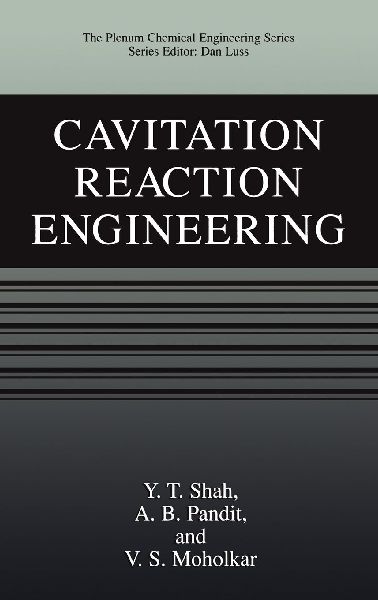
Cavitation Reaction Engineering
von Y. T. Shah, A. B. Pandit und V. S. Moholkar
Aus der Reihe The Plenum Chemical Engineering Series
- Einband
- Gebunden
- Seiten
- 376
- Sprache
- Englisch
- Erschienen
- September 1999
- Verlag
- Springer
Buchbeschreibung
The literature on cavitation chemistry is ripe with conjectures, possibilities, heuris tic arguments, and intelligent guesses.
The chemical effects of cavitation have been explained by means of many theories, consisting of empirical constants, adjustable parameters, and the like. The chemists working with cavitation chemistry agree that the phenomenon is very complex and system specific.
Ganze Beschreibung lesenWeniger anzeigen
Mathematicians and physi cists have offered partial solutions to the observed phenomena on the basis of cavitation parameters, whereas chemists have attempted explanations based on the modes of reaction and the detection of intermediate chemical species.
Nevertheless, no one has been able to formulate a unified theme, however crude, for its effects on the basis of the known parameters, such as cavitation and transient chemistry involving extremely high temperatures of nanosecond durations. When one surveys the literature on cavitation-assisted reactions, it is clear that the approach so far has been "Edisonian" in nature.
While a large number of reactions have showed either enhanced yields or reduced reaction times, many reactions have remained unaffected in the presence of cavitation. The success or failure of cavitation reactions ultimately depends on the collapse of the cavity.
Cavitation chemistry is based on the principles of the formation of small transient cavities, their growth and implosion, which produce chemical reactions caused by the generation of extreme pressures and temperatures and a high degree of micro turbulence.
Inhaltsverzeichnis
- 1. Sources and Types of Cavitation
- 1.1. Introduction
- 1.2. Hydrodynamic Cavitation
- 1.3. Acoustic Cavitation
- 1.4. Optic and Particle Cavitation
- 2. Cavitation Bubble Dynamics
- 2.1. Introduction
- 2.2. Bubble Dynamics
Ganzes Inhaltsverzeichnis anzeigen (61 Einträge)Weniger anzeigen
- 2.3. Cluster Dynamics
- 2.4. Heat and Mass Transfer Effects in Cavitation
- 2.5. Concluding Remarks
- 3. Factors Affecting Cavitation Behavior
- 3.1. Introduction
- 3.2. Factors Affecting Cavity Behavior in Hydrodynamic Cavitation
- 3.3. Factors Affecting Cavity Behavior in Acoustic Cavitation
- 3.4. Factors Affecting Optical Cavitation
- 3.5. Factors Affecting Cavity Cluster Behavior in Hydrodynamic Cavitation
- 3.6. Factors Affecting Cavity Cluster Behavior in Acoustic Cavitation
- 3.7. Concluding Remarks
- 4. Gas-Liquid Cavitation Chemistry
- 4.1. Introduction
- 4.2. Mechanisms for Cavitation Reaction
- 4.3. Factors Affecting Cavitation Chemistry
- 4.4. Inorganic and Organic Cavitation Reactions
- 4.5. Depolymerization and Repolymerization Reactions
- 4.6. Ultrasound and Homogeneous Oxidation
- 4.7. Ultrasound and Liquid-Liquid Phase-Transfer Reactions
- 5. Gas-Liquid-Solid Cavitation Chemistry
- 5.1. Introduction
- 5.2. General Effects of Ultrasound on Gas-Liquid-Solid Reactions
- 5.3. Specific Role of Ultrasound on Gas-Liquid-Solid Reactions
- 5.4. Case Studies
- 6. Cavitation Reactors
- 6.1. Introduction
- 6.2. Hydrodynamic Cavitation Reactors
- 6.3. Acoustic Cavitation Reactors
- 6.4. Laser Cavitation Reactors
- 6.5. Some Additional Considerations for Flow Reactors
- 6.6. Health and Safety Aspects of Laboratory Reactors
- 6.7. Integration of Cavitation into Existing Scaled-Up Processes
- 6.8. Concluding Remarks
- 7. Models for Cavitation Reactors
- 7.1. Introduction
- 7.2. General Considerations for a Gas-Liquid Cavitation Reactor Model
- 7.3. Modeling a Batch Gas-Liquid Acoustic Reactor
- 7.4. Characterization of the Reaction Zone
- 7.5. Reactor Design and Scaleup based on the Concept of Cavitation Yield
- 7.6. Memory Effect in a Loop Cavitation Reactor
- 7.7. Concluding Remarks
- 8. Energy Efficiency and the Economics of the Cavitation Conversion Process
- 8.1. Introduction
- 8.2. Efficiency of Energy Transformation
- 8.3. Economics of Cavitation Conversion Processes
- 8.4. Concluding Remarks
- 9. CAV-OX Process
- 9.1. Introduction
- 9.2. Description of Process
- 9.3. Process Economics
- 9.4. Case Studies
- Nomenclature
- References
Details
- Erscheinungstermin
- September 1999
- Kategorie
- Fremdsprachige Bücher
- Einband
- Gebunden
- Seiten
- 376
- Sprache
- Englisch
- Verlag
- Springer
- Reihe
- The Plenum Chemical Engineering Series
- Format
- 24,1 × 16,0 cm
- Dicke
- 2,5 cm
- Gewicht
- 677 g
- EAN / ISBN-13
- 9780306461415
Versand und Rückgabe
Standardversand: 1 bis 3 Werktage, 3,99 €, kostenlos ab 35 €
Liefergebiet: Deutschland
Rücksendung: 14 Tage Widerrufsrecht. Bei einem Widerruf tragen Sie die Kosten der Rücksendung. Bei einer Falschlieferung oder einem Fehler von uns erstatten wir Ihnen das Rückporto. Den Widerruf erklären Sie über den Knopf „Vertrag widerrufen“ im Fuß der Seite.
Hersteller und ProduktsicherheitSpringer Nature Customer Service Center GmbH
Springer Nature Customer Service Center GmbH
Europaplatz 3
69115 Heidelberg
Deutschland
ProductSafety@springernature.com
Mehr aus der Reihe The Plenum Chemical Engineering Series
Ähnliche Titel
Kinetics of Metal Ion Adsorption from Aqueous Solutions
Chi Tien
Gebunden, Englisch, 2 Ausgaben
ab 213,99 €
Sustainable Membrane Technology for Water and Wastewater Treatment
Alberto Figoli (Hrsg.)
Gebunden, Englisch, 2 Ausgaben
ab 235,39 €
Bewertungen
Zu diesem Titel gibt es noch keine Bewertung. Bewerten kann, wer ihn bei uns gekauft hat.
So prüfen wir Bewertungen
Eine Bewertung kann bei uns nur abgeben, wer den Titel über sein Kundenkonto bei uns gekauft hat. Jede Bewertung ist fest mit der zugehörigen Bestellung verknüpft; anders kommt sie technisch gar nicht zustande. Deshalb trägt jede angezeigte Bewertung den Hinweis „Verifizierter Kauf". Wir zeigen positive wie negative Bewertungen und löschen nur bei Rechtsverstößen. Für Bewertungen gibt es keine Gegenleistung.
320,99 €Voraussichtlich 7. bis 9. Dez.