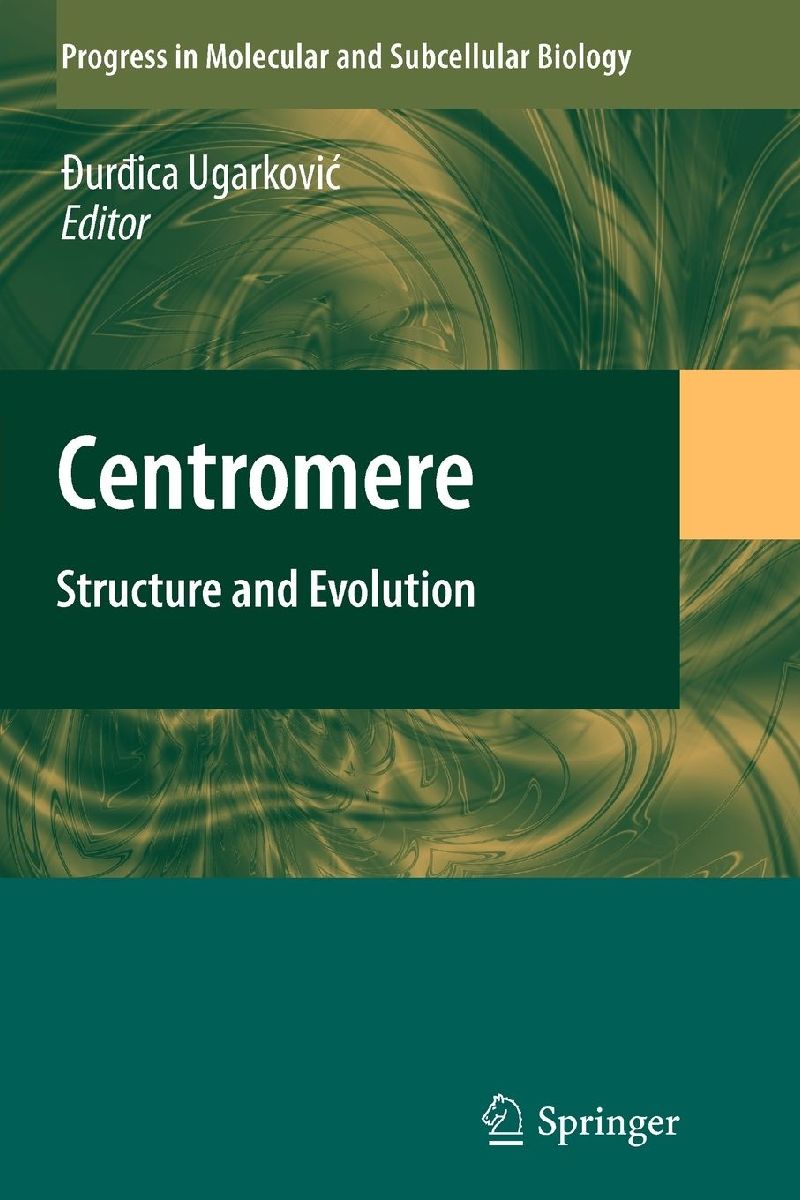
Centromere
Structure and Evolution
Herausgegeben von: Durdica Ugarkovic
Aus der Reihe Progress in Molecular and Subcellular Biology
- Einband
- Kartoniert
- Seiten
- 196
- Sprache
- Englisch
- Erschienen
- Oktober 2010
- Verlag
- Springer
Buchbeschreibung
The centromere is a chromosomal region that enables the accurate segregation of chromosomes during mitosis and meiosis.
It holds sister chromatids together, and through its centromere DNA-protein complex known as the kinetochore binds spindle microtubules to bring about accurate chromosome movements. Despite this conserved function, centromeres exhibit dramatic difference in structure, size, and complexity.
Ganze Beschreibung lesenWeniger anzeigen
Extensive studies on centromeric DNA revealed its rapid evolution resulting often in significant difference even among closely related species.
Such a plasticity of centromeric DNA could be explained by epigenetic c- trol of centromere function, which does not depend absolutely on primary DNA sequence. According to epigenetic centromere concept, which is thoroughly d- cussed by Tanya Panchenko and Ben Black in Chap. 1 of this book, centromere activation or inactivation might be caused by modifications of chromatin.
Such acquired chromatin epigenetic modifications are then inherited from one cell di- sion to the next. Concerning centromere-specific chromatin modification, it is now evident that all centromeres contain a centromere specific histone H3 variant, CenH3, which replaces histone H3 in centromeric nucleosomes and provides a structural basis that epigenetically defines centromere and differentiates it from the surrounding chromatin.
Recent insights into the CenH3 presented in this chapter add important mechanistic understanding of how centromere identity is initially established and subsequently maintained in every cell cycle.
Inhaltsverzeichnis
- The Epigenetic Basis for Centromere Identity
- The Centromere-Drive Hypothesis: A Simple Basis for Centromere Complexity
- Centromere-Competent DNA: Structure and Evolution
- The Role of ncRNA in Centromeres: A Lesson from Marsupials
- Evolutionary New Centromeres in Primates
- Structure and Evolution of Plant Centromeres
Details
- Erscheinungstermin
- Oktober 2010
- Kategorie
- Fremdsprachige Bücher
- Einband
- Kartoniert
- Seiten
- 196
- Sprache
- Englisch
- Verlag
- Springer
- Reihe
- Progress in Molecular and Subcellular Biology
- Format
- 23,5 × 15,5 cm
- Dicke
- 1,3 cm
- Gewicht
- 342 g
- EAN / ISBN-13
- 9783642101236
Versand und Rückgabe
Standardversand: 1 bis 3 Werktage, 3,99 €, kostenlos ab 35 €
Liefergebiet: Deutschland
Rücksendung: 14 Tage Widerrufsrecht. Bei einem Widerruf tragen Sie die Kosten der Rücksendung. Bei einer Falschlieferung oder einem Fehler von uns erstatten wir Ihnen das Rückporto. Den Widerruf erklären Sie über den Knopf „Vertrag widerrufen“ im Fuß der Seite.
Hersteller und ProduktsicherheitSpringer Nature Customer Service Center GmbH
Springer Nature Customer Service Center GmbH
Europaplatz 3
69115 Heidelberg
Deutschland
ProductSafety@springernature.com
Mehr aus der Reihe Progress in Molecular and Subcellular Biology


Wound healing: Advanced strategies in energy-dependent tissue regeneration
Werner E. G. Müller (Hrsg.)
Gebunden, Englisch
192,59 €


Satellite DNAs in Physiology and Evolution
Ðurðica Ugarkovi¿ (Hrsg.)
Gebunden, Englisch, 2 Ausgaben
ab 192,59 €
Ähnliche Titel


Plant Cell Culture Protocols
Víctor M. Loyola-Vargas (Hrsg.)
Gebunden, Englisch, 2 Ausgaben
ab 160,49 €

Advances in Plant and Animal Boron Nutrition
Fangsen Xu (Hrsg.)
Gebunden, Englisch, 2 Ausgaben
ab 160,49 €

Bewertungen
Zu diesem Titel gibt es noch keine Bewertung. Bewerten kann, wer ihn bei uns gekauft hat.
So prüfen wir Bewertungen
Eine Bewertung kann bei uns nur abgeben, wer den Titel über sein Kundenkonto bei uns gekauft hat. Jede Bewertung ist fest mit der zugehörigen Bestellung verknüpft; anders kommt sie technisch gar nicht zustande. Deshalb trägt jede angezeigte Bewertung den Hinweis „Verifizierter Kauf". Wir zeigen positive wie negative Bewertungen und löschen nur bei Rechtsverstößen. Für Bewertungen gibt es keine Gegenleistung.
160,49 €Voraussichtlich 1. bis 3. Dez.