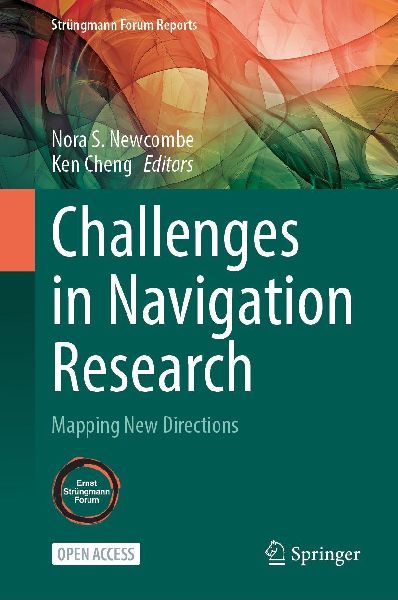
Challenges in Navigation Research
Mapping New Directions
Herausgegeben von: Nora S. Newcombe, Herausgegeben von: Ken Cheng
Aus der Reihe Strüngmann Forum Reports
- Einband
- Gebunden
- Seiten
- 496
- Sprache
- Englisch
- Erschienen
- April 2026
- Verlag
- Springer
Buchbeschreibung
This open access book presents a multidisciplinary synthesis of research on animal navigation, integrating perspectives from behavior, neuroscience, and ecology to advance understanding of how animals orient and move within their environments.
Successful navigation is essential for survival. How animals move through complex landscapes, cross vast oceans, or traverse barren deserts has long intrigued scientists.
Ganze Beschreibung lesenWeniger anzeigen
For over a century, research has sought to uncover the mechanisms that enable such remarkable feats. The knowledge gained has far-reaching implications—from enhancing mobility and independence in aging populations to shaping the design of advanced navigational technologies.
In the past decade, rapid advances in computational methods have fueled a surge in behavioral and neural data, placing the study of navigation at the forefront of scientific progress. Yet, significant challenges persist. Fragmentation across disciplines and levels of analysis has hindered integration, and the sheer volume of findings makes synthesis difficult.
To confront these challenges, the Ernst Strüngmann Forum brought together experts from diverse fields to integrate research on biological navigation. This volume presents the outcomes of that multidisciplinary exchange, integrating perspectives across behavioral, cellular, circuit, and systems levels, and spanning species, environments, and individual differences.
It delineates unifying principles and frameworks to guide future research on navigation across taxa, developmental stages, and descriptive levels, and outlines agendas to advance the field.
Inhaltsverzeichnis
- 1.Addressing the Challenges of Navigational Research
- 2. Taking a Functional Look at Bird Navigation
- 3. How Roboticists Think about Navigation and Major Unsolved Challenges
- 4. Universal Principles of Navigation across Species and Spatial Scales
- 5. What Are the Contributions of Modeling to Bridging the Gaps between Methods and across Species?
- 6. Do Data from Intracranial Techniques Align (or Not) with What We Have Learned about Human Navigation from fMRI?
- 7. What Do We Know about Navigation Development from the Perspective of Cognitive Neuroscience in Humans?
- 8. How Can Development Inform Us about the Neural Mechanisms of Navigation in Rats?
Ganzes Inhaltsverzeichnis anzeigen (16 Einträge)Weniger anzeigen
- 9. Spatial Navigation: From Cells to Behavior
- 10. Planning and Imagination in the Navigational Domain: The Role of the Hippocampus and Prefrontal Cortex
- 11. The Role of Motivation and Emotion in the Hippocampal Navigation System
- 12. The Future of Navigation: Moving Beyond Static Representations to Dynamic Cognitive Maps
- 13. How Does Aging Impact the Structure and Function of Parallel Navigation Circuits Across Mammals?
- 14. How Do Aging and Neurodegenerative Diseases Affect Spatial Navigation at the Behavioral Level?
- 15. Designing Effective Clinical Tools for Measuring Navigation Deficits Associated with Cognitive Impairment: Insights from Human-Computer Interaction Research
- 16. From Fundamental Science to the Clinic (and Back Again): A Translational Framework for Navigation and Aging
Details
- Erscheinungstermin
- April 2026
- Kategorie
- Fremdsprachige Bücher
- Einband
- Gebunden
- Seiten
- 496
- Sprache
- Englisch
- Verlag
- Springer
- Reihe
- Strüngmann Forum Reports
- Format
- 24,1 × 16,0 cm
- Dicke
- 3,3 cm
- Gewicht
- 853 g
- EAN / ISBN-13
- 9783032205629
Über Nora S. Newcombe (Hrsg.)
Nora S. Newcombe received a PhD from the Department of Psychology at Harvard University. She was a faculty member at Pennsylvania State University before moving to Temple University, where she is now Laura H.
Mehr über Nora S. Newcombe (Hrsg.)Weniger anzeigen
Carnell Professor. Her research in cognition and cognitive development centers on spatial cognition and episodic memory, along with translational work on STEM education. She is a member of the National Academy of Sciences, the American Academy of Arts and Sciences, and the Society of Experimental Psychologists. Honors include the Rumelhart Prize from the Cognitive Science Society, the Distinguished Scientific Contributions Award from the Society for Research in Child Development, the William James Fellow Award from the Association for Psychological Science, and the Howard Crosby Warren Medal from the Society of Experimental Psychologists.
Ken Cheng received a PhD from the Department of Psychology and Social Relations at the University of Pennsylvania. He did postdoctoral work at the University of Sussex and at Western University of Canada (previously called the University of Western Ontario in London, Ontario), before accepting a University Research Fellowship at the University of Toronto. In 1995, he joined Macquarie University, Sydney, Australia, where he is currently Professor in the School of Natural Sciences. Cheng’s research has focused on functional as well as mechanistic questions in animal navigation across diverse species. Over 40 years, study animals have featured rats, pigeons, black-capped chickadees, humans, honey bees, and a number of species of ants, including desert ants in Australia and Tunisia. A key topic has been how animals use visual information in their surroundings to navigate. Cheng has served a long stint as an editor of the journal Animal Cognition, receiving both an Author Service Award and an Editorial Contribution Award from Springer Nature in 2025. Cheng has published a reference book on animal cognition for a general audience, How Animals Think and Feel (ABC-CLIO, 2016) and two short books on academic writing. In 2023, Cheng was given the career Research Award by the Comparative Cognition Society “in Honor of Outstanding Contributions to the Study of Cognitive Processes in Animals.”
Versand und Rückgabe
Standardversand: 1 bis 3 Werktage, 3,99 €, kostenlos ab 35 €
Liefergebiet: Deutschland
Rücksendung: 14 Tage Widerrufsrecht. Bei einem Widerruf tragen Sie die Kosten der Rücksendung. Bei einer Falschlieferung oder einem Fehler von uns erstatten wir Ihnen das Rückporto. Den Widerruf erklären Sie über den Knopf „Vertrag widerrufen“ im Fuß der Seite.
Hersteller und ProduktsicherheitSpringer Nature Customer Service Center GmbH
Springer Nature Customer Service Center GmbH
Europaplatz 3
69115 Heidelberg
Deutschland
ProductSafety@springernature.com
Mehr aus der Reihe Strüngmann Forum Reports

Ähnliche Titel
Ethnoecology and Medicinal Plants of the Highland Maya
John Richard Stepp
Kartoniert, Englisch, 2 Ausgaben
ab 106,99 €

Plants on Plants - The Biology of Vascular Epiphytes
Gerhard Zotz
Gebunden, Englisch, 2 Ausgaben
ab 117,69 €
Emerging Issues in Fish Larvae Research
Manuel Yúfera (Hrsg.)
Gebunden, Englisch, 2 Ausgaben
ab 192,59 €
Bewertungen
Zu diesem Titel gibt es noch keine Bewertung. Bewerten kann, wer ihn bei uns gekauft hat.
So prüfen wir Bewertungen
Eine Bewertung kann bei uns nur abgeben, wer den Titel über sein Kundenkonto bei uns gekauft hat. Jede Bewertung ist fest mit der zugehörigen Bestellung verknüpft; anders kommt sie technisch gar nicht zustande. Deshalb trägt jede angezeigte Bewertung den Hinweis „Verifizierter Kauf". Wir zeigen positive wie negative Bewertungen und löschen nur bei Rechtsverstößen. Für Bewertungen gibt es keine Gegenleistung.
53,49 €Voraussichtlich 4. bis 8. Dez.