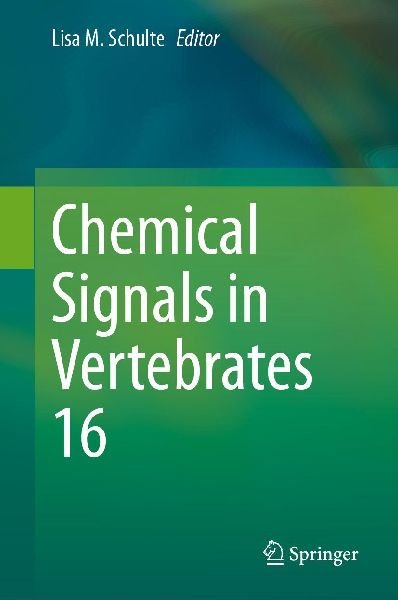
Chemical Signals in Vertebrates 16
Herausgegeben von: Lisa M. Schulte
- Einband
- Gebunden
- Seiten
- 364
- Sprache
- Englisch
- Erschienen
- Oktober 2026
- Verlag
- Springer
Buchbeschreibung
Chemical communication is the evolutionarily oldest form of communication in the animal kingdom.
Pheromones and other chemical substances are used for both intra- and interspecific communication and have a strong influence on the behaviour and/or physiology of animals. The use of pheromones for chemical communication is known in almost all animal groups and the exchange of chemical substances is being researched using multiple methods – working directly with the animals (e.g.
Ganze Beschreibung lesenWeniger anzeigen
using behavioural observations and experiments), and on the chemical substances that the animals use to communicate (e.g. through chemical analyses or proteomics).
While research on chemical signals in invertebrates (especially insects) is already well advanced, the chemical signals that vertebrates exchange with each other are usually much more complex and because of this often less well researched.
It is therefore of great importance to create a platform for regular exchange between scientists whose research focusses on the chemical world of mammals (including humans), birds, reptiles, amphibians and fish.
The international conference "Chemical Signals in Vertebrates" (CSiV) has been held for almost 50 years to bring together scientists from all over the world who work on chemical communication in vertebrates. It takes place every three years in a wide variety of countries, such as England, the USA, France, Poland - and also Germany (Berlin, 2011). The 16th CSiV conference, which took place in 2024, was held in Germany again.
This time in Frankfurt. The "Wildlife and Zoo Animal Biology and Systematics" working group at the Institute of Ecology, Evolution and Diversity (Department of Biosciences) at Goethe University Frankfurt organised the conference this year.
This proceeding summarises the important findings from the 5-day event which consisted of scientific presentations (divided into various symposia), with three plenary speakers and a poster session where young scientists presented their research.
Inhaltsverzeichnis
- The Evolution of Functional Complexity in the MUP Family: Biochemistry Meets Behaviour
- Chemical Signals, Olfactory Learning and Individual Differences: 50 Years of Research
- Avian Chemical Ecology: History and Future Directions
- The Evolution of Lizard Chemical Signals across Time, Space, and Contexts
- Chemosensory Self-Inspection
- A New Perspective on Squamate Social Cognition – the Use of Semiochemicals
- Scent Marking in Wild-Derived Black Rats (Rattus rattus): Observations from Different Experimental Procedures
- Chemical Communication Using the Urinary Compounds in the Domestic Cat
Ganzes Inhaltsverzeichnis anzeigen (19 Einträge)Weniger anzeigen
- Exploring the Molecular Basis of Chemical Communication in the Iberian Lynx (Lynx pardinus)
- Olfactory Stimuli Involved in the Male Effect in Small Ruminants: A Current Perspective
- Contrasting Effects of Tricaine and Liquid Nitrogen on Injury Cue Perception in Ranitomeya sirensis
- The Use of Habituation-Discrimination Tests in Chemical Communication Studies: Evaluation of the Benefit and Limitations on Model Rodent Species, Djungarian and Golden Hamsters
- Elucidating the Role of Squalene in the Chemical Communication of Vertebrates: an in-silico Study Using Various Odorant-Binding Proteins
- Gas Chromatography-Olfactometry in the Analysis of Axillary Odors: Insights and Outlook
- Finding the “Needle in the Haystack”: A Comparison of Statistical Tools for Untargeted Chemical Analysis
- Odors in the City: Intraspecific Chemical Communication in Urban Environments
- 3-Mercapto-3-methyl-1-butanol, a Component of Leopard Urine, Repels Leopards and Spotted Hyaenas and Protects Livestock from Leopard Attacks; a Series of Case Studies
- Using Semiochemical Analogs to Help Pigs Cope with Farming Practices
- The Vomeronasal Organ in Domestic Carnivores: from the Physiology to the Pathology, from the Diagnostic to the Clinical Perspectives
Details
- Erscheinungstermin
- Oktober 2026
- Kategorie
- Fremdsprachige Bücher
- Einband
- Gebunden
- Seiten
- 364
- Sprache
- Englisch
- Verlag
- Springer
- Format
- 24,1 × 16,0 cm
- Dicke
- 2,6 cm
- Gewicht
- 659 g
- EAN / ISBN-13
- 9783032307514
Über Lisa M. Schulte (Hrsg.)
Prof. Dr. Lisa M. Schulte studies amphibian chemical communication at the Goethe University Frankfurt in Germany.
Mehr über Lisa M. Schulte (Hrsg.)Weniger anzeigen
Her research has a strong focus on sex pheromones and other chemical signals and cues exchanged within and between different frog species. She received her diploma in biology from the Philipps-University in Marburg and obtained her doctorate at the University Trier, where she worked on chemical communication during parental care behaviours in poison dart frogs.
Versand und Rückgabe
Standardversand: 1 bis 3 Werktage, 3,99 €, kostenlos ab 35 €
Liefergebiet: Deutschland
Rücksendung: 14 Tage Widerrufsrecht. Bei einem Widerruf tragen Sie die Kosten der Rücksendung. Bei einer Falschlieferung oder einem Fehler von uns erstatten wir Ihnen das Rückporto. Den Widerruf erklären Sie über den Knopf „Vertrag widerrufen“ im Fuß der Seite.
Hersteller und ProduktsicherheitSpringer Nature Customer Service Center GmbH
Springer Nature Customer Service Center GmbH
Europaplatz 3
69115 Heidelberg
Deutschland
ProductSafety@springernature.com
Ähnliche Titel



Extracellular Composite Matrices in Arthropods
Ephraim Cohen (Hrsg.)
Gebunden, Englisch, 2 Ausgaben
ab 299,59 €
Bewertungen
Zu diesem Titel gibt es noch keine Bewertung. Bewerten kann, wer ihn bei uns gekauft hat.
So prüfen wir Bewertungen
Eine Bewertung kann bei uns nur abgeben, wer den Titel über sein Kundenkonto bei uns gekauft hat. Jede Bewertung ist fest mit der zugehörigen Bestellung verknüpft; anders kommt sie technisch gar nicht zustande. Deshalb trägt jede angezeigte Bewertung den Hinweis „Verifizierter Kauf". Wir zeigen positive wie negative Bewertungen und löschen nur bei Rechtsverstößen. Für Bewertungen gibt es keine Gegenleistung.
267,49 €Voraussichtlich 4. bis 8. Dez.