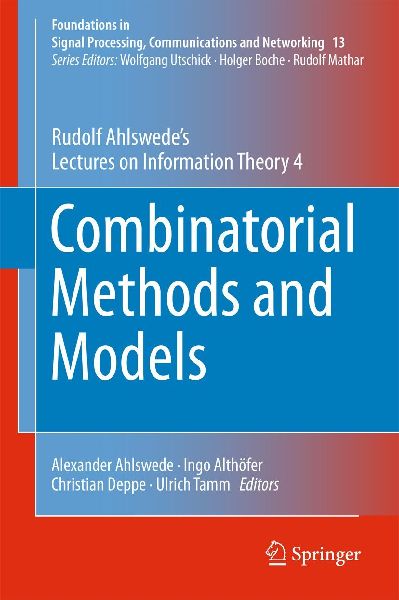
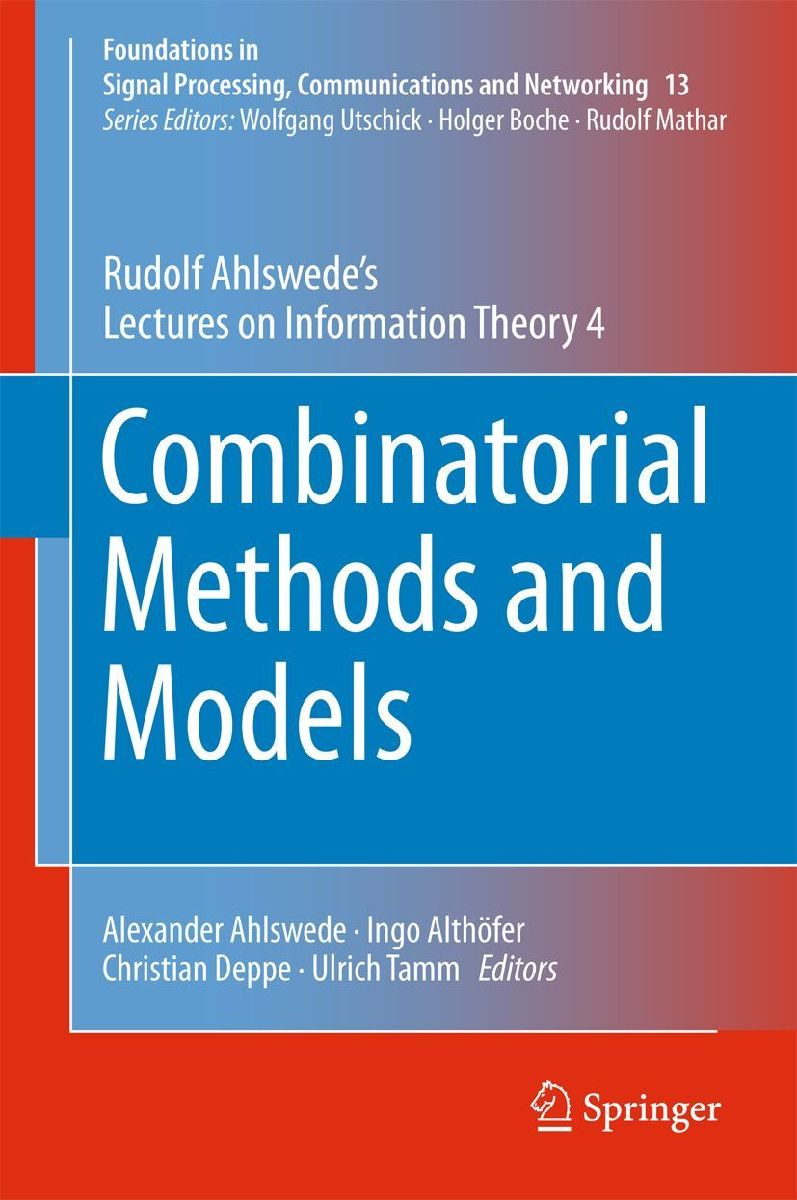
Combinatorial Methods and Models
Rudolf Ahlswede's Lectures on Information Theory 4
von Rudolf Ahlswede
Herausgegeben von: Alexander Ahlswede, Herausgegeben von: Ingo Althöfer, Herausgegeben von: Christian Deppe, und weitere
Aus der Reihe Foundations in Signal Processing, Communications and Networking
- Einband
- Gebunden
- Seiten
- 404
- Sprache
- Englisch
- Erschienen
- Juli 2017
- Verlag
- Springer
Buchbeschreibung
The fourth volume of Rudolf Ahlswede's lectures on Information Theory is focused on Combinatorics.
Ahlswede was originally motivated to study combinatorial aspects of Information Theory via zero-error codes: in this case the structure of the coding problems usually drastically changes from probabilistic to combinatorial. The best example is Shannon's zero error capacity, where independent sets in graphs have to be examined.
Ganze Beschreibung lesenWeniger anzeigen
The extension to multiple access channels leads to the Zarankiewicz problem.
A code can be regarded combinatorially as a hypergraph; and many coding theorems can be obtained by appropriate colourings or coverings of the underlying hypergraphs. Several such colouring and covering techniques and their applications are introduced in this book. Furthermore, codes produced by permutations and one of Ahlswede's favourite research fields -- extremal problems in Combinatorics -- are presented.
Whereas the first part of the book concentrateson combinatorial methods in order to analyse classical codes as prefix codes or codes in the Hamming metric, the second is devoted to combinatorial models in Information Theory. Here the code concept already relies on a rather combinatorial structure, as in several concrete models of multiple access channels or more refined distortions.
An analytical tool coming into play, especially during the analysis of perfect codes, is the use of orthogonal polynomials.
Classical information processing concerns the main tasks of gaining knowledge and the storage, transmission and hiding of data. The first task is the prime goal of Statistics. For transmission and hiding data, Shannon developed an impressive mathematical theory called Information Theory, which he based on probabilistic models.
The theory largely involves the concept of codes with small error probabilities in spite of noise in the transmission, which is modeled by channels. The lectures presentedin this work are suitable for graduate students in Mathematics, and also for those working in Theoretical Computer Science, Physics, and Electrical Engineering with a background in basic Mathematics.
The lectures can be used as the basis for courses or to supplement courses in many ways. Ph. D. students will also find research problems, often with conjectures, that offer potential subjects for a thesis. More advanced researchers may find questions which form the basis of entire research programs.
Inhaltsverzeichnis
- Preface
- I Combinatorial Methods for Information Theory
- II Combinatorial Models in Information Theory
- III Supplement
- Gedenkworte für Rudolf Ahlswede
- Commemorating Rudolf Ahlswede
- Comments by Alon Orlitzky
- Index
Details
- Erscheinungstermin
- Juli 2017
- Kategorie
- Fremdsprachige Bücher
- Einband
- Gebunden
- Seiten
- 404
- Sprache
- Englisch
- Verlag
- Springer
- Reihe
- Foundations in Signal Processing, Communications and Networking
- Format
- 24,1 × 16,0 cm
- Dicke
- 2,6 cm
- Gewicht
- 791 g
- EAN / ISBN-13
- 9783319531373
Über Rudolf Ahlswede
Rudolf Ahlswede (1938 - 2010) studied Mathematics in Göttingen, and held postdoc positions in Erlangen, Germany and Ohio, USA. From 1977 on he was full Professor of Applied Mathematics at the University of Bielefeld.
Mehr über Rudolf AhlswedeWeniger anzeigen
His work represents an essential contribution to information theory and networking. He developed and contributed to a number of central areas, including network coding, and theory of identification, while also advancing the fields of combinatorics and number theory. These efforts culminated in his research program "Development of a General Theory of Information Transfer". In recognition of his work, Rudolf Ahlswede received several awards for "Best Paper", as well as the distinguished "Shannon Award".
Versand und Rückgabe
Standardversand: 1 bis 3 Werktage, 3,99 €, kostenlos ab 35 €
Liefergebiet: Deutschland
Rücksendung: 14 Tage Widerrufsrecht. Bei einem Widerruf tragen Sie die Kosten der Rücksendung. Bei einer Falschlieferung oder einem Fehler von uns erstatten wir Ihnen das Rückporto. Den Widerruf erklären Sie über den Knopf „Vertrag widerrufen“ im Fuß der Seite.
Hersteller und ProduktsicherheitSpringer Nature Customer Service Center GmbH
Springer Nature Customer Service Center GmbH
Europaplatz 3
69115 Heidelberg
Deutschland
ProductSafety@springernature.com
Mehr von Rudolf Ahlswede

Mehr aus der Reihe Foundations in Signal Processing, Communications and Networking

Statistical Robust Beamforming for Broadcast Channels and Applications in Satellite Communication
Andreas Gründinger
Gebunden, Englisch, 2 Ausgaben
ab 106,99 €

Ähnliche Titel


Time-dependent Problems in Imaging and Parameter Identification
Barbara Kaltenbacher (Hrsg.)
Gebunden, Englisch, 2 Ausgaben
ab 160,49 €
Bewertungen
Zu diesem Titel gibt es noch keine Bewertung. Bewerten kann, wer ihn bei uns gekauft hat.
So prüfen wir Bewertungen
Eine Bewertung kann bei uns nur abgeben, wer den Titel über sein Kundenkonto bei uns gekauft hat. Jede Bewertung ist fest mit der zugehörigen Bestellung verknüpft; anders kommt sie technisch gar nicht zustande. Deshalb trägt jede angezeigte Bewertung den Hinweis „Verifizierter Kauf". Wir zeigen positive wie negative Bewertungen und löschen nur bei Rechtsverstößen. Für Bewertungen gibt es keine Gegenleistung.
128,39 €Voraussichtlich 3. bis 7. Dez.