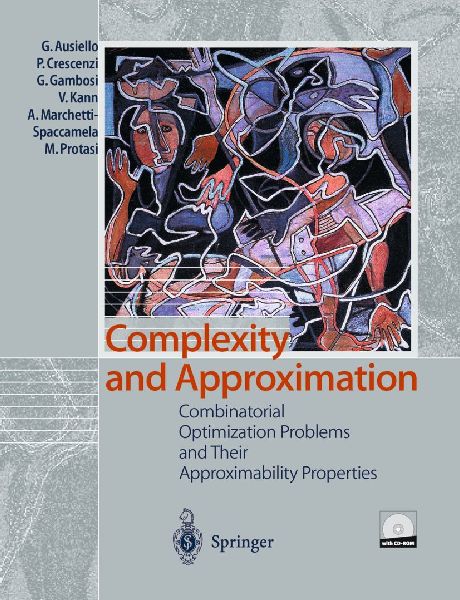
Complexity and Approximation
Combinatorial Optimization Problems and Their Approximability Properties
von Giorgio Ausiello, Pierluigi Crescenzi, Giorgio Gambosi und 3 weitere
- Einband
- Kartoniert
- Seiten
- 548
- Sprache
- Englisch
- Erschienen
- Oktober 2013
- Verlag
- Springer

Buchbeschreibung
N COMPUTER applications we are used to live with approximation.
Var I ious notions of approximation appear, in fact, in many circumstances. One notable example is the type of approximation that arises in numer ical analysis or in computational geometry from the fact that we cannot perform computations with arbitrary precision and we have to truncate the representation of real numbers.
Ganze Beschreibung lesenWeniger anzeigen
In other cases, we use to approximate com plex mathematical objects by simpler ones: for example, we sometimes represent non-linear functions by means of piecewise linear ones. The need to solve difficult optimization problems is another reason that forces us to deal with approximation.
In particular, when a problem is computationally hard (i. e. , the only way we know to solve it is by making use of an algorithm that runs in exponential time), it may be practically unfeasible to try to compute the exact solution, because it might require months or years of machine time, even with the help of powerful parallel computers.
In such cases, we may decide to restrict ourselves to compute a solution that, though not being an optimal one, nevertheless is close to the optimum and may be determined in polynomial time. We call this type of solution an approximate solution and the corresponding algorithm a polynomial-time approximation algorithm.
Most combinatorial optimization problems of great practical relevance are, indeed, computationally intractable in the above sense. In formal terms, they are classified as Np-hard optimization problems.
Inhaltsverzeichnis
- 1 The Complexity of Optimization Problems
- 1.1 Analysis of algorithms and complexity of problems
- 1.2 Complexity classes of decision problems
- 1.3 Reducibility among problems
- 1.4 Complexity of optimization problems
- 1.5 Exercises
- 1.6 Bibliographical notes
- 2 Design Techniques for Approximation Algorithms
Ganzes Inhaltsverzeichnis anzeigen (84 Einträge)Weniger anzeigen
- 2.1 The greedy method
- 2.2 Sequential algorithms for partitioning problems
- 2.3 Local search
- 2.4 Linear programming based algorithms
- 2.5 Dynamic programming
- 2.6 Randomized algorithms
- 2.7 Approaches to the approximate solution of problems
- 2.8 Exercises
- 2.9 Bibliographical notes
- 3 Approximation Classes
- 3.1 Approximate solutions with guaranteed performance
- 3.2 Polynomial-time approximation schemes
- 3.3 Fully polynomial-time approximation schemes
- 3.4 Exercises
- 3.5 Bibliographical notes
- 4 Input-Dependent and Asymptotic Approximation
- 4.1 Between APX and NPO
- 4.2 Between APX and PTAS
- 4.3 Exercises
- 4.4 Bibliographical notes
- 5 Approximation through Randomization
- 5.1 Randomized algorithms for weighted vertex cover
- 5.2 Randomized algorithms for weighted satisfiability
- 5.3 Algorithms based on semidefinite programming
- 5.4 The method of the conditional probabilities
- 5.5 Exercises
- 5.6 Bibliographical notes
- 6 NP, PCP and Non-approximability Results
- 6.1 Formal complexity theory
- 6.2 Oracles
- 6.3 The PCP model
- 6.4 Using PCP to prove non-approximability results
- 6.5 Exercises
- 6.6 Bibliographical notes
- 7 The PCP theorem
- 7.1 Transparent long proofs
- 7.2 Almost transparent short proofs
- 7.3 The final proof
- 7.4 Exercises
- 7.5 Bibliographical notes
- 8 Approximation Preserving Reductions
- 8.1 The World of NPO Problems
- 8.2 AP-reducibility
- 8.3 NPO-completeness
- 8.4 APX-completeness
- 8.5 Exercises
- 8.6 Bibliographical notes
- 9 Probabilistic analysis of approximation algorithms
- 9.1 Introduction
- 9.2 Techniques for the probabilistic analysis of algorithms
- 9.3 Probabilistic analysis and multiprocessor scheduling
- 9.4 Probabilistic analysis and bin packing
- 9.5 Probabilistic analysis and maximum clique
- 9.6 Probabilistic analysis and graph coloring
- 9.7 Probabilistic analysis and Euclidean TSP
- 9.8 Exercises
- 9.9 Bibliographical notes
- 10 Heuristic methods
- 10.1 Types of heuristics
- 10.2 Construction heuristics
- 10.3 Local search heuristics
- 10.4 Heuristics based on local search
- 10.5 Exercises
- 10.6 Bibliographical notes
- A Mathematical preliminaries
- A.1 Sets
- A.1.1 Sequences, tuples and matrices
- A.2 Functions and relations
- A.3 Graphs
- A.4 Strings and languages
- A.5 Boolean logic
- A.6 Probability
- A.6.1 Random variables
- A.7 Linear programming
- A.8 Two famous formulas
- B A List of NP Optimization Problems
Details
- Erscheinungstermin
- Oktober 2013
- Kategorie
- Fremdsprachige Bücher
- Einband
- Kartoniert
- Seiten
- 548
- Sprache
- Englisch
- Verlag
- Springer
- Format
- 24,2 × 19,3 cm
- Dicke
- 3,0 cm
- Gewicht
- 1.051 g
- EAN / ISBN-13
- 9783642635816
Versand und Rückgabe
Standardversand: 1 bis 3 Werktage, 3,99 €, kostenlos ab 35 €
Liefergebiet: Deutschland
Rücksendung: 14 Tage Widerrufsrecht. Bei einem Widerruf tragen Sie die Kosten der Rücksendung. Bei einer Falschlieferung oder einem Fehler von uns erstatten wir Ihnen das Rückporto. Den Widerruf erklären Sie über den Knopf „Vertrag widerrufen“ im Fuß der Seite.
Hersteller und ProduktsicherheitSpringer Nature Customer Service Center GmbH
Springer Nature Customer Service Center GmbH
Europaplatz 3
69115 Heidelberg
Deutschland
ProductSafety@springernature.com
Mehr von Giorgio Ausiello



Fifth IFIP International Conference on Theoretical Computer Science - TCS 2008
Giorgio Ausiello (Hrsg.)
Kartoniert, Englisch, 2 Ausgaben
ab 160,49 €

Analysis and Design of Algorithms in Combinatorial Optimization
Giorgio Ausiello (Hrsg.)
Kartoniert, Englisch
53,49 €
Ähnliche Titel


Multigrammatical Framework for Knowledge-Based Digital Economy
Igor A. Sheremet
Gebunden, Englisch, 2 Ausgaben
ab 213,99 €
Bewertungen
Zu diesem Titel gibt es noch keine Bewertung. Bewerten kann, wer ihn bei uns gekauft hat.
So prüfen wir Bewertungen
Eine Bewertung kann bei uns nur abgeben, wer den Titel über sein Kundenkonto bei uns gekauft hat. Jede Bewertung ist fest mit der zugehörigen Bestellung verknüpft; anders kommt sie technisch gar nicht zustande. Deshalb trägt jede angezeigte Bewertung den Hinweis „Verifizierter Kauf". Wir zeigen positive wie negative Bewertungen und löschen nur bei Rechtsverstößen. Für Bewertungen gibt es keine Gegenleistung.
74,89 €Voraussichtlich 1. bis 3. Dez.