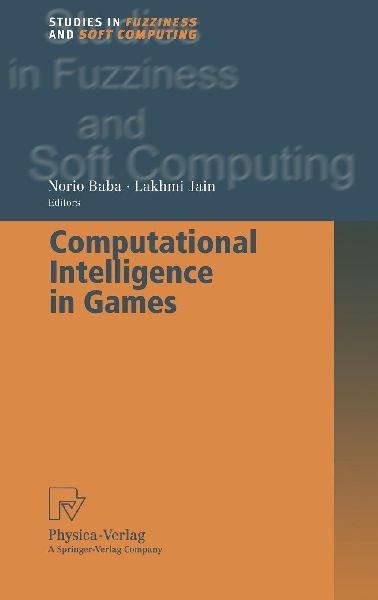
Computational Intelligence in Games
Herausgegeben von: Norio Baba
Aus der Reihe Studies in Fuzziness and Soft Computing
- Einband
- Gebunden
- Seiten
- 176
- Sprache
- Englisch
- Erschienen
- Februar 2001
- Verlag
- Physica
Buchbeschreibung
The most powerful computers in the world are not only used for scientific research, defence, and business, but also in game playing.
Computer games are a multi-billion dollar industry. Recent advances in computational intelligence paradigms have generated tremendous interest among researchers in the theory and implementation of games. Game theory is a branch of operational research dealing with decision theory in a competitive situation.
Ganze Beschreibung lesenWeniger anzeigen
Game theory involves the mathematical calculations and heuristics to optimize the efficient lines of play.
This book presents a sample of the most recent research on the application of computational intelligence techniques in games. This book contains 7 chapters. The first chapter, by Chen, Fanelli, Castellano, and Jain, is an introduction to computational intelligence paradigms. It presents the basics of the main constituents of compu tational intelligence paradigms including knowledge representation, probability-based approaches, fuzzy logic, neural networks, genetic algorithms, and rough sets.
In the second chapter, Chellapilla and Fogel present the evolution of a neural network to play checkers without human expertise. This chapter focuses on the use of a population of neural networks, where each network serves as an evaluation function to describe the quality of the current board position.
After only a little more than 800 generations, the evolutionary process has generated a neural network that can play checkers at the expert level as designated by the u.s. Chess Federation rating system. The program developed by the authors has also competed well against commercially available software.
Inhaltsverzeichnis
- 1 Introduction to computational intelligence paradigms
- 1 Introduction
- 2 Search and knowledge representation
- 3 Probability-based approaches
- 4 Fuzzy logic
- 5 Artificial neural networks
- 6 Genetic algorithms
- 7 Rough sets
Ganzes Inhaltsverzeichnis anzeigen (57 Einträge)Weniger anzeigen
- 8 Fusion
- 9 Discussion and conclusion
- References
- 2 Evolving a neural network to play checkers without human expertise
- 1 Introduction
- 2 Background on neural networks and evolutionary computation
- 3 Background on computer programs for checkers
- 4 Method and results of evolving neural networks for checkers from scratch
- 5 Discussion
- References
- Appendix: Moves for Game 1 - Anaconda vs. "Beatrice" from Hoyle's Classic Games
- 3 Retrograde analysis of patterns versus metaprogramming
- 1 Introduction
- 2 The game of Hex and the game of Go
- 3 Retrograde analysis of patterns
- 4 Metaprogramming
- 5 Using the generated knowledge
- 6 Future work and conclusion
- References
- 4 Learning to evaluate Go positions via temporal difference methods
- 1 Introduction
- 2 Temporal difference learning
- 3 Network architecture
- 4 Training strategies
- 5 Empirical results
- 6 Summary
- References
- 5 Model-based reinforcement learning for evolving soccer strategies
- 1 Introduction
- 2 The soccer simulator
- 3 RL with CMAC models
- 4 PIPE
- 5 Experiments
- 6 Conclusion
- References
- Appendix A: Prioritized sweeping
- Appendix B: Non-pessimistic value functions
- Appendix C: Q(?)-learning
- 6 Fuzzy rule-based strategy for a market selection game
- 1 Introduction
- 2 Market selection game
- 3 Game strategies
- 4 Fuzzy rule-based strategy
- 4.1 Fuzzy Q-learning
- 4.2 Simulation results
- 4.3 Knowledge acquisition
- 5 Conclusions
- References
- List of Contributors
Details
- Erscheinungstermin
- Februar 2001
- Kategorie
- Fremdsprachige Bücher
- Einband
- Gebunden
- Seiten
- 176
- Sprache
- Englisch
- Verlag
- Physica
- Reihe
- Studies in Fuzziness and Soft Computing
- Format
- 24,1 × 16,0 cm
- Dicke
- 1,5 cm
- Gewicht
- 384 g
- EAN / ISBN-13
- 9783790813487
Versand und Rückgabe
Standardversand: 1 bis 3 Werktage, 3,99 €, kostenlos ab 35 €
Liefergebiet: Deutschland
Rücksendung: 14 Tage Widerrufsrecht. Bei einem Widerruf tragen Sie die Kosten der Rücksendung. Bei einer Falschlieferung oder einem Fehler von uns erstatten wir Ihnen das Rückporto. Den Widerruf erklären Sie über den Knopf „Vertrag widerrufen“ im Fuß der Seite.
Hersteller und ProduktsicherheitSpringer Nature Customer Service Center GmbH
Springer Nature Customer Service Center GmbH
Europaplatz 3
69115 Heidelberg
Deutschland
ProductSafety@springernature.com
Mehr von Norio Baba


Mehr aus der Reihe Studies in Fuzziness and Soft Computing


Fuzzy Logic, Smart Control, and the Future of Essential Oils
Zakiah Mohd Yusoff
Gebunden, Englisch
171,19 €


Ähnliche Titel




Evolutionary Computation in Economics and Finance
Shu-Heng Chen
Gebunden, Englisch, 2 Ausgaben
ab 160,49 €
Bewertungen
Zu diesem Titel gibt es noch keine Bewertung. Bewerten kann, wer ihn bei uns gekauft hat.
So prüfen wir Bewertungen
Eine Bewertung kann bei uns nur abgeben, wer den Titel über sein Kundenkonto bei uns gekauft hat. Jede Bewertung ist fest mit der zugehörigen Bestellung verknüpft; anders kommt sie technisch gar nicht zustande. Deshalb trägt jede angezeigte Bewertung den Hinweis „Verifizierter Kauf". Wir zeigen positive wie negative Bewertungen und löschen nur bei Rechtsverstößen. Für Bewertungen gibt es keine Gegenleistung.
106,99 €Voraussichtlich 3. bis 7. Dez.