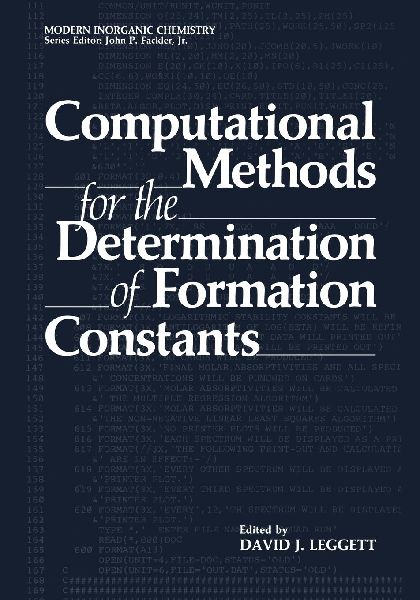
Computational Methods for the Determination of Formation Constants
Herausgegeben von: David J. Leggett
Aus der Reihe Modern Inorganic Chemistry
- Einband
- Kartoniert
- Seiten
- 496
- Sprache
- Englisch
- Erschienen
- Februar 2012
- Verlag
- Springer
Buchbeschreibung
This volume is concerned with methods that are available for the calculation of for mation constants, in particular computational procedures.
Although graphical meth ods have considerable value in the exploration of primary (raw) data they have been overtaken by computational methods, which, for the most part, take primary data and return the refined formation constants. Graphical methods are now considered com plementary to these general computational procedures.
Ganze Beschreibung lesenWeniger anzeigen
This volume brings together programs that span the lifetime of computer-assisted determination of formation constants. On one hand the reader will find listings of programs that are derived from LETAGROP (b.l961) and the GAUSS-G/SCOGS (b. 1962) families. On the other hand programs are presented that are the newest mem bers of the SCOGS lineage and from the on-going MINIQUAD series.
One program is presented that describes a computational approach to the classical Hedstrom Osterberg methods; another that takes care of electrode calibration in a simple yet rigorous manner. Potentiometry and spectrophotometry are the most popular experimental tech niques for equilibrium studies, and the programs in this volume reflect this.
Four programs handle potentiometric data, two will process spectrophotometric data, and one makes use of both types of data separately or in combination.
Inhaltsverzeichnis
- 1 The Determination of Formation Constants: An Overview of Computational Methods for Data Processing
- 1. Introduction
- 2. Direct Search and Univariate Methods
- 3. Least-Squares Methods
- 4. Other Methods
- 5. Summary
- 6. References
- 2 Strategies for Solution Equilibria Studies with Specific Reference to Spectrophotometry
Ganzes Inhaltsverzeichnis anzeigen (58 Einträge)Weniger anzeigen
- 1. Elucidation of the Equilibrium Model
- 2. Determination of pKa's from Absorbance pH Studies
- 3. Initial Methods for Investigating Complex Equlibria
- 4. Conclusions
- 5. References
- 3 MAGEC: A Program for the Definite Calibration of the Glass Electrode
- 1. Introduction
- 2. Descrition of the Program MAGEC
- 3. References
- 4. Instructions for the Use of MAGEC
- 5. Presentation of the Program
- 4 SCOGS2: A Nonlinear Least-Squares Program for the Evaluation of Formation Constants of Metal Complexes
- 1. Introduction
- 2. Description of the Program SCOGS2
- 3. References
- 4. Instructions for SCOGS2
- 5. Presentation of the Program
- 5 MINI
- QUAD and MIQUV: Two Approaches for the Computation of Formation Constants from Potentiometric Data
- 1. Introduction
- 2. Description of the Programs
- 3. References
- 4. Instructions for the Programs
- 5. Presentation of the Programs
- 6 SQUAD: Stability Quotients from Absorbance Data
- 1. Introduction
- 2. Description of the Program SQUAD
- 3. References
- 4. Instructions for SQUAD
- 5. Presentation of the Program
- 7 General Computer Programs for the Determination of Formation Constants from Various Types of Data
- 1. Multiparametric Curve Fitting Using ABLET
- 2. MRLET: Formation Constants of MmLn from Mole Ratio Data
- 3. POLET: Formation Constants from Potentiometric Data
- 4. EXLET: Formation Constants and Related Parameters from Spectrophotometric Extraction Data
- 5. Other Programs of the ABLET
- Family
- 6. References
- 8 PSEQUAD: A Comprehensive Program for the Evaluation of Potentiometric and/or Spectrophotometric Equilibrium Data Using Analytical Derivatives
- 1. Introduction
- 2. Description of the Program PSEQUAD
- 3. References
- 4. Program Instructions
- 5. Presentation of the Program
- 9 STBLTY: Methods for Construction and Refinement of Equilibrium Models
- 1. Introduction
- 2. Program Description
- 3. References
- 4. Description of Batch Input Protocol
- 5. Source Listing of Stblty
Details
- Erscheinungstermin
- Februar 2012
- Kategorie
- Fremdsprachige Bücher
- Einband
- Kartoniert
- Seiten
- 496
- Sprache
- Englisch
- Verlag
- Springer
- Reihe
- Modern Inorganic Chemistry
- Format
- 25,4 × 17,8 cm
- Dicke
- 2,7 cm
- Gewicht
- 924 g
- EAN / ISBN-13
- 9781468449365
Versand und Rückgabe
Standardversand: 1 bis 3 Werktage, 3,99 €, kostenlos ab 35 €
Liefergebiet: Deutschland
Rücksendung: 14 Tage Widerrufsrecht. Bei einem Widerruf tragen Sie die Kosten der Rücksendung. Bei einer Falschlieferung oder einem Fehler von uns erstatten wir Ihnen das Rückporto. Den Widerruf erklären Sie über den Knopf „Vertrag widerrufen“ im Fuß der Seite.
Hersteller und ProduktsicherheitSpringer Nature Customer Service Center GmbH
Springer Nature Customer Service Center GmbH
Europaplatz 3
69115 Heidelberg
Deutschland
ProductSafety@springernature.com
Mehr aus der Reihe Modern Inorganic Chemistry
Cooperative Phenomena in Jahn-Teller Crystals
Michael D. Kaplan
Kartoniert, Englisch, 2 Ausgaben
ab 53,49 €

Ähnliche Titel

Dielectric Properties of Ionic Liquids
Marian Paluch (Hrsg.)
Gebunden, Englisch, 2 Ausgaben
ab 106,99 €
Bewertungen
Zu diesem Titel gibt es noch keine Bewertung. Bewerten kann, wer ihn bei uns gekauft hat.
So prüfen wir Bewertungen
Eine Bewertung kann bei uns nur abgeben, wer den Titel über sein Kundenkonto bei uns gekauft hat. Jede Bewertung ist fest mit der zugehörigen Bestellung verknüpft; anders kommt sie technisch gar nicht zustande. Deshalb trägt jede angezeigte Bewertung den Hinweis „Verifizierter Kauf". Wir zeigen positive wie negative Bewertungen und löschen nur bei Rechtsverstößen. Für Bewertungen gibt es keine Gegenleistung.
53,49 €Voraussichtlich 1. bis 3. Dez.