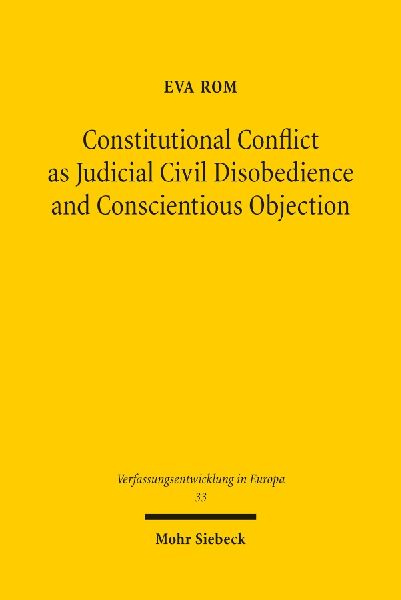
Constitutional Conflict as Judicial Civil Disobedience and Conscientious Objection
Reconceptualising National Constitutional Court Rulings in the European Union Legal Space
von Eva Rom
Aus der Reihe Verfassungsentwicklung in Europa
- Einband
- Kartoniert
- Seiten
- 425
- Sprache
- Englisch
- Erschienen
- Oktober 2026
- Verlag
- Mohr Siebeck GmbH & Co. K
Buchbeschreibung
Eva Rom focuses on the primacy of Union law, its properties, its justification, and - most delicately and most decisively of all - its limits.
The Court of Justice of the European Union and some national constitutional courts have different understandings of where the primacy of Union law over national law finds its limits and whose task it is to define these limits. The consequence in certain cases is constitutional conflict.
Ganze Beschreibung lesenWeniger anzeigen
In the literature of Union law, one finds scholars drawing upon civil disobedience and conscientious objection to enrich the study of constitutional conflict, but this has not yet been done in an exhaustive, theoretically detailed manner.
Eva Rom intends to remedy that. The literature on civil disobedience and conscientious objection contains important insights which can be drawn upon to build a framework with which to assess cases of constitutional conflict in the European Union. Civil disobedience and conscientious objection as concepts describing a qualified form of resistance will prove highly valuable to study in order to arrive at an analytically sharper understanding of constitutional conflict.
The two concepts will not be used to formulaically defend breaches of Union law. The aim is not to provide for an apologetic endorsement of breaking the law. Instead, this project is aimed at moderation, differentiation, and at pondering the following question: Under what exact conditions could an opposing ruling by a national constitutional court be considered justified and what would the consequences of such a classification as justified be?
Inhaltsverzeichnis
- Introduction
- I. Irreconcilability as the starting point
- II. Conscientious disobedience: Is there space for resistance in a democratic regime?
- III. Conscientious disobedience and constitutional conflict in the European Union: Of underexplored parallels between two highly normative debates
- IV. Exploring the potential of conscientious disobedience for constitutional conflict in the European Union in a more comprehensive manner
- V. Aims and inherent limits of this reconceptualisation
- VI. General structure
- VII. On a technical note
Ganzes Inhaltsverzeichnis anzeigen (34 Einträge)Weniger anzeigen
- A. Constitutional Conflict in the European Union after PSPP
- I. Introduction
- II. Two irreconcilable visions of public authority in the European Union as the starting point
- III. Constitutional pluralism as a response to irreconcilability
- IV. Applying the language of legality & illegality to the different visions laid out
- V. Chapter Summary
- B. Conscientious Disobedience
- I. Introduction
- II. Civil disobedience
- III. Conscientious objection
- IV. Demarcating civil disobedience and conscientious objection
- V. Readjusting the lens: Proposing an alternative understanding of conscientious disobedience as an intra-legal drama
- VI. Chapter Summary
- C. A Proposal for a Framework of Judicial Conscientious Disobedience
- I. Introduction
- II. Importing civil disobedience to the field of international and Union law
- III. Proposing a framework of judicial conscientious disobedience
- IV. Chapter Summary
- D. Application to Selected Case Law
- I. The Solange saga as an instance of judicial civil disobedience
- II. The Taricco saga as an instance of judicial conscientious objection
- III. Ajos as an instance of judicial civil disobedience
- IV. Rereading recent judgments by the Trybunä Konstytucyjny as instances of judicial civil disobedience?
- V. Chapter Summary
- Conclusion
- I. Towards a novel understanding of conscientious disobedience - II. Applying the framework - results - III. Once again: Limits of the reconceptualisation - IV. Unresolved questions - possible future avenues for research - V. Constant negotiation ahead
Details
- Erscheinungstermin
- Oktober 2026
- Kategorie
- Fremdsprachige Bücher
- Einband
- Kartoniert
- Seiten
- 425
- Sprache
- Englisch
- Verlag
- Mohr Siebeck GmbH & Co. K
- Reihe
- Verfassungsentwicklung in Europa
- Format
- 23,2 × 15,5 cm
- Dicke
- 2,4 cm
- Gewicht
- 632 g
- EAN / ISBN-13
- 9783162003942
Über Eva Rom
Geboren 1993; Studium der Rechtswissenschaft sowie der englischen und deutschen Philologie an der Universität Heidelberg und der University of Edinburgh; 2016 B.A., 2018 Erste Juristische Prüfung; …
Mehr über Eva RomWeniger anzeigen
Geboren 1993; Studium der Rechtswissenschaft sowie der englischen und deutschen Philologie an der Universität Heidelberg und der University of Edinburgh; 2016 B.A., 2018 Erste Juristische Prüfung; 2019 MPhil in Theoretical and Applied Linguistics an der University of Cambridge; 2025 Promotion im Fach Rechtswissenschaft an der Humboldt-Universität zu Berlin; 2025 Zweite Juristische Staatsprüfung (OLG Karlsruhe).
Versand und Rückgabe
Standardversand: 1 bis 3 Werktage, 3,99 €, kostenlos ab 35 €
Versandbeginn: in der Regel am selben oder am nächsten Werktag
Liefergebiet: Deutschland
Rücksendung: 14 Tage Widerrufsrecht. Bei einem Widerruf tragen Sie die Kosten der Rücksendung. Bei einer Falschlieferung oder einem Fehler von uns erstatten wir Ihnen das Rückporto. Den Widerruf erklären Sie über den Knopf „Vertrag widerrufen“ im Fuß der Seite.
Hersteller und ProduktsicherheitJana Trispel
Mehr aus der Reihe Verfassungsentwicklung in Europa



Verfassungs- versus Fachgerichtsbarkeit im europäischen Gerichtsverbund
Daniel Krotov
Kartoniert
99,00 €
Ähnliche Titel



Bewertungen
Zu diesem Titel gibt es noch keine Bewertung. Bewerten kann, wer ihn bei uns gekauft hat.
So prüfen wir Bewertungen
Eine Bewertung kann bei uns nur abgeben, wer den Titel über sein Kundenkonto bei uns gekauft hat. Jede Bewertung ist fest mit der zugehörigen Bestellung verknüpft; anders kommt sie technisch gar nicht zustande. Deshalb trägt jede angezeigte Bewertung den Hinweis „Verifizierter Kauf". Wir zeigen positive wie negative Bewertungen und löschen nur bei Rechtsverstößen. Für Bewertungen gibt es keine Gegenleistung.
99,00 €Voraussichtlich 30. Nov. bis 2. Dez.