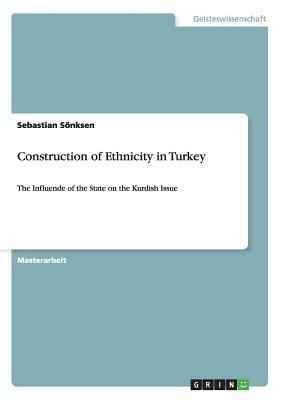
Construction of Ethnicity in Turkey
The Influende of the State on the Kurdish Issue
- Einband
- Kartoniert
- Seiten
- 80
- Sprache
- Deutsch
- Erschienen
- Juni 2012
- Verlag
- GRIN Verlag
Buchbeschreibung
Masterarbeit aus dem Jahr 2011 im Fachbereich Soziologie - Politische Soziologie, Majoritäten, Minoritäten, Humboldt-Universität zu Berlin, Sprache: Deutsch, Abstract: The thesis tries to understand the development of ethnic identification in the Turkish Republic.
Ganze Beschreibung lesenWeniger anzeigen
It focusses on Kurdishness and the current, seemingly paradoxical situation of a growing recognition of Kurdish ethnicity with a simultaneous increase of social tensions on this issue.
In the theoretical part of the thesis, the concept of ethnicity is analyzed. This includes an examination of the etymology of the term and an introduction of the major schools of thought on ethnicity: primordialism and social constructivism. While primordialism defines ethnicity as a fixed identity constituted by objective and often physical characteristics like ancestry, skin color, or mother tongue, social constructive theories view ethnicity as a variable social category dependent on space and time.
Two theories are of importance for the Turkish case: Nagel's (1994) social constructive model of ethnicity which underlines the influences and interrelations of the society, the state, individuals and groups in the social construction of ethnic categories, and Scott's (1990) argument that the perception of opposition on parts of a minority group leads to an increase in its ethnic identification.
Based on these theoretical grounds, the empirical part examines the conceptions of Kurdish ethnicity in Turkey from the establishment of the Republic in 1923 until today. At first sight, the developments seem to have been oscillating non-systematically between the two poles of denial and recognition, and ended up in the contemporary paradox of an increasing recognition of Kurdish ethnicity facilitated by the politics of the contemporary AKP government on the one side, and growing social tensions on ethnic issues on the other side.
But as the thesis argues, there are signs of a long-term process of increasing recognition of Kurdish ethnicity and growing interaction between parts of the society that define themselves and „Turkish“ and „Kurdish“.
This development led to a stronger perception of opposition on the latter side, which in turn and according to Scott's theory strengthened their ethnic identification. The result of this process is the questioned paradox of recognition and conflict.
Details
- Erscheinungstermin
- Juni 2012
- Kategorie
- Fachbuch
- Einband
- Kartoniert
- Seiten
- 80
- Sprache
- Deutsch
- Verlag
- GRIN Verlag
- Format
- 21,0 × 14,8 cm
- Dicke
- 0,6 cm
- Gewicht
- 129 g
- EAN / ISBN-13
- 9783656212386
Versand und Rückgabe
Standardversand: 1 bis 3 Werktage, 3,99 €, kostenlos ab 35 €
Liefergebiet: Deutschland
Rücksendung: 14 Tage Widerrufsrecht. Bei einem Widerruf tragen Sie die Kosten der Rücksendung. Bei einer Falschlieferung oder einem Fehler von uns erstatten wir Ihnen das Rückporto. Den Widerruf erklären Sie über den Knopf „Vertrag widerrufen“ im Fuß der Seite.
Hersteller und ProduktsicherheitGRIN Publishing GmbH
Mehr von Sebastian Sönksen

Ähnliche Titel



Bewertungen
Zu diesem Titel gibt es noch keine Bewertung. Bewerten kann, wer ihn bei uns gekauft hat.
So prüfen wir Bewertungen
Eine Bewertung kann bei uns nur abgeben, wer den Titel über sein Kundenkonto bei uns gekauft hat. Jede Bewertung ist fest mit der zugehörigen Bestellung verknüpft; anders kommt sie technisch gar nicht zustande. Deshalb trägt jede angezeigte Bewertung den Hinweis „Verifizierter Kauf". Wir zeigen positive wie negative Bewertungen und löschen nur bei Rechtsverstößen. Für Bewertungen gibt es keine Gegenleistung.
42,95 €Voraussichtlich 2. bis 4. Dez.