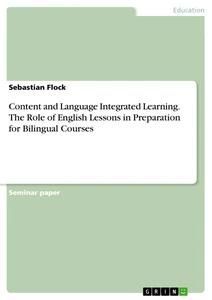
Content and Language Integrated Learning. The Role of English Lessons in Preparation for Bilingual Courses
von Sebastian Flock
- Einband
- Kartoniert
- Seiten
- 16
- Sprache
- Englisch
- Erschienen
- Dezember 2016
- Verlag
- GRIN Verlag
Buchbeschreibung
Seminar paper from the year 2014 in the subject Didactics - English - Pedagogy, Literature Studies, grade: 2,7, http://www.uni-jena.de/ (Institut für Anglistik/Amerikanistik), course: Teaching Grammar and Vocabulary, language: English, abstract: Bilingual education in Germany has existed for more than 40 years: it is a product of the Élysée Treaty from 1963.
Ganze Beschreibung lesenWeniger anzeigen
Its aim was to stop the 'hereditary enmity', that had determined the relations between France and Germany for many years, through the increased teaching in French, especially in history classes.
Nowadays, things have changed. At the conceptual level the German term 'bilingualer Unterricht' is more and more replaced by the European term 'CLIL', which stands for Content and Language Integrated Learning. At the level of content as well, changes have taken place. It is no longer the political idea of international friendship that dominates bilingual approaches.
The aim of CLIL is to convey cognitive-conceptual, discursive and methodical competences. That means the ability to understand and describe subject specific issues in the target language and to reflect and use subject specific procedures and problem solving strategies. This involved that not only French but also other languages like English or Spanish can be used as a communication medium and that is exactly what a foreign language in CLIL classes is supposed to be: a bare medium.
It is not about learning English, it is about learning in English. The foreign language is not in the foreground but it is used to talk about subject specific topics in an appropriate way. Hence, principles, aims and contents of the CLIL lesson are defined by the subject and not by the foreign language. The same counts for the didactic.
Study und working techniques in CLIL classes are those of the subject and not of English lessons. This means that CLIL teachers must not try to solve grammar or language problems during the CLIL course. However, it is obvious that not allbn learners meet the requirements to talk about subject specific matters in their second language.
This requests a high language register that learners in grade seven normally have not accomplished yet. In consideration of the fact that such language problems are not to be solved in CLIL classes, the question arises how general English teachers can prepare their students for future CLIL classes in their English lessons appropriately.
To answer this question it is necessary to analyse firstly the reasons for the linguistic problems in CLIL and the obstacles that hinder the students to participate in bilingual lessons. After that it is possible to provide approaches to solving these problems in form of CLIL preparation courses.
Details
- Erscheinungstermin
- Dezember 2016
- Kategorie
- Fremdsprachige Bücher
- Einband
- Kartoniert
- Seiten
- 16
- Sprache
- Englisch
- Verlag
- GRIN Verlag
- Format
- 21,0 × 14,8 cm
- Dicke
- 0,2 cm
- Gewicht
- 40 g
- EAN / ISBN-13
- 9783668361188
Versand und Rückgabe
Standardversand: 1 bis 3 Werktage, 3,99 €, kostenlos ab 35 €
Liefergebiet: Deutschland
Rücksendung: 14 Tage Widerrufsrecht. Bei einem Widerruf tragen Sie die Kosten der Rücksendung. Bei einer Falschlieferung oder einem Fehler von uns erstatten wir Ihnen das Rückporto. Den Widerruf erklären Sie über den Knopf „Vertrag widerrufen“ im Fuß der Seite.
Hersteller und ProduktsicherheitGRIN Publishing GmbH
Mehr von Sebastian Flock


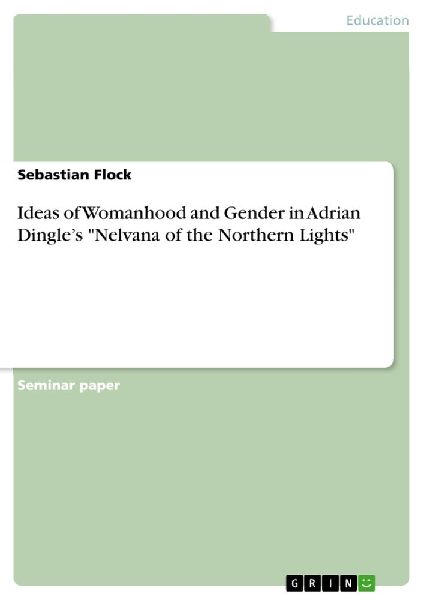
Ideas of Womanhood and Gender in Adrian Dingle's "Nelvana of the Northern Lights"
Sebastian Flock
Kartoniert, Englisch
17,95 €

Ähnliche Titel


Bewertungen
Zu diesem Titel gibt es noch keine Bewertung. Bewerten kann, wer ihn bei uns gekauft hat.
So prüfen wir Bewertungen
Eine Bewertung kann bei uns nur abgeben, wer den Titel über sein Kundenkonto bei uns gekauft hat. Jede Bewertung ist fest mit der zugehörigen Bestellung verknüpft; anders kommt sie technisch gar nicht zustande. Deshalb trägt jede angezeigte Bewertung den Hinweis „Verifizierter Kauf". Wir zeigen positive wie negative Bewertungen und löschen nur bei Rechtsverstößen. Für Bewertungen gibt es keine Gegenleistung.
15,95 €Voraussichtlich 3. bis 7. Dez.