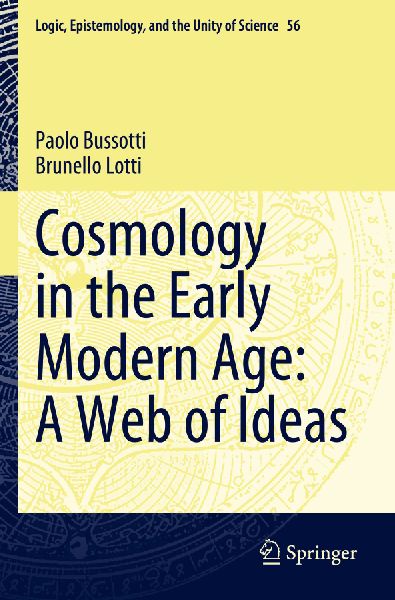
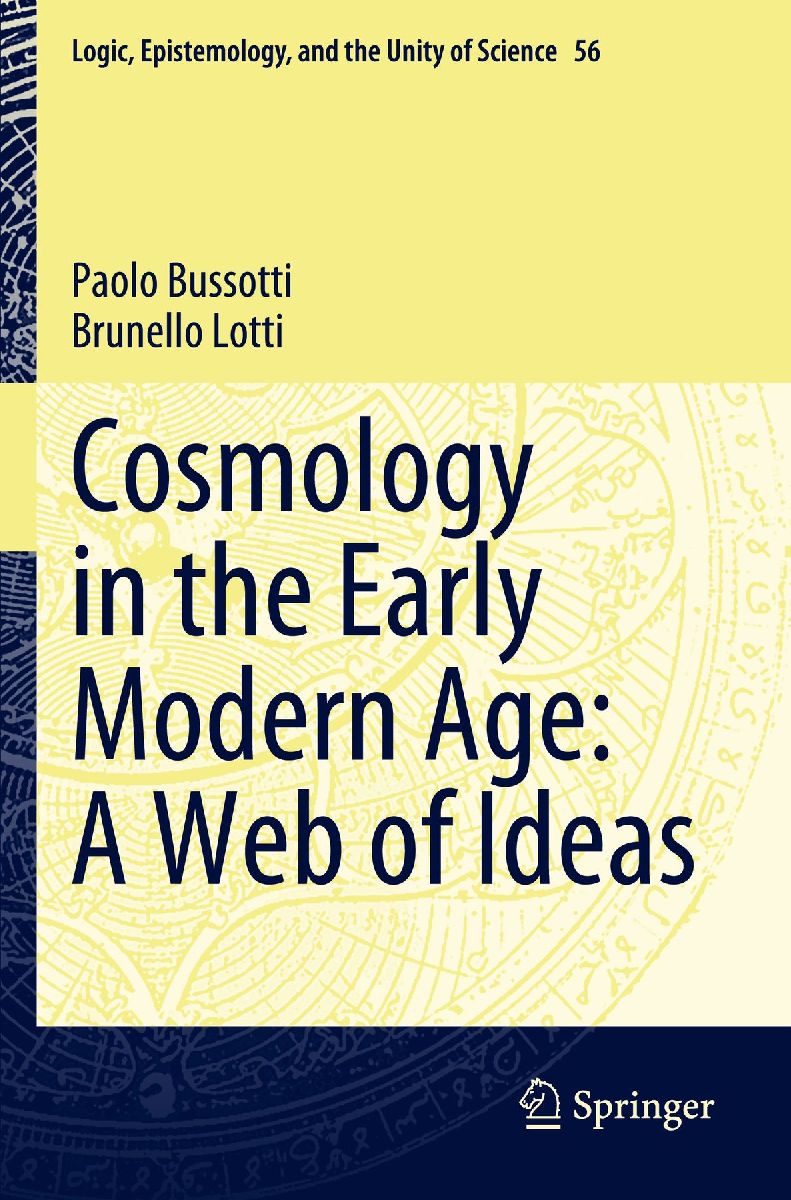
Cosmology in the Early Modern Age: A Web of Ideas
von Paolo Bussotti und Brunello Lotti
Aus der Reihe Logic, Epistemology, and the Unity of Science
- Einband
- Kartoniert
- Seiten
- 352
- Sprache
- Englisch
- Erschienen
- Januar 2024
- Verlag
- Springer
Buchbeschreibung
This volume addresses the history and epistemology of early modern cosmology.
The authors reconstruct the development of cosmological ideas in the age of 'scientific revolution' from Copernicus to Leibniz, taking into account the growth of a unified celestial-and-terrestrial mechanics.
Ganze Beschreibung lesenWeniger anzeigen
The volume investigates how, in the rise of the new science, cosmology displayed deep and multifaceted interrelations between scientific notions (stemming from mechanics, mathematics, geometry, astronomy) and philosophical concepts.
These were employed to frame a general picture of the universe, as well as to criticize and interpret scientific notions and observational data.
This interdisciplinary work reconstructs a conceptual web pervaded by various intellectual attitudes and drives. It presents an historical-epistemological unified itinerary which includes Copernicus, Kepler, Galileo, Descartes, Huygens, Newton and Leibniz. For each of the scientists and philosophers, a presentation and commentary is made of their cosmological views, and where relevant, outlines of their most relevant physical concepts are given.
Furthermore, the authors highlight the philosophical and epistemological implications of their scientific works. This work is helpful both as a synthetic overview of early modern cosmology, and an analytical exposition of the elements that were intertwined in early-modern cosmology.
This book addresses historians, philosophers, and scientists and can also be used as a research source book by post-graduate students in epistemology, history of science and history of philosophy.
Inhaltsverzeichnis
- Foreword
- Preface
- Introduction
- Chapter 1. The elements of a cosmological model
- Chapter 2. Copernicus' astronomical revolution
- Chapter 3. Kepler: the cosmographer par excellence
- Chapter 4.Galileo and the spread of the Copernican system
- Chapter 5. Descartes and the new mechanistic paradigm
Ganzes Inhaltsverzeichnis anzeigen (17 Einträge)Weniger anzeigen
- Chapter 6. Huygens: the greatest Cartesian scientist
- Chapter 7. Newton and his system of the world
- Chapter 8. Leibniz: the philosopher-scientist
- Conclusion
- Bibliography
- Glossary of the Technical Terms
- Index of Subjects
- Index of Figures
- Index of Names.¿
Details
- Erscheinungstermin
- Januar 2024
- Kategorie
- Fremdsprachige Bücher
- Einband
- Kartoniert
- Seiten
- 352
- Sprache
- Englisch
- Verlag
- Springer
- Reihe
- Logic, Epistemology, and the Unity of Science
- Format
- 23,5 × 15,5 cm
- Dicke
- 2,0 cm
- Gewicht
- 534 g
- EAN / ISBN-13
- 9783031121975
Über Paolo Bussotti
Paolo Bussotti is Associate Professor in History of Science and Techniques at the University of Udine (Italy).
Mehr über Paolo BussottiWeniger anzeigen
His research areas are history of science and mathematics, in particular history of geometry and number theory between the 17th and the 19th centuries, and history of physics and astronomy in the 17th century. He is the author of more than 100 scientific publications, among which a monograph on the history of the method of infinite descent (number theory), From Fermat to Gauss. Indefinite descent and methods of reduction in Number Theory (2006) and one on Leibniz's planetary theory, The complex itinerary of Leibniz's planetary theory (2015). He is the co-author (jointly with prof. R. Pisano) of many papers on the Geneva Edition of Newton's Principia published in important journals dedicated to the history of science. He is reviewer for leading scientific journals as the Zentralblatt für Mathematik.
Brunello Lotti is Associate Professor of History of Philosophy at the University of Udine (Italy). His research interests on early modern British philosophy focus on the relations between natural philosophy, metaphysics and theology, including the history of platonism, the reception of Cartesian scepticism and mechanicism, and the issue of the origin of motion. He is author of the monographs Ralph Cudworth e l'idea di natura plastica (2004), L'iperbole del dubbio. Lo scetticismo cartesiano nella filosofia inglese tra Sei e Settecento (2010), "Spiritus intus alit". La ricezione di un luogo filosofico virgiliano nel pensiero moderno (2021). He coedited Scienza e teologia fra Seicento e Ottocento. Studi in memoria di Maurizio Mamiani (2006), and Eredità cartesiane nella cultura britannica (2011). His articles and essays cover several authors in early modern British philosophy, from the Cambridge Platonists to Locke and Berkeley.
Versand und Rückgabe
Standardversand: 1 bis 3 Werktage, 3,99 €, kostenlos ab 35 €
Liefergebiet: Deutschland
Rücksendung: 14 Tage Widerrufsrecht. Bei einem Widerruf tragen Sie die Kosten der Rücksendung. Bei einer Falschlieferung oder einem Fehler von uns erstatten wir Ihnen das Rückporto. Den Widerruf erklären Sie über den Knopf „Vertrag widerrufen“ im Fuß der Seite.
Hersteller und ProduktsicherheitSpringer Nature Customer Service Center GmbH
Springer Nature Customer Service Center GmbH
Europaplatz 3
69115 Heidelberg
Deutschland
ProductSafety@springernature.com
Mehr von Paolo Bussotti


Mehr aus der Reihe Logic, Epistemology, and the Unity of Science

An Intellectual History of Science in the Renaissance
Raffaele Pisano (Hrsg.)
Gebunden, Englisch
139,09 €

An Intellectual History of Science in the Renaissance
Raffaele Pisano (Hrsg.)
Gebunden, Englisch
149,79 €


The Theory of Plane Area at the Crossroads
Eduardo N. Giovannini
Gebunden, Englisch, 2 Ausgaben
ab 128,39 €
Ähnliche Titel




Bewertungen
Zu diesem Titel gibt es noch keine Bewertung. Bewerten kann, wer ihn bei uns gekauft hat.
So prüfen wir Bewertungen
Eine Bewertung kann bei uns nur abgeben, wer den Titel über sein Kundenkonto bei uns gekauft hat. Jede Bewertung ist fest mit der zugehörigen Bestellung verknüpft; anders kommt sie technisch gar nicht zustande. Deshalb trägt jede angezeigte Bewertung den Hinweis „Verifizierter Kauf". Wir zeigen positive wie negative Bewertungen und löschen nur bei Rechtsverstößen. Für Bewertungen gibt es keine Gegenleistung.
128,39 €Voraussichtlich 2. bis 4. Dez.