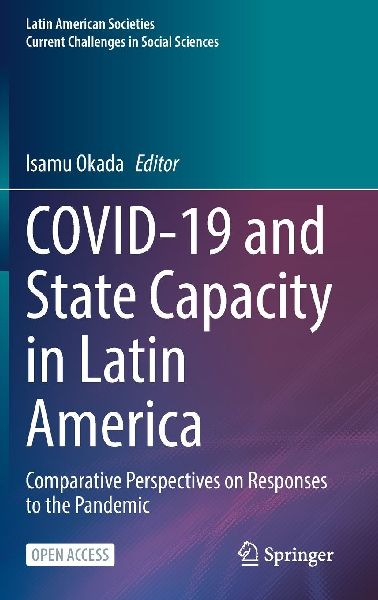
COVID-19 and State Capacity in Latin America
Comparative Perspectives on Responses to the Pandemic
Herausgegeben von: Isamu Okada
Aus der Reihe Latin American Societies
- Einband
- Gebunden
- Seiten
- 208
- Sprache
- Englisch
- Erschienen
- Februar 2026
- Verlag
- Springer
Buchbeschreibung
This open access book analyses Latin American countries’ state capacity based on these countries’ responses to the COVID-19 pandemic.
The causes and consequences of uneven state capacity have been a popular academic debate in social welfare provision during the last decades. The pandemic raises further concerns.
Ganze Beschreibung lesenWeniger anzeigen
The making and implementation of infection-preventive measures have relied on the capability of the state authority to deploy health infrastructure, provide timely and extensive health services, and mobilize policy tools to build desirable collective action either by coercive or non-coercive means. In this sense, the global pandemic "presents a rare naturally occurring experiment" to draw comparative lessons.
Additionally, amid the burgeoning COVID-19 literature worldwide, Latin America stood out as a region that provides an important reference to the comparative perspective on the global pandemic. It unfolded one of the worst scenarios, particularly during the first year of the pandemic, evident in the major indicators such as infected cases, death tolls, and mortality rates.
So, not all of the Global South hit the score evenly, making Latin America remarkably worse in inter-regional terms than Africa and Asia, making it one of the epicenters of the pandemic. Academic studies have added nuance to this picture by suggesting intra-regional variations. Latin American countries differed in many critical ways, including early successes and failures in containing virus spreads, political leadership and coordination, and measures taken for social distancing.
Subnational variations were also remarkable in federal regimes. This multi-layered diversity thus provides seedbeds for the identification and test of theoretical puzzles. COVID-19 and State Capacity in Latin America: Comparative Perspectives on Responses to the Pandemic will be a valuable resource for political scientists and researchers from many other disciplines within the social sciences interested in the study of state capacity and social welfare provision.
Inhaltsverzeichnis
- Chapter 1. Introduction: Revisiting State Capacity on the COVID-19 Pandemic
- Chapter 2. State Capacity, Divergence in Health Systems, and Outcomes among Latin American Countries
- Chapter 3. Tracing Test Capacity in Latin America during the COVID-19 Pandemic
- Chapter 4. Assessing the Impact of Central Government Announcements on Mask-Wearing Compliance in Latin America during COVID-19
- Chapter 5. Path Dependent Disparities of Brazil’s Healthcare System and State Response in Coping with COVID-19
- Chapter 6. State Capacity and Policy Diffusion in Latin America: The Case of COVID-19
- Chapter 7. Collaborative Governance as a Policy Strategy to Combat the Covid-19 Pandemic: Lessons from Latin America
- Chapter 8. State Capacities in Argentina's COVID-19 Vaccine Endeavor: Challenges, Strategies, and Lessons towards Pandemic Preparedness
- Chapter 9. Conclusion
Details
- Erscheinungstermin
- Februar 2026
- Kategorie
- Fremdsprachige Bücher
- Einband
- Gebunden
- Seiten
- 208
- Sprache
- Englisch
- Verlag
- Springer
- Reihe
- Latin American Societies
- Format
- 24,1 × 16,0 cm
- Dicke
- 1,7 cm
- Gewicht
- 431 g
- EAN / ISBN-13
- 9783032155719
Über Isamu Okada (Hrsg.)
Isamu Okada is a political scientist and a professor at the Graduate School of International Development, Nagoya University.
Mehr über Isamu Okada (Hrsg.)Weniger anzeigen
Before his current position, he worked at the Japanese Embassy in the Plurinational State of Bolivia and as a Postdoctoral Research Fellow at the Japan Society for Promotion of Science. His research interests range from resource governance, political participation, Latin American politics, and, most recently, the social impacts of COVID-19. He has publications employing quantitative methods and on-site and online surveys before and during the pandemic, published in World Development, the Journal of Behavioral Public Administration, Frontiers in Psychology, and Humanities and Social Sciences Communications. He has ample fieldwork experience in Bolivia, Peru, and other Latin American countries.
Versand und Rückgabe
Standardversand: 1 bis 3 Werktage, 3,99 €, kostenlos ab 35 €
Liefergebiet: Deutschland
Rücksendung: 14 Tage Widerrufsrecht. Bei einem Widerruf tragen Sie die Kosten der Rücksendung. Bei einer Falschlieferung oder einem Fehler von uns erstatten wir Ihnen das Rückporto. Den Widerruf erklären Sie über den Knopf „Vertrag widerrufen“ im Fuß der Seite.
Hersteller und ProduktsicherheitSpringer Nature Customer Service Center GmbH
Springer Nature Customer Service Center GmbH
Europaplatz 3
69115 Heidelberg
Deutschland
ProductSafety@springernature.com
Mehr aus der Reihe Latin American Societies
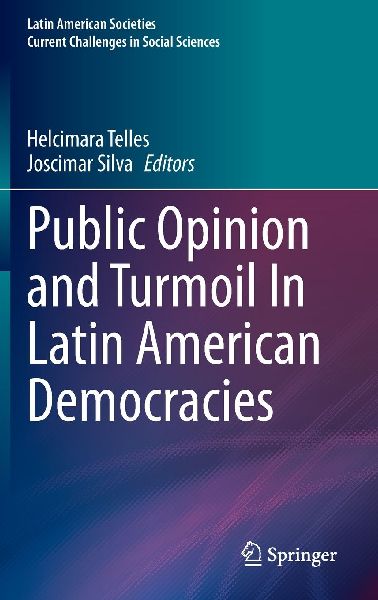
Public Opinion and Turmoil In Latin American Democracies
Helcimara Telles (Hrsg.)
Gebunden, Englisch, 2 Ausgaben
ab 160,49 €
Making the Rural Urban
Sebastián Felipe Villamizar-Santamaría
Gebunden, Englisch, 2 Ausgaben
ab 128,39 €
Ähnliche Titel
Social Capital and Subjective Well-Being
Anna Almakaeva (Hrsg.)
Kartoniert, Englisch, 2 Ausgaben
ab 106,99 €

The Evolution and Everyday Practice of Collective Patient Involvement in Europe
Alexander Haarmann
Gebunden, Englisch, 2 Ausgaben
ab 106,99 €
The Populist Radical Right and Health
Michelle Falkenbach (Hrsg.)
Kartoniert, Englisch, 2 Ausgaben
ab 53,49 €
Bewertungen
Zu diesem Titel gibt es noch keine Bewertung. Bewerten kann, wer ihn bei uns gekauft hat.
So prüfen wir Bewertungen
Eine Bewertung kann bei uns nur abgeben, wer den Titel über sein Kundenkonto bei uns gekauft hat. Jede Bewertung ist fest mit der zugehörigen Bestellung verknüpft; anders kommt sie technisch gar nicht zustande. Deshalb trägt jede angezeigte Bewertung den Hinweis „Verifizierter Kauf". Wir zeigen positive wie negative Bewertungen und löschen nur bei Rechtsverstößen. Für Bewertungen gibt es keine Gegenleistung.
53,49 €Voraussichtlich 7. bis 9. Dez.