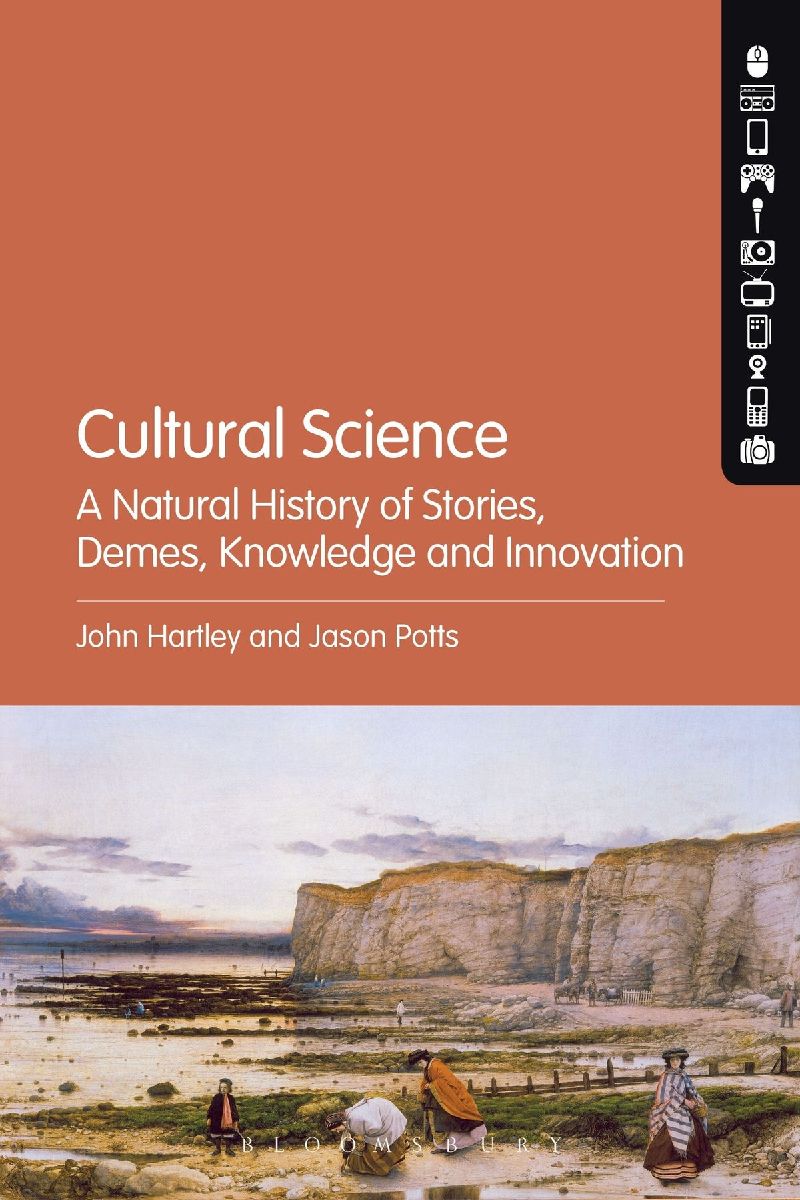
Cultural Science
von John Hartley
- Einband
- Kartoniert
- Seiten
- 266
- Sprache
- Englisch
- Erschienen
- März 2016
- Verlag
- Bloomsbury 3PL
Buchbeschreibung
Cultural Science introduces a new way of thinking about culture.
Adopting an evolutionary and systems approach, the authors argue that culture is the population-wide source of newness and innovation; it faces the future, not the past. Its chief characteristic is the formation of groups or 'demes' (organised and productive subpopulation; 'demos'). Demes are the means for creating, distributing and growing knowledge.
Ganze Beschreibung lesenWeniger anzeigen
However, such groups are competitive and knowledge-systems are adversarial. Starting from a rereading of Darwinian evolutionary theory, the book utilises multidisciplinary resources: Raymond Williams's 'culture is ordinary' approach; evolutionary science (e.g. Mark Pagel and Herbert Gintis); semiotics (Yuri Lotman); and economic theory (from Schumpeter to McCloskey).
Successive chapters argue that:-Culture and knowledge need to be understood from an externalist ('linked brains') perspective, rather than through the lens of individual behaviour; -Demes are created by culture, especially storytelling, which in turn constitutes both politics and economics; -The clash of systems - including demes - is productive of newness, meaningfulness and successful reproduction of culture; -Contemporary urban culture and citizenship can best be explained by investigating how culture is used, and how newness and innovation emerge from unstable and contested boundaries between different meaning systems;-The evolution of culture is a process of technologically enabled 'demic concentration' of knowledge, across overlapping meaning-systems or semiospheres; a process where the number of demes accessible to any individual has increased at an accelerating rate, resulting in new problems of scale and coordination for cultural science to address.
The book argues for interdisciplinary 'consilience', linking evolutionary and complexity theory in the natural sciences, economics and anthropology in the social sciences, and cultural, communication and media studies in the humanities and creative arts. It describes what is needed for a new 'modern synthesis' for the cultural sciences.
It combines analytical and historical methods, to provide a framework for a general reconceptualisation of the theory of culture - one that is focused not on its political or customary aspects but rather its evolutionary significance as a generator of newness and innovation.
Inhaltsverzeichnis
- Intro
- 1. Curiously Parallel - The Nature of Culture
- Part I: Culture Makes Groups
- 2. Externalism - Identity ('Me' is 'We')
- 3. Demes - Universal-Adversarial Groupishness ('We' vs 'They')
- 4. Malvoisine - Bad Neighbours
- 5. Citizens - Demic Concentration Creates Knowledge
- Part II: Groups Make Knowledge
Ganzes Inhaltsverzeichnis anzeigen (17 Einträge)Weniger anzeigen
- 6. Meaningfulness - The Growth of Knowledge
- 7. Newness - Innovation
- 8. Waste - Reproductive Success
- 9. Extinction - Resilience and Ossification
- Part III: Outro
- 10. A Natural History of Demic Concentration
- Acknowledgements
- References
- Index
Details
- Erscheinungstermin
- März 2016
- Kategorie
- Fremdsprachige Bücher
- Einband
- Kartoniert
- Seiten
- 266
- Sprache
- Englisch
- Verlag
- Bloomsbury 3PL
- Format
- 23,4 × 15,6 cm
- Dicke
- 1,4 cm
- Gewicht
- 409 g
- EAN / ISBN-13
- 9781474279239
Über John Hartley
John Hartley is Professor of Cultural Science and Director of the Centre for Culture and Technology at Curtin University, Western Australia; and Professor of Journalism, Media and Cultural Studies at Cardiff University, Wales.
Mehr über John HartleyWeniger anzeigen
He was co-founder of the Australian Research Council's Centre of Excellence for Creative Industries and Innovation at Queensland University of Technology, where he held an ARC Federation Fellowship and was founding Dean of the Creative Industries Faculty. He has held visiting scholar positions in the USA, UK, China, Germany and Denmark. He was awarded the Order of Australia for service to education, and holds fellowships of the Australian Academy of the Humanities, Royal Society of Arts, and International Communication Association. He has published more than 20 books (as author, co-author or editor) in communication, cultural and media studies, including Popular Reality (Bloomsbury).
Jason Potts, Schumpeter Prize winner, is ARC Future Fellow, Professor and Principal Research Fellow in the School of Economics, Finance and Marketing at RMIT University, Melbourne, Australia; and Editor of the Journal of Institutional Economics. He is the author of 6 books and over 80 papers in evolutionary economics and innovation.
Versand und Rückgabe
Standardversand: 1 bis 3 Werktage, 3,99 €, kostenlos ab 35 €
Liefergebiet: Deutschland
Rücksendung: 14 Tage Widerrufsrecht. Bei einem Widerruf tragen Sie die Kosten der Rücksendung. Bei einer Falschlieferung oder einem Fehler von uns erstatten wir Ihnen das Rückporto. Den Widerruf erklären Sie über den Knopf „Vertrag widerrufen“ im Fuß der Seite.
Hersteller und ProduktsicherheitBloomsbury 3PL
Bloomsbury 3PL
Europaallee 1
36244 Bad Hersfeld
Deutschland
gpsr@libri.de
Verantwortliche Person in der EU
Libri GmbHEuropaallee 1
36244 Bad Hersfeld
Deutschland
gpsr@libri.de
Mehr von John Hartley
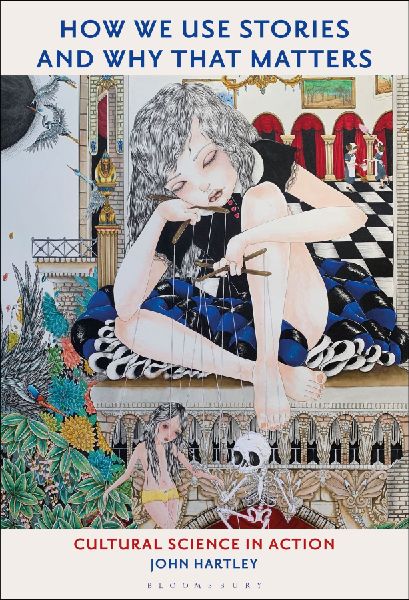
Ähnliche Titel
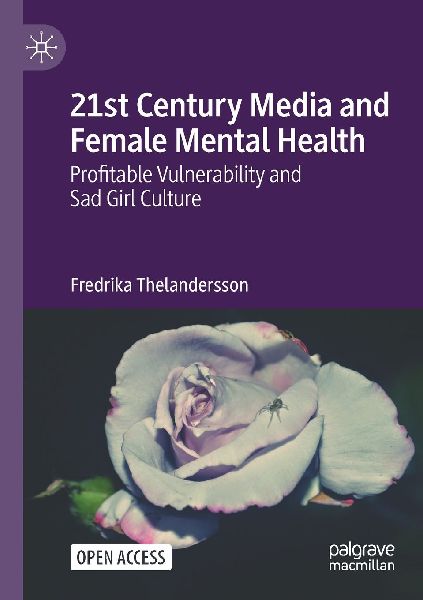
21st Century Media and Female Mental Health
Fredrika Thelandersson
Kartoniert, Englisch, 2 Ausgaben
ab 42,79 €

BRICS, Geopolitics, and the Synchronization of Foreign News
Augusto Santos
Kartoniert, Englisch
117,69 €
Bewertungen
Zu diesem Titel gibt es noch keine Bewertung. Bewerten kann, wer ihn bei uns gekauft hat.
So prüfen wir Bewertungen
Eine Bewertung kann bei uns nur abgeben, wer den Titel über sein Kundenkonto bei uns gekauft hat. Jede Bewertung ist fest mit der zugehörigen Bestellung verknüpft; anders kommt sie technisch gar nicht zustande. Deshalb trägt jede angezeigte Bewertung den Hinweis „Verifizierter Kauf". Wir zeigen positive wie negative Bewertungen und löschen nur bei Rechtsverstößen. Für Bewertungen gibt es keine Gegenleistung.
58,60 €Voraussichtlich 2. bis 4. Dez.