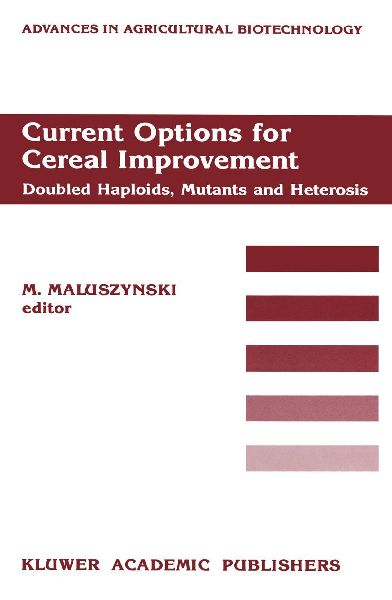
Current Options for Cereal Improvement
Doubled Haploids, Mutants and Heterosis Proceedings of the First FAO/IAEA Research Co-ordination Meeting on "Use of Induced Mutations in Connection with Haploids and Heterosis in Cereals", 8-12 December 1986, Guelph, Canada
Herausgegeben von: M. Maluszynski
Aus der Reihe Advances in Agricultural Biotechnology
- Einband
- Kartoniert
- Seiten
- 228
- Sprache
- Englisch
- Erschienen
- September 2011
- Verlag
- Springer
Buchbeschreibung
China was the first country to use cytoplasmic male sterility to develop hybrid rice for commercial use in 1973. In 1986 more than 8 million hectares of hybrid rice were planted in China, which is one fourth of the total rice area and produces one third of the total rice in the country. Hybrids usually out yield the leading commercial varieties by -20-30%, giving an average yield advantage of 1 to 1.
Ganze Beschreibung lesenWeniger anzeigen
5 t/ha, because of their better morphological traits, higher physiological efficiency, better resistance to major diseases and insects, and wide adaptability to various agro-ecological stresses.
IMPROVEMENT OF HYBRID RICE A. Mutation techniques Almost all of the cultivated F1 rice hybrids in China are developed from cytoplasmic male sterile and restorer lines. According to surveys made in recent years, more than 30 sources of cytoplasmic male sterility in rice can be identified, among which only six are being commercially used (Table 1). Wild rice with aborted pollen (WA) cytosterility system is the most popular one in use to develop male sterile lines (MS line) in China.
The main technique available for developing stable MS lines is sUbstitution backcrossing of the genome of one species into alien cytoplasm of another. Sufficient backcrosses are required to eliminate all nuclear genes derived from the cytoplasm donor species. A number of studies have shown that using interspecies crosses, such as the cross of wild rice (Q. perennis, Q. sativa, f.
Inhaltsverzeichnis
- Project Reports and Invited Papers
- Quantifying gametoclonal variation in wheat doubled haploids
- Breeding on a cellular level, and research on hybrid F1 development
- Use of high pairing wheat mutants for the transfer of useful traits from alien species into cultivated wheats
- Male sterile facilitated recurrent selection
- Wide hybridization for cereal improvement
- The effect of dwarfing genes on the expression of heterosis for grain yield in F1 hybrid wheat
- A summary on current status of hybrid rice improvement by using induced mutations and in-vitro techniques
Ganzes Inhaltsverzeichnis anzeigen (22 Einträge)Weniger anzeigen
- Production of haploids in cereals
- Somaclonal selection of physiological mutants through plant cell culture
- Exploitation and analysis of heterosis in wheat with induced mutations
- Barley mutants - diversity, genetics and plant breeding value
- Barley mutant heterosis
- Rice improvement (involving altered flower structure more suitable to cross-pollination) using in-vitro biotechniques in combination with mutagenesis
- Use of doubled haploid lines in recurrent and natural selection in barley
- Commercialization of the bulbosum method in barley (Hordeum vulgare L.)
- Induced mutagenesis to facilitate heterosis and hybrid seed production in barley
- Some prospects of hybrid triticale breeding
- Induction of salt tolerance in high-yielding rice varieties through mutagenesis and anther culture
- Short Communications
- Crossability of spring barley mutants with H. bulbosum
- The commercial application of cereal haploidy.
Details
- Erscheinungstermin
- September 2011
- Kategorie
- Fremdsprachige Bücher
- Einband
- Kartoniert
- Seiten
- 228
- Sprache
- Englisch
- Verlag
- Springer
- Reihe
- Advances in Agricultural Biotechnology
- Format
- 23,5 × 15,5 cm
- Dicke
- 1,3 cm
- Gewicht
- 353 g
- EAN / ISBN-13
- 9789401068901
Versand und Rückgabe
Standardversand: 1 bis 3 Werktage, 3,99 €, kostenlos ab 35 €
Liefergebiet: Deutschland
Rücksendung: 14 Tage Widerrufsrecht. Bei einem Widerruf tragen Sie die Kosten der Rücksendung. Bei einer Falschlieferung oder einem Fehler von uns erstatten wir Ihnen das Rückporto. Den Widerruf erklären Sie über den Knopf „Vertrag widerrufen“ im Fuß der Seite.
Hersteller und ProduktsicherheitSpringer Nature Customer Service Center GmbH
Springer Nature Customer Service Center GmbH
Europaplatz 3
69115 Heidelberg
Deutschland
ProductSafety@springernature.com
Mehr aus der Reihe Advances in Agricultural Biotechnology


Systems for Cytogenetic Analysis in Vicia Faba L.
S. A. Tarawali (Hrsg.)
Kartoniert, Englisch, 2 Ausgaben
ab 53,49 €
Ähnliche Titel
Molecular and Biotechnological Tools for Plant Disease Management
Jen-Tsung Chen (Hrsg.)
Kartoniert, Englisch, 2 Ausgaben
ab 235,39 €

Self-Incompatibility in Flowering Plants
Vernonica E. Franklin-Tong (Hrsg.)
Gebunden, Englisch, 2 Ausgaben
ab 160,49 €
Phosphorus in Agriculture: 100 % Zero
Ewald Schnug (Hrsg.)
Kartoniert, Englisch, 2 Ausgaben
ab 117,69 €
Bewertungen
Zu diesem Titel gibt es noch keine Bewertung. Bewerten kann, wer ihn bei uns gekauft hat.
So prüfen wir Bewertungen
Eine Bewertung kann bei uns nur abgeben, wer den Titel über sein Kundenkonto bei uns gekauft hat. Jede Bewertung ist fest mit der zugehörigen Bestellung verknüpft; anders kommt sie technisch gar nicht zustande. Deshalb trägt jede angezeigte Bewertung den Hinweis „Verifizierter Kauf". Wir zeigen positive wie negative Bewertungen und löschen nur bei Rechtsverstößen. Für Bewertungen gibt es keine Gegenleistung.
53,49 €Voraussichtlich 1. bis 3. Dez.