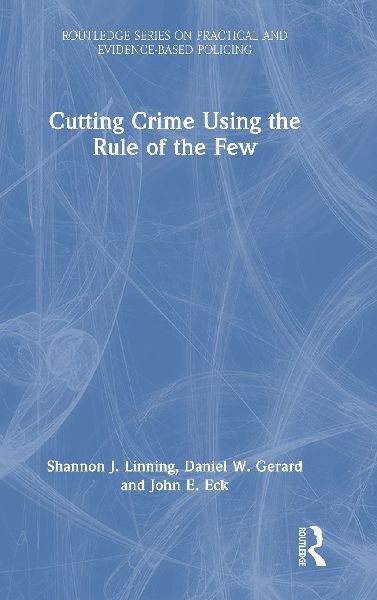
Cutting Crime Using the Rule of the Few
von Shannon J. Linning, Daniel W. Gerard und John E. Eck
- Einband
- Gebunden
- Seiten
- 354
- Sprache
- Englisch
- Erschienen
- Mai 2026
- Verlag
- Routledge
Buchbeschreibung
Based on decades of research, this book reveals how the rule of the few can redirect your focus to create effective crime control policies.
Many crime reduction strategies fail because they apply common crime fallacies. They assume that: solutions to crime need to be complicated, crime is widespread, residents matter the most, more arrests reduce crime, and police can solve all crime problems. At the heart of each fallacy is a failure to consider an old idea: the rule of the few.
Ganze Beschreibung lesenWeniger anzeigen
The rule of the few means a tiny fraction of inputs cause most of the outcomes. Research shows that solving problems at smaller scales can cut crime substantially, crime is highly concentrated at a few places in any city, only a few residents can usually effect change, only a few people commit most of the crime, and a few everyday people can dismantle crime opportunities.
Cutting Crime Using the Rule of the Few shows that crime is not merely a police problem. It explains how those who own or manage property and design the products we use have far more power to suppress crime opportunities than they realize. Cutting Crime reveals how to use the rule of the few to identify and solve crime problems.
It provides a set of tools and spells out specific strategies that the police, property owners, business owners, and government agencies can use to reduce crime. Just as it only takes a few to create a lot of crime, it only takes a few to prevent those crimes.
Inhaltsverzeichnis
- 1. The Hockey Stick Epiphany Part 1: How Many Get Crime Wrong
- 2. Is Crime Widespread?
- 3. Do Residents Matter Most?
- 4. Do Arrests Reduce Crime? Part 2: Re-Thinking Crime
- 5. Crime as a By-Product of Everyday Life
- 6. Small Wins That Count
- 7. The Power of Place Managers Part 3: What's Your Problem?
- 8. What is a Problem?
Ganzes Inhaltsverzeichnis anzeigen (17 Einträge)Weniger anzeigen
- 9. How Do Crime Problems Arise?
- 10. How Do We Fix Problems?
- 11. What If Place Managers Do Not Cooperate?
- 12. Won't Offenders Just Move Around the Corner? Part 4: Putting the Rule of the Few into Practice
- 13. Lessons from a Homicide Scene
- 14. Crime Radiation and Place Network Investigations
- 15. Deployment with a Purpose
- 16. Finding Public Characters
- 17. SCRAP What Does Not Work
Details
- Erscheinungstermin
- Mai 2026
- Kategorie
- Fremdsprachige Bücher
- Einband
- Gebunden
- Seiten
- 354
- Sprache
- Englisch
- Verlag
- Routledge
- Format
- 23,5 × 15,7 cm
- Dicke
- 2,4 cm
- Gewicht
- 616 g
- EAN / ISBN-13
- 9781032553313
Über Shannon J. Linning
Shannon J. Linning, PhD, is an Assistant Professor of Criminology at Simon Fraser University. She teaches courses in crime prevention, policing, and research methods.
Mehr über Shannon J. LinningWeniger anzeigen
Her research explores how the owners and managers of property can create safer areas by suppressing crime opportunities at and around their properties. Her research explores how the owners and managers of property can create safer areas by surpressing crime opportunities at and around their properties. Her research appears in many academic journals, and she is the co-author of books, including Place Management and Crime: Ownership and Property Rights as a Source of Social Control. Daniel W. Gerard, MS, is a retired captain and 32-year veteran of the Cincinnati, Ohio Police Department. He has published articles in both academic and practitioner journals and has served as an invited consultant, speaker, trainer, and instructor for numerous police agencies, universities, and organizations throughout the United States and Canada.
John E. Eck, PhD, is an Emeritus Professor of Criminal Justice at the University of Cincinnati. His work spans five decades, working with police agencies around the world, conducting research and developing thinking tools to aid crime prevention. He is one of the key architects of widely used crime problem-solving tools such as the SARA model, the crime problem triangle, the CHEERS criteria, and the General Problem-Solving Matrix. He has worked for the Police Executive Research Forum as its Research Director, the Washington/Baltimore High Intensity Drug Trafficking Area as its Evaluation Director, and at the University of Cincinnati, where he taught courses on police effectiveness, crime prevention, and professional writing.
Versand und Rückgabe
Standardversand: 1 bis 3 Werktage, 3,99 €, kostenlos ab 35 €
Liefergebiet: Deutschland
Rücksendung: 14 Tage Widerrufsrecht. Bei einem Widerruf tragen Sie die Kosten der Rücksendung. Bei einer Falschlieferung oder einem Fehler von uns erstatten wir Ihnen das Rückporto. Den Widerruf erklären Sie über den Knopf „Vertrag widerrufen“ im Fuß der Seite.
Hersteller und ProduktsicherheitRoutledge
Routledge
Europaallee 1
36244 Bad Hersfeld
Deutschland
gpsr@libri.de
Verantwortliche Person in der EU
Libri GmbHEuropaallee 1
36244 Bad Hersfeld
Deutschland
gpsr@libri.de
Ähnliche Titel

Fundamentals of Road Traffic Collision Investigation Hardcover
Matthias Schmidt
Gebunden, Englisch
154,90 €

Bewertungen
Zu diesem Titel gibt es noch keine Bewertung. Bewerten kann, wer ihn bei uns gekauft hat.
So prüfen wir Bewertungen
Eine Bewertung kann bei uns nur abgeben, wer den Titel über sein Kundenkonto bei uns gekauft hat. Jede Bewertung ist fest mit der zugehörigen Bestellung verknüpft; anders kommt sie technisch gar nicht zustande. Deshalb trägt jede angezeigte Bewertung den Hinweis „Verifizierter Kauf". Wir zeigen positive wie negative Bewertungen und löschen nur bei Rechtsverstößen. Für Bewertungen gibt es keine Gegenleistung.
256,60 €Voraussichtlich 4. bis 8. Dez.