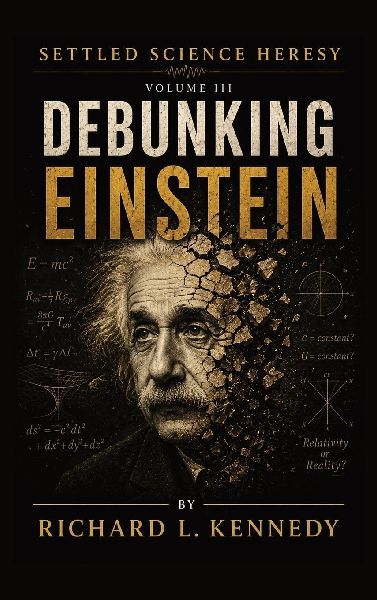
Debunking Einstein
- Einband
- Gebunden
- Seiten
- 156
- Sprache
- Englisch
- Erschienen
- November 2026
- Verlag
- Richard L. Kennedy
Buchbeschreibung
In 1919, photographs of stars near the eclipsed Sun helped make Albert Einstein the most celebrated scientist of his age.
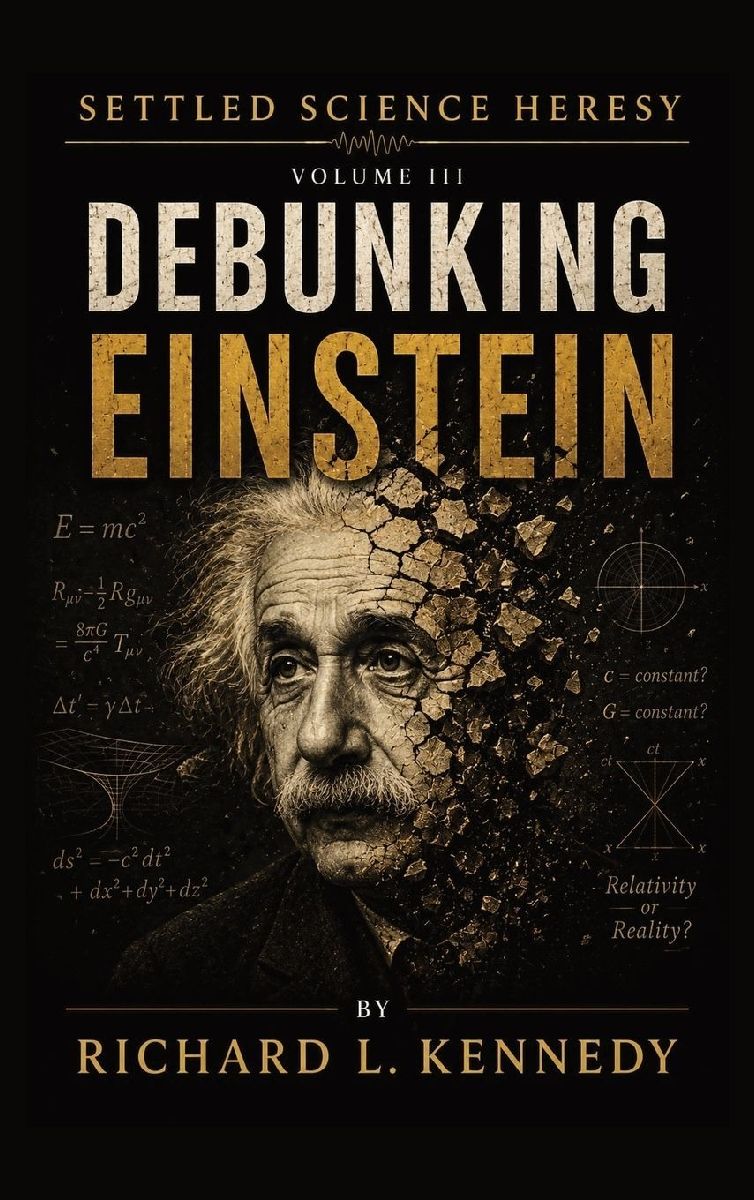
What did those photographs show? And how did a disputed measurement become a public verdict? In Debunking Einstein, Volume 3 of Settled Science Heresy, Richard L. Kennedy reopens the case.
Ganze Beschreibung lesenWeniger anzeigen
He takes readers to the eclipse expeditions on Príncipe and in Brazil, where astronomers set out to see whether starlight passing near the Sun appeared to shift by the amount Einstein predicted.
Follow the evidence from the photographic plates to the newspaper headlines and see how the uncertainties in the measurements gave way to a story of scientific revolution.
The eclipse is the first exhibit. Kennedy traces the gravitational constant back to Henry Cavendish's experiment with lead balls, which set out to determine the density of Earth. He follows Einstein's reasoning to the squared speed of light in E = mc² and asks what the equation tells us about the relationship between matter and energy.
Then he takes up one of the strangest pictures to emerge from relativity, a block universe in which the day you were born, the moment you are reading this, and the last day of your life all belong to the same spacetime structure.
The inquiry turns from the history of relativity to things you can picture and, in some cases, watch for yourself. Sand gathers into patterns on a vibrating plate. A collapsing bubble gives off a flash of light. Electrons arrive one at a time, leaving dots that build into bands on a screen. Add detectors to tell which slit the electrons pass through, and the bands disappear.
Each example gives the reader a concrete way to consider how motion produces patterns and how the way we observe an experiment affects what we see.
These examples lead to Kennedy's own account of time. A clock gives us two readings. Between them, your heart beats, a car passes, and a cloud crosses the sky. The readings give us points of reference. Kennedy argues that the changes themselves are what make up time.
The Royal Society's motto, Nullius in verba, gives the book its guiding instruction. Take nobody's word for it. Here is the evidence. What would your verdict be?
Details
- Erscheinungstermin
- November 2026
- Kategorie
- Fremdsprachige Bücher
- Einband
- Gebunden
- Seiten
- 156
- Sprache
- Englisch
- Verlag
- Richard L. Kennedy
- Format
- 23,5 × 15,7 cm
- Dicke
- 1,3 cm
- Gewicht
- 339 g
- EAN / ISBN-13
- 9798183162066
Versand und Rückgabe
Standardversand: 1 bis 3 Werktage, 3,99 €, kostenlos ab 35 €
Liefergebiet: Deutschland
Rücksendung: 14 Tage Widerrufsrecht. Bei einem Widerruf tragen Sie die Kosten der Rücksendung. Bei einer Falschlieferung oder einem Fehler von uns erstatten wir Ihnen das Rückporto. Den Widerruf erklären Sie über den Knopf „Vertrag widerrufen“ im Fuß der Seite.
Hersteller und ProduktsicherheitRichard L. Kennedy
Richard L. Kennedy
Europaallee 1
36244 Bad Hersfeld
Deutschland
gpsr@libri.de
Verantwortliche Person in der EU
Libri GmbHEuropaallee 1
36244 Bad Hersfeld
Deutschland
gpsr@libri.de
Mehr von Richard L. Kennedy
Ähnliche Titel
Bewertungen
Zu diesem Titel gibt es noch keine Bewertung. Bewerten kann, wer ihn bei uns gekauft hat.
So prüfen wir Bewertungen
Eine Bewertung kann bei uns nur abgeben, wer den Titel über sein Kundenkonto bei uns gekauft hat. Jede Bewertung ist fest mit der zugehörigen Bestellung verknüpft; anders kommt sie technisch gar nicht zustande. Deshalb trägt jede angezeigte Bewertung den Hinweis „Verifizierter Kauf". Wir zeigen positive wie negative Bewertungen und löschen nur bei Rechtsverstößen. Für Bewertungen gibt es keine Gegenleistung.
34,40 €Voraussichtlich 4. bis 8. Dez.