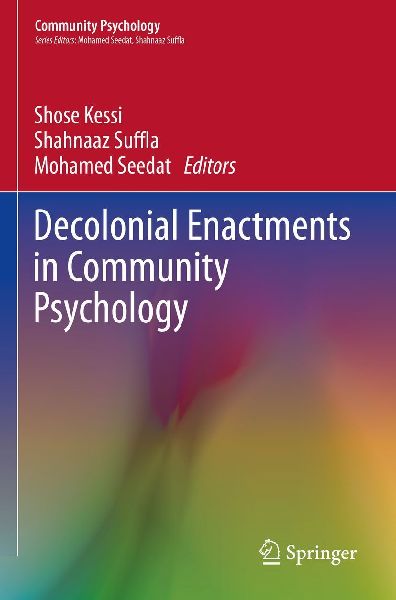
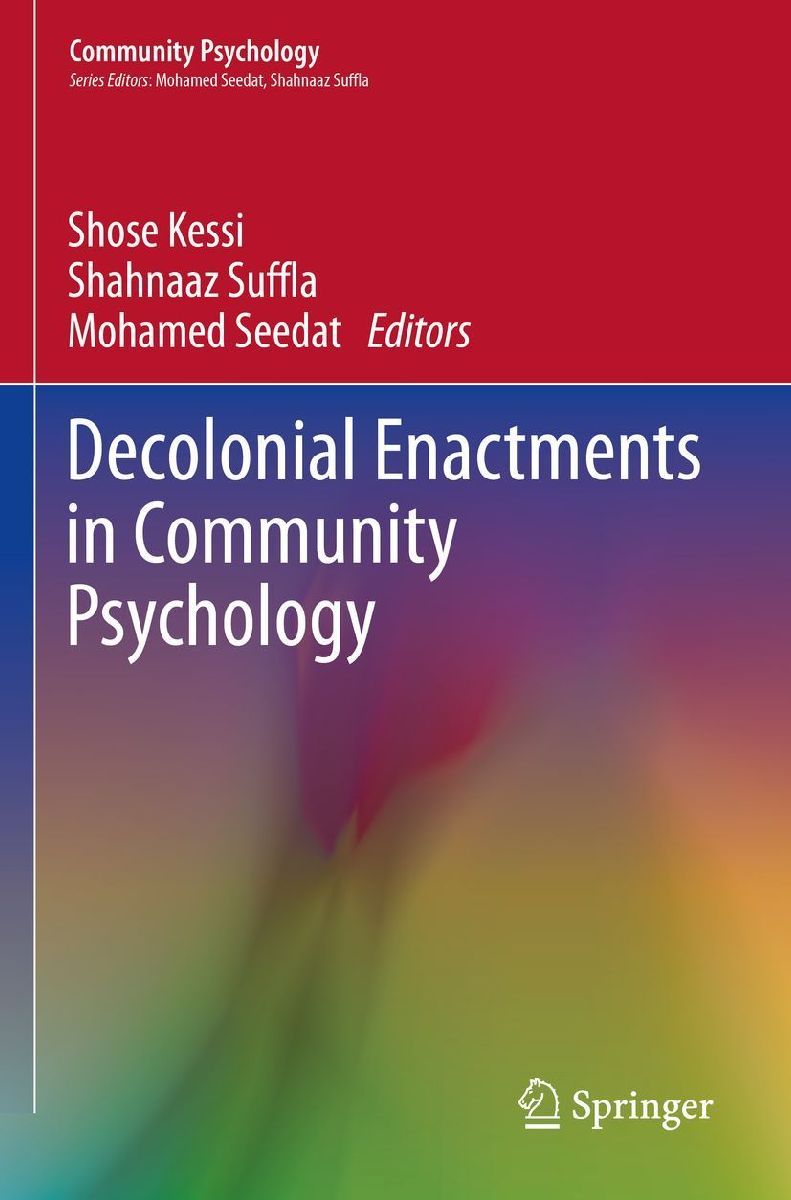
Decolonial Enactments in Community Psychology
Herausgegeben von: Shose Kessi, Herausgegeben von: Shahnaaz Suffla, Herausgegeben von: Mohamed Seedat
Aus der Reihe Community Psychology
- Einband
- Kartoniert
- Seiten
- 292
- Sprache
- Englisch
- Erschienen
- Dezember 2022
- Verlag
- Humana
Buchbeschreibung
This edited volume in the Community Psychology Book Series emphasizes applications of community psychology for disrupting dominant and hegemonic power relations.
The book explores domains of work that are located within critical community psychology, as well as work that is conventionally not self-defined as community psychology but which draws on and contributes to the foundations and enactments of critical and liberatory community psychology.
Ganze Beschreibung lesenWeniger anzeigen
Specifically, the book advances conceptions and praxes for community psychology grounded within a decolonial framework.
The volume heeds the call for a generation of approaches to community psychology that link local struggles to broader questions of power, identity, and knowledge production, bringing together examples of praxes from different contexts as a political project of highlighting indigenous struggles toward self-determination.
Collectively, the chapters in this book embody a decolonial agenda for community psychology that foregrounds social justice; the lives and knowledges of the marginalized and oppressed; epistemic disobedience and transdisciplinarity; and decolonial aesthetics. The book is divided into two parts - Part I: Conceptions of Engagement for Community Psychology delves into the conceptual framework for a decolonial community psychology, and Part II: Modes of Enactments and Praxes for Community Psychology builds on these theoretical advancements through examples of praxis in different contexts.
The audience for the book includes scholars, researchers, practitioners, activists, and students located within community psychology specifically, as well as disciplines within the health and social sciences, and arts and humanities more broadly.
Inhaltsverzeichnis
- Part I: Conceptions of Engagement for Community Psychology
- Chapter 1: Community Psychology in Historical Context: Power, Identity and Knowledge
- Chapter 2: The Coordinates of Decolonising Practice and Praxis in Community Psychology
- Chapter 3: Community and the Making of Community: Critiques and Critical Conceptions
- Chapter 4: Interrogating Dominant and Liberatory Narratives on Engagement in Community Psychology
- Chapter 5: Psycho-social Change and Africa-centred Community Psychology
- Decolonising Participatory Action Research in Community Psychology
- Part II: Modes of Enactments and Praxes for Community Psychology
Ganzes Inhaltsverzeichnis anzeigen (19 Einträge)Weniger anzeigen
- Chapter 7: M¿ori - and Aboriginal-centred Community Psychologies for Well-being and Self-determination
- Chapter 8: Everyday Violence and Everyday Peace: Interventions Towards Social Justice
- Chapter 9: Post-conflict Reconciliation and Community-based Restorative Justice
- Chapter 10: The Workings of Imagination and Memory in Resistance to Violence
- Chapter 11:Immigration and Sense of Community
- Chapter 12: Poverty and Sustainable Living
- Chapter 13: A Decolonising Approach to Health Promotion
- Chapter 14: Youth Activism and Community Change
- Chapter 15: Social Justice and Food Security: Intervening in Global South Contexts
- Chapter 16: The Politics and Praxis of Social Transformation: A Civil Society Perspective
- Conclusion: Re-imagining Praxis, Community, and Engagement
Details
- Erscheinungstermin
- Dezember 2022
- Kategorie
- Fremdsprachige Bücher
- Einband
- Kartoniert
- Seiten
- 292
- Sprache
- Englisch
- Verlag
- Humana
- Reihe
- Community Psychology
- Format
- 23,5 × 15,5 cm
- Dicke
- 1,6 cm
- Gewicht
- 446 g
- EAN / ISBN-13
- 9783030752033
Über Shose Kessi (Hrsg.)
Shose Kessi is Associate Professor in the Department of Psychology at the University of Cape Town (UCT) and Dean of the Faculty of Humanities.
Mehr über Shose Kessi (Hrsg.)Weniger anzeigen
Professor Kessi is the founder and the first chairperson of the UCT Black Academic Caucus (BAC), an organisation that has been a leader in the transformation debate at UCT. Her innovations in teaching and research, in addition to her contributions to institutional leadership, are an integral part of the project of transformation and decolonisation in higher education, and her focus on participatory action research also mitigates the epistemic violence of traditional research practices by bridging the gap between academic knowledges and the knowledges of marginalized communities. She received the Harvard-Mandela fellowship in 2014, the Erik Erickson Award for political psychology in 2018, has published extensively in journals, and was a visiting scholar at the London School of Economics and Political Science (LSE).Shahnaaz Suffla is Associate Professor at the Institute for Social and Health Sciences at the University of South Africa. Her research interests draw from the intersections of critical African, community and peace psychologies, and public health, and are located within liberatory philosophies and epistemologies. Her thinking and scholarship is influenced by the vision of research as a transforming, humanising and decolonising enterprise. Specifically, her research interests include a focus on psychosocial and psychopolitical interventions in contexts of structural and epistemic violence; participatory engagement as a site of activism, resistance and social change; and Africa-centred approaches to research and scholarship. Professor Suffla is actively engaged in organised psychology in South Africa, and is currently the President-Elect of the Psychological Society of South Africa.
Mohamed Seedat is Professor and Head of the Institute for Social and Health Sciences at the University of South
Africa. With a background in transdisciplinary thought, he writes about community engagement, social connectivity and solidarity, violence, critical humanism, intellectual traditions in science, and the psychologies underlying South Africa's ongoing and renewed struggles for a decolonised caring society. His body of work, inclusive of regional and international collaborations, contributes to compassionate emancipatory scholarship for the 21st century, the capacitation of next generation socially-engaged researchers and academic leaders, and the transformation of writing cultures in the academy. He is currently leading studies on the social anatomy of protests, psychopolitics underlying struggles for justice, and safety promotion demonstration sites. Professor Seedat is a vision-making and strategic development facilitator and life-oriented academic coach, mentor and post-graduate student supervisor. He has published widely in his areas of interest.
Versand und Rückgabe
Standardversand: 1 bis 3 Werktage, 3,99 €, kostenlos ab 35 €
Liefergebiet: Deutschland
Rücksendung: 14 Tage Widerrufsrecht. Bei einem Widerruf tragen Sie die Kosten der Rücksendung. Bei einer Falschlieferung oder einem Fehler von uns erstatten wir Ihnen das Rückporto. Den Widerruf erklären Sie über den Knopf „Vertrag widerrufen“ im Fuß der Seite.
Hersteller und ProduktsicherheitSpringer Nature Customer Service Center GmbH
Springer Nature Customer Service Center GmbH
Europaplatz 3
69115 Heidelberg
Deutschland
ProductSafety@springernature.com
Mehr aus der Reihe Community Psychology
Handbook of Decolonial Community Psychology
Christopher C. Sonn (Hrsg.)
Kartoniert, Englisch, 2 Ausgaben
ab 299,59 €

For an Anti-capitalist Psychology of Community
Nick Malherbe
Gebunden, Englisch, 2 Ausgaben
ab 117,69 €
Ähnliche Titel


International Perspectives on Gender-Based Violence
Madhumita Pandey (Hrsg.)
Gebunden, Englisch, 2 Ausgaben
ab 171,19 €
Emancipatory and Participatory Methodologies in Peace, Critical, and Community Psychology
Mohamed Seedat (Hrsg.)
Gebunden, Englisch, 2 Ausgaben
ab 117,69 €

Interdisciplinary Perspectives on Fairness, Equity, and Justice
Meng Li (Hrsg.)
Gebunden, Englisch, 2 Ausgaben
ab 106,99 €
Bewertungen
Zu diesem Titel gibt es noch keine Bewertung. Bewerten kann, wer ihn bei uns gekauft hat.
So prüfen wir Bewertungen
Eine Bewertung kann bei uns nur abgeben, wer den Titel über sein Kundenkonto bei uns gekauft hat. Jede Bewertung ist fest mit der zugehörigen Bestellung verknüpft; anders kommt sie technisch gar nicht zustande. Deshalb trägt jede angezeigte Bewertung den Hinweis „Verifizierter Kauf". Wir zeigen positive wie negative Bewertungen und löschen nur bei Rechtsverstößen. Für Bewertungen gibt es keine Gegenleistung.
149,79 €Voraussichtlich 2. bis 4. Dez.