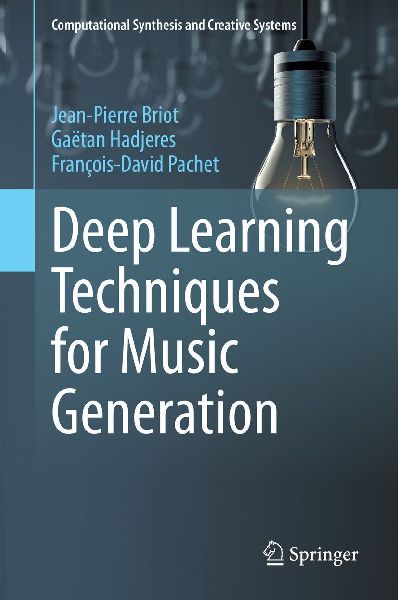
Deep Learning Techniques for Music Generation
von Jean-Pierre Briot, Gaëtan Hadjeres und François-David Pachet
Aus der Reihe Computational Synthesis and Creative Systems
- Einband
- Gebunden
- Seiten
- 312
- Sprache
- Englisch
- Erschienen
- November 2019
- Verlag
- Springer
Buchbeschreibung
This book is a survey and analysis of how deep learning can be used to generate musical content.
The authors offer a comprehensive presentation of the foundations of deep learning techniques for music generation. They also develop a conceptual framework used to classify and analyze various types of architecture, encoding models, generation strategies, and ways to control the generation.
Ganze Beschreibung lesenWeniger anzeigen
The five dimensions of this framework are: objective (the kind of musical content to be generated, e.g., melody, accompaniment); representation (the musical elements to be considered and how to encode them, e.g., chord, silence, piano roll, one-hot encoding); architecture (the structure organizing neurons, their connexions, and the flow of their activations, e.g., feedforward, recurrent, variational autoencoder); challenge (the desired properties and issues, e.g., variability, incrementality, adaptability); and strategy (the way to model and control the process of generation, e.g., single-step feedforward, iterative feedforward, decoder feedforward, sampling).
To illustrate the possible design decisions and to allow comparison and correlation analysis they analyze and classify more than 40 systems, and they discuss important open challenges such as interactivity, originality, and structure. The authors have extensive knowledge and experience in all related research, technical, performance, and business aspects.
The book is suitable for students, practitioners, and researchers in the artificial intelligence, machine learning, and music creation domains. The reader does not require any prior knowledge about artificial neural networks, deep learning, or computer music. The text is fully supported with a comprehensive table of acronyms, bibliography, glossary, and index, and supplementary material is available from the authors' website.
Inhaltsverzeichnis
- Introduction
- Method
- Objective
- Representation
- Architecture
- Challenge and Strategy
- Analysis
- Discussion and Conclusion
Details
- Erscheinungstermin
- November 2019
- Kategorie
- Fremdsprachige Bücher
- Einband
- Gebunden
- Seiten
- 312
- Sprache
- Englisch
- Verlag
- Springer
- Reihe
- Computational Synthesis and Creative Systems
- Format
- 24,1 × 16,0 cm
- Dicke
- 2,3 cm
- Gewicht
- 583 g
- EAN / ISBN-13
- 9783319701622
Versand und Rückgabe
Standardversand: 1 bis 3 Werktage, 3,99 €, kostenlos ab 35 €
Liefergebiet: Deutschland
Rücksendung: 14 Tage Widerrufsrecht. Bei einem Widerruf tragen Sie die Kosten der Rücksendung. Bei einer Falschlieferung oder einem Fehler von uns erstatten wir Ihnen das Rückporto. Den Widerruf erklären Sie über den Knopf „Vertrag widerrufen“ im Fuß der Seite.
Hersteller und ProduktsicherheitSpringer Nature Customer Service Center GmbH
Springer Nature Customer Service Center GmbH
Europaplatz 3
69115 Heidelberg
Deutschland
ProductSafety@springernature.com
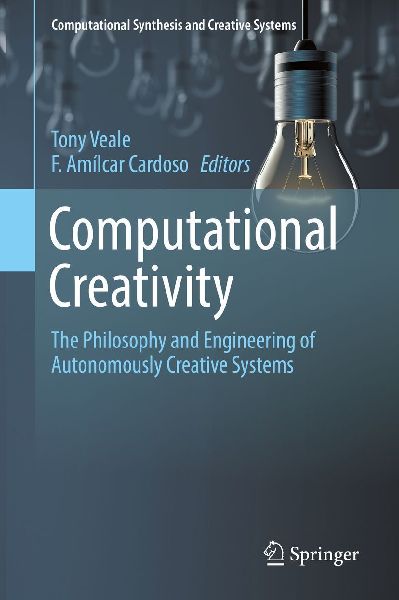
Mehr aus der Reihe Computational Synthesis and Creative Systems
Artificial Intelligence and the Arts
Penousal Machado (Hrsg.)
Gebunden, Englisch, 2 Ausgaben
ab 213,99 €

Bewertungen
Zu diesem Titel gibt es noch keine Bewertung. Bewerten kann, wer ihn bei uns gekauft hat.
So prüfen wir Bewertungen
Eine Bewertung kann bei uns nur abgeben, wer den Titel über sein Kundenkonto bei uns gekauft hat. Jede Bewertung ist fest mit der zugehörigen Bestellung verknüpft; anders kommt sie technisch gar nicht zustande. Deshalb trägt jede angezeigte Bewertung den Hinweis „Verifizierter Kauf". Wir zeigen positive wie negative Bewertungen und löschen nur bei Rechtsverstößen. Für Bewertungen gibt es keine Gegenleistung.
149,79 €Voraussichtlich 4. bis 8. Dez.