"Genesis" - der theologische Sinn des kosmologischen Standardmodells der Physik
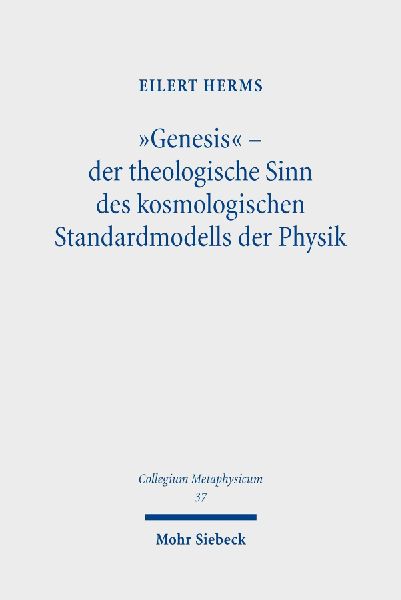
Eilert Herms
Gebunden
94,00 €
Darstellung und Kritik klassischer Versuche sowie eine Reformulierung anhand der Feinabstimmung der physikalischen Naturkonstanten und kosmologischen Anfangswerte
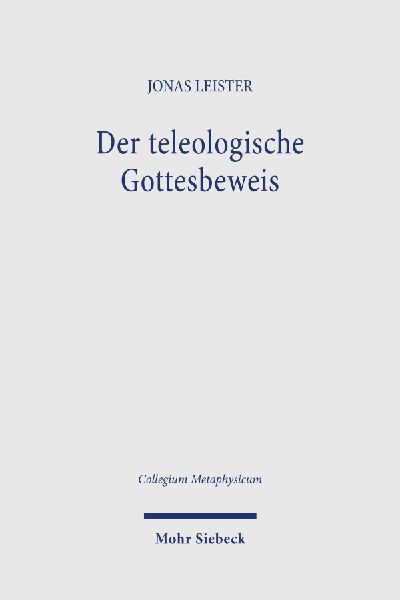
von Jonas Leister
Aus der Reihe Collegium Metaphysicum
Jonas Leister addresses the phenomenon of fine-tuning in a comprehensive scientific, philosophical, and philosophy-of-religion analysis.
Drawing on current examples of the fine-tuning of the constants of nature from particle physics and cosmology, he demonstrates with precision, on the basis of Bayesian probability theory, the extent to which this phenomenon calls for explanation.
Furthermore, the explanatory demand posed by fine-tuning is defended against contemporary objections, such as the so-called „problem of old evidence,“ on the basis of epistemology and Objective Bayesianism.
The subsequent part presents all major explanatory approaches to fine-tuning and offers a detailed assessment of their respective explanatory power. In particular, the explanations provided by the anthropic principle, a theory of everything, a multiverse, and a design hypothesis are systematically introduced and examined. Both the strong and weak versions of the anthropic principle are analysed in detail.
The analysis of a final physical theory, or theory of everything, is, for the first time, consistently and comprehensively guided by criteria derived from the philosophy of science, with a high degree of analytical precision. The most extensive treatment is devoted to the multiverse hypothesis. Here, multiverse theories based on string theory and cosmological inflation are examined alongside those derived from big bounce models and from theories of the evolutionary development of black holes.
Drawing on the current scholarly literature on multiverse theories, the status of their empirical confirmation is presented and critically assessed. A substantial portion of the study is devoted to the question of what empirical evidence would suffice, from the standpoint of the philosophy of science, to regard a multiverse as confirmed, and whether the current state of research permits an inference from fine-tuning to the existence of a multiverse.
The design hypothesis is analysed in light of the empiricist philosophical tradition, particularly through engagement with David Hume. Against the background of Kant's critique, the idealism of the later Schelling, and Hegel's critique of the proofs of God's existence, a distinctive position is developed that demonstrates the success of the teleological argument.
At the same time, it is shown that, given empiricist foundational premises, teleological deism possesses a higher probability than classical theism.
Geboren 1991; 2025 Promotion an der Eberhard Karls Universität Tübingen; Projektingenieur für Photovoltaik in Essen.
Standardversand: 1 bis 3 Werktage, 3,99 €, kostenlos ab 35 €
Liefergebiet: Deutschland
Rücksendung: 14 Tage Widerrufsrecht. Bei einem Widerruf tragen Sie die Kosten der Rücksendung. Bei einer Falschlieferung oder einem Fehler von uns erstatten wir Ihnen das Rückporto. Den Widerruf erklären Sie über den Knopf „Vertrag widerrufen“ im Fuß der Seite.
Eilert Herms
Gebunden
94,00 €
Zu diesem Titel gibt es noch keine Bewertung. Bewerten kann, wer ihn bei uns gekauft hat.