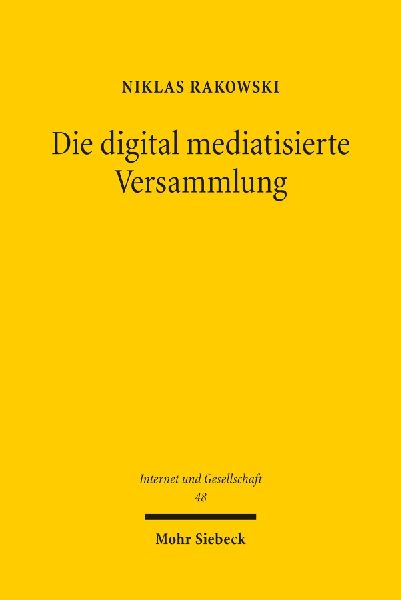
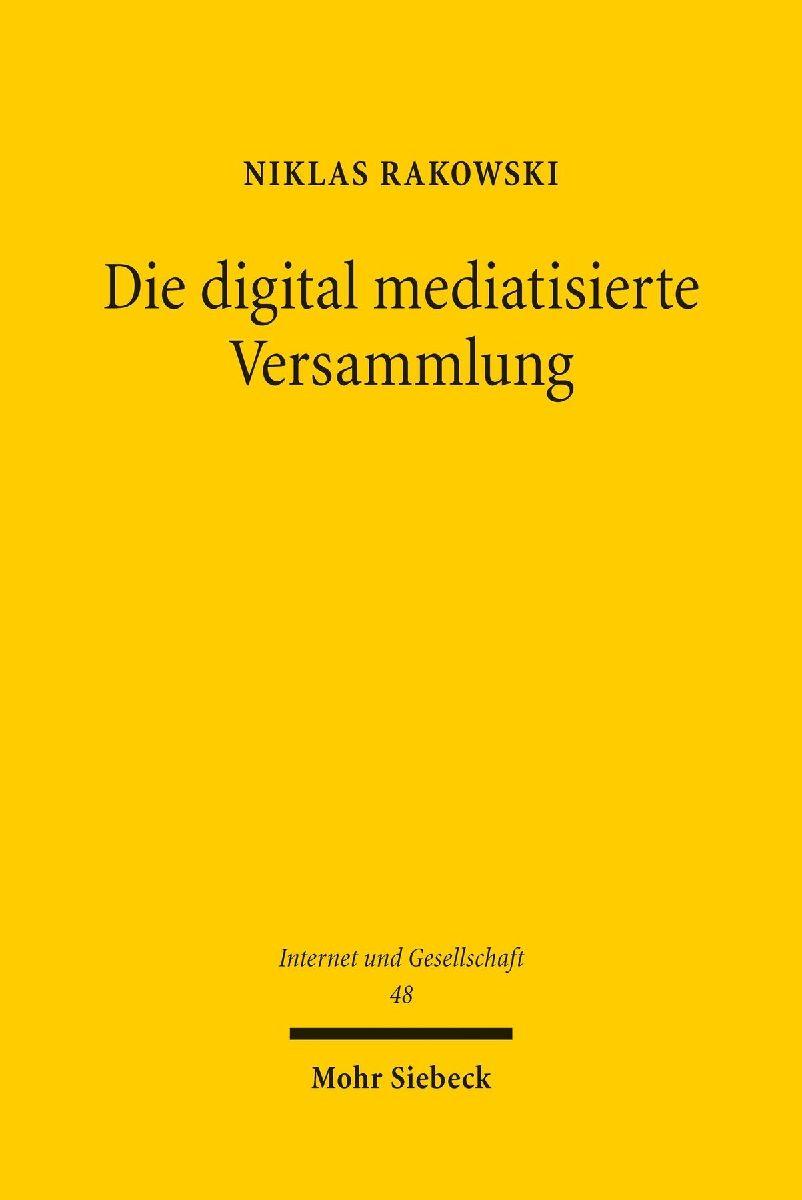
Die digital mediatisierte Versammlung
Gewährleistung eines demokratischen Grundrechts in der digitalen Konstellation
von Niklas Rakowski
Aus der Reihe Internet und Gesellschaft
- Einband
- Kartoniert
- Seiten
- 380
- Sprache
- Deutsch
- Erschienen
- November 2026
- Verlag
- Mohr Siebeck GmbH & Co. K
Buchbeschreibung
Niklas Rakowski draws on insights from Science and Technology Studies, social movement research, political theory, and interaction sociology.
To capture more precisely the interplay between technology and society, he introduces the conceptual framework of the „digital constellation.“
Ganze Beschreibung lesenWeniger anzeigen
The core of the work is an interpretation of the normative content of the freedom of assembly, based on the classical methods of legal interpretation: wording, legal history, systematic context, international and European law references, as well as functional considerations.
It becomes evident that this fundamental right does not inherently require a physical form of manifestation. Physical presence is not an end in itself; rather, it serves specific functions that can also be fulfilled through digitally mediated interaction. What is decisive is not spatial co-presence, but whether the concrete configuration allows for the realization of key characteristics of an assembly: the identifiable appearance of participants, their mutual perceptibility, and a continuous, sequential possibility of exchange.
Synchronous action is not required. Under these conditions, chat groups, hashtag collectives, or interactive video livestreams may also attain the quality of an assembly.
The author identifies a partial gap in the framework of fundamental rights protection and, on a solid doctrinal basis, assigns the fleeting, collective, and digitally mediated organizational element to the scope of protection of Article 8(1) of the German Basic Law.
Because this approach is grounded in the structural components of assemblies rather than in specific applications, it remains robust even with regard to future forms of collective organization.
Inhaltsverzeichnis
- A. Einleitung
- B. Kollektive Entfaltung in der digitalen Konstellation
- I. Rechtliche Reflexion digitaler Wandlungsprozesse
- II. Digital mediatisierte Kollektivität
- III. Erste Anknüpfungspunkte in der Rechtsprechung
- IV. Repression digital mediatisierter Kollektivität und grundrechtliches Schutzniveau
- C. Grundzüge der Versammlungsfreiheit
- I. Ursprünge der Versammlungsfreiheit
Ganzes Inhaltsverzeichnis anzeigen (20 Einträge)Weniger anzeigen
- II. Verfassungssystematische Verortung
- III. Funktionen der Versammlungsfreiheit
- IV. Versammlungskomponenten
- V. Zur körperlichen Prägung der Versammlungsfreiheit
- D. Interpretation des versammlungsfreiheitlichen Normgehalts
- I. Divergierende Zugangsebenen - II. Öffnung des Versammlungsbegriffs
- III. Rechtshistorische Bezüge
- IV. Systematische Orientierungspunkte
- V. Anleihen aus dem Völker- und Europarecht
- VI. Vergleichbare Funktionsleistungen
- VII. Zwischenfazit
- E. Latente Versammlungsambiguitäten
Details
- Erscheinungstermin
- November 2026
- Kategorie
- Fachbuch
- Einband
- Kartoniert
- Seiten
- 380
- Sprache
- Deutsch
- Verlag
- Mohr Siebeck GmbH & Co. K
- Reihe
- Internet und Gesellschaft
- Format
- 23,2 × 15,5 cm
- EAN / ISBN-13
- 9783162007384
Über Niklas Rakowski
Geboren 1989; 2025 Promotion (HU Berlin); Legal and Policy Officer, AI Office, DG CNECT, Europäische Kommission, Brüssel (Belgien).
Versand und Rückgabe
Standardversand: 1 bis 3 Werktage, 3,99 €, kostenlos ab 35 €
Liefergebiet: Deutschland
Rücksendung: 14 Tage Widerrufsrecht. Bei einem Widerruf tragen Sie die Kosten der Rücksendung. Bei einer Falschlieferung oder einem Fehler von uns erstatten wir Ihnen das Rückporto. Den Widerruf erklären Sie über den Knopf „Vertrag widerrufen“ im Fuß der Seite.
Hersteller und ProduktsicherheitJana Trispel
Mehr aus der Reihe Internet und Gesellschaft




Bewertungen
Zu diesem Titel gibt es noch keine Bewertung. Bewerten kann, wer ihn bei uns gekauft hat.
So prüfen wir Bewertungen
Eine Bewertung kann bei uns nur abgeben, wer den Titel über sein Kundenkonto bei uns gekauft hat. Jede Bewertung ist fest mit der zugehörigen Bestellung verknüpft; anders kommt sie technisch gar nicht zustande. Deshalb trägt jede angezeigte Bewertung den Hinweis „Verifizierter Kauf". Wir zeigen positive wie negative Bewertungen und löschen nur bei Rechtsverstößen. Für Bewertungen gibt es keine Gegenleistung.
94,00 €Erscheint 11/2026