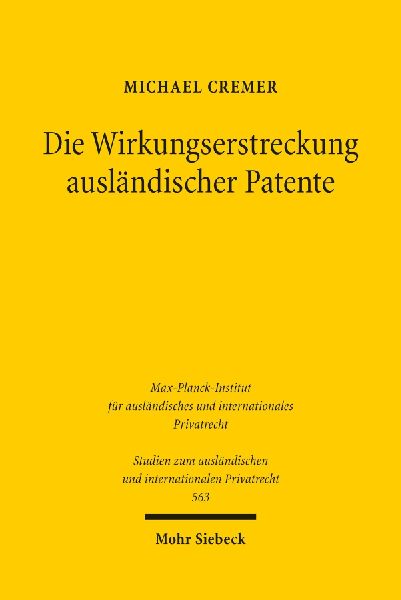
Die Wirkungserstreckung ausländischer Patente
Grenzüberschreitender Patentschutz durch Kollisionsrecht
von Michael Cremer
Aus der Reihe Studien zum ausländischen und internationalen Privatrecht
- Einband
- Kartoniert
- Seiten
- 500
- Sprache
- Deutsch
- Erschienen
- November 2026
- Verlag
- Mohr Siebeck GmbH & Co. K
Buchbeschreibung
Patent law is traditionally territorial in nature: patents provide protection only in the state that grants them and have no effect abroad.
While this territoriality has deep historical roots, it sits uneasily with global markets and the worldwide disclosure of inventions. Michael Cremer takes this tension as a starting point to question the territorial conception of patent law.
Ganze Beschreibung lesenWeniger anzeigen
He explores whether, and to what extent, cross-border patent protection can and should be achieved by extending the effects of foreign patents into the domestic legal order.
Cremer first demonstrates that territoriality is an umbrella term for several distinct legal principles, most notably the geographically limited effect of patents and the prohibition of substitution. The fragmentation of patent protection, however, ultimately results from each state's conflict-of-laws decision to deny foreign patents legal significance within its own legal system.
The author shows that the territorial limitation of patent law is primarily rooted in history. It emerged from the development of patent law out of early invention privileges and reflected the original purpose of patent protection: importing knowledge that was already known abroad into the domestic sphere.
Subsequent developments in patent law had little impact on this territorial framework because of the field's early internationalization through the Paris Convention of 1883.
From a contemporary perspective, there is no compelling reason for the territorial fragmentation of patent law. Extending the effects of patents through conflict-of-laws rules would allow states to cooperate more closely in promoting global innovation while still maintaining sufficient control over the influence of foreign law.
Finally, Michael Cremer turns to the practical implementation of such an extension of effects and examines four different conflict-of-laws approaches: applying foreign patent law, protecting foreign patents as acquired rights, recognizing foreign patent grants as administrative acts, and substituting domestic patents for foreign ones.
He concludes that recognition is the preferable solution, as it enables nuanced outcomes while providing a high degree of legal certainty.
Inhaltsverzeichnis
- Einleitung
- Teil 1 - Grundstrukturen des Patent- und Patentkollisionsrechts
- § 1 Funktionen und Grundzüge des materiellen Patentrechts
- § 2 Territoriale Begrenzung des Patentrechts
- § 3 Instrumente für transnationalen Patentschutz de lege lata
- § 4 Patentkollisionsrecht
- § 5 Territoriale Aufspaltung des Patentschutzes durch das Kollisionsrecht
- Teil 2 - Historie und Legitimation der territorialen Struktur des Patentrechts
Ganzes Inhaltsverzeichnis anzeigen (23 Einträge)Weniger anzeigen
- Abschnitt 1 - Historie der territorialen Struktur des Patentrechts
- § 6 Historische Entwicklung des (internationalen) Erfindungsschutzes bis zur Pariser Verbandsübereinkunft
- § 7 Versteinerung des internationalen Patentrechts durch die Pariser Verbandsübereinkunft
- Abschnitt 2 - Heutige Rechtfertigung der territorialen Struktur des Patentrechts
- § 8 Vorgaben aus dem Völkerrecht
- § 9 Grundlegende Eigenschaften des Patentschutzes
- § 10 Rechtsdogmatische und rechtspolitische Rechtfertigung
- Teil 3 - Wirkungserstreckung ausländischer Patente
- § 11 Grundlagen und Umsetzungsmethoden der Wirkungserstreckung
- § 12 Verweisung auf ausländisches Patentrecht
- § 13 Schutz ausländischer Patente als wohlerworbene Rechte
- § 14 Verwaltungsrechtliche Anerkennung ausländischer Patenterteilungen
- § 15 Substitution des inländischen Patents
- § 16 Bewertung der Wirkungserstreckung
- Zusammenfassung der wesentlichen Ergebnisse
Details
- Erscheinungstermin
- November 2026
- Kategorie
- Fachbuch
- Einband
- Kartoniert
- Seiten
- 500
- Sprache
- Deutsch
- Verlag
- Mohr Siebeck GmbH & Co. K
- Reihe
- Studien zum ausländischen und internationalen Privatrecht
- Format
- 23,2 × 15,5 cm
- EAN / ISBN-13
- 9783162010438
Über Michael Cremer
Geboren 1993; Studium der Rechtswissenschaft in Hamburg, New York und Oxford; Wissenschaftlicher Assistent am Max-Planck-Institut für ausländisches und internationales Privatrecht, Hamburg; …
Mehr über Michael CremerWeniger anzeigen
Geboren 1993; Studium der Rechtswissenschaft in Hamburg, New York und Oxford; Wissenschaftlicher Assistent am Max-Planck-Institut für ausländisches und internationales Privatrecht, Hamburg; Rechtsreferendariat am Hanseatischen Oberlandesgericht, Hamburg; 2026 Promotion (Hamburg).
Versand und Rückgabe
Standardversand: 1 bis 3 Werktage, 3,99 €, kostenlos ab 35 €
Liefergebiet: Deutschland
Rücksendung: 14 Tage Widerrufsrecht. Bei einem Widerruf tragen Sie die Kosten der Rücksendung. Bei einer Falschlieferung oder einem Fehler von uns erstatten wir Ihnen das Rückporto. Den Widerruf erklären Sie über den Knopf „Vertrag widerrufen“ im Fuß der Seite.
Hersteller und ProduktsicherheitJana Trispel
Mehr von Michael Cremer


Mehr aus der Reihe Studien zum ausländischen und internationalen Privatrecht



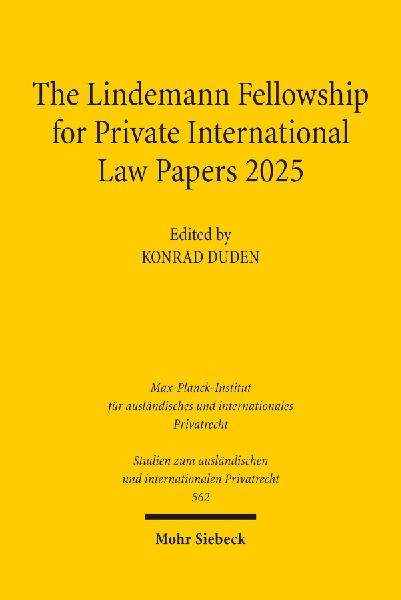
The Lindemann Fellowship for Private International Law Papers 2025
Konrad Duden (Hrsg.)
Kartoniert, Englisch
79,00 €
Bewertungen
Zu diesem Titel gibt es noch keine Bewertung. Bewerten kann, wer ihn bei uns gekauft hat.
So prüfen wir Bewertungen
Eine Bewertung kann bei uns nur abgeben, wer den Titel über sein Kundenkonto bei uns gekauft hat. Jede Bewertung ist fest mit der zugehörigen Bestellung verknüpft; anders kommt sie technisch gar nicht zustande. Deshalb trägt jede angezeigte Bewertung den Hinweis „Verifizierter Kauf". Wir zeigen positive wie negative Bewertungen und löschen nur bei Rechtsverstößen. Für Bewertungen gibt es keine Gegenleistung.
109,00 €Erscheint 11/2026