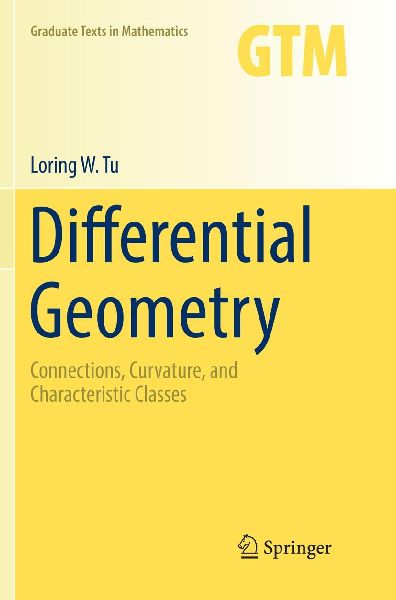
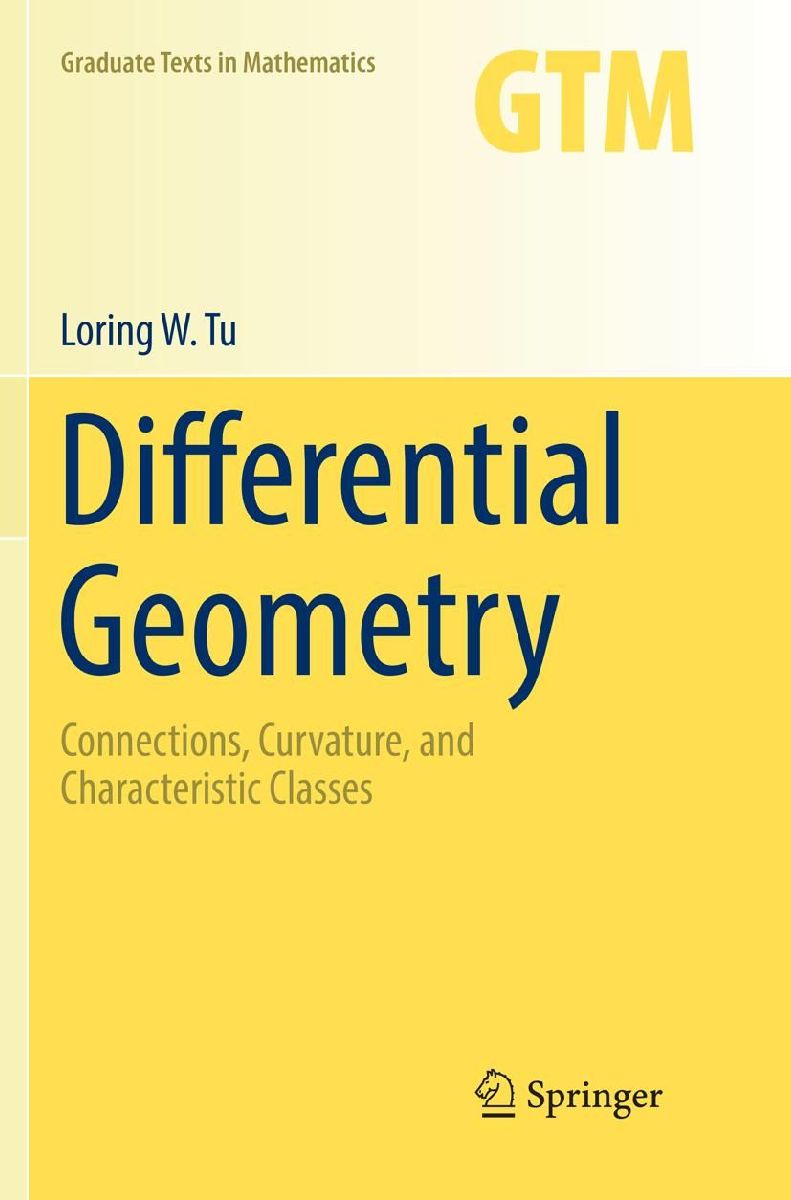
Differential Geometry
Connections, Curvature, and Characteristic Classes
von Loring W. Tu
Aus der Reihe Graduate Texts in Mathematics
- Einband
- Kartoniert
- Seiten
- 368
- Sprache
- Englisch
- Erschienen
- August 2018
- Verlag
- Springer
Buchbeschreibung
This text presents a graduate-level introduction to differential geometry for mathematics and physics students.
The exposition follows the historical development of the concepts of connection and curvature with the goal of explaining the Chern-Weil theory of characteristic classes on a principal bundle. Along the way we encounter some of the high points in the history of differential geometry, for example, Gauss' Theorema Egregium and the Gauss-Bonnet theorem.
Ganze Beschreibung lesenWeniger anzeigen
Exercises throughout the book test the reader's understanding of the material and sometimes illustrate extensions of the theory. Initially, the prerequisites for the reader include a passing familiarity with manifolds. After the first chapter, it becomes necessary to understand and manipulate differential forms. A knowledge of de Rham cohomology is required for the last third of the text.
Prerequisite material is contained in author's text An Introduction to Manifolds, and can be learned in one semester. For the benefit of the reader and to establish common notations, Appendix A recalls the basics of manifold theory. Additionally, in an attempt to make the exposition more self-contained, sections on algebraic constructions such as the tensor product and the exterior power are included.
Differential geometry, as its name implies, is the study of geometry using differential calculus. It dates back to Newton and Leibniz in the seventeenth century, but it was not until the nineteenth century, with the work of Gauss on surfaces and Riemann on the curvature tensor, that differential geometry flourished and its modern foundation was laid.
Over the past one hundred years, differential geometry has proven indispensable to an understanding of the physical world, in Einstein's general theory of relativity, in the theory of gravitation, in gauge theory, and now in string theory. Differential geometry is also useful in topology, several complex variables, algebraic geometry, complex manifolds, and dynamical systems, among other fields.
The field has even found applications to group theory as in Gromov's work and to probability theory as in Diaconis's work. It is not too far-fetched to argue that differential geometry should be in every mathematician's arsenal.
Inhaltsverzeichnis
- Preface
- Chapter 1. Curvature and Vector Fields
- 1. Riemannian Manifolds
- 2. Curves
- 3. Surfaces in Space
- 4. Directional Derivative in Euclidean Space
- 5. The Shape Operator
- 6. Affine Connections
Ganzes Inhaltsverzeichnis anzeigen (45 Einträge)Weniger anzeigen
- 7. Vector Bundles
- 8. Gauss's Theorema Egregium
- 9. Generalizations to Hypersurfaces in Rn+1
- Chapter 2. Curvature and Differential Forms
- 10. Connections on a Vector Bundle
- 11. Connection, Curvature, and Torsion Forms
- 12. The Theorema Egregium Using Forms
- Chapter 3. Geodesics
- 13. More on Affine Connections
- 14. Geodesics
- 15. Exponential Maps
- 16. Distance and Volume
- 17. The Gauss-Bonnet Theorem
- Chapter 4. Tools from Algebra and Topology
- 18. The Tensor Product and the Dual Module
- 19. The Exterior Power
- 20. Operations on Vector Bundles
- 21. Vector-Valued Forms
- Chapter 5. Vector Bundles and Characteristic Classes
- 22. Connections and Curvature Again
- 23. Characteristic Classes
- 24. Pontrjagin Classes
- 25. The Euler Class and Chern Classes
- 26. Some Applications of Characteristic Classes
- Chapter 6. Principal Bundles and Characteristic Classes
- 27. Principal Bundles
- 28. Connections on a Principal Bundle
- 29. Horizontal Distributions on a Frame Bundle
- 30. Curvature on a Principal Bundle
- 31. Covariant Derivative on a Principal Bundle
- 32. Character Classes of Principal Bundles
- A. Manifolds
- B. Invariant Polynomials
- Hints and Solutions to Selected End-of-Section Problems
- List of Notations
- References
- Index
Details
- Erscheinungstermin
- August 2018
- Kategorie
- Fremdsprachige Bücher
- Einband
- Kartoniert
- Seiten
- 368
- Sprache
- Englisch
- Verlag
- Springer
- Reihe
- Graduate Texts in Mathematics
- Format
- 23,5 × 15,5 cm
- Dicke
- 1,9 cm
- Gewicht
- 624 g
- EAN / ISBN-13
- 9783319855622
Versand und Rückgabe
Standardversand: 1 bis 3 Werktage, 3,99 €, kostenlos ab 35 €
Liefergebiet: Deutschland
Rücksendung: 14 Tage Widerrufsrecht. Bei einem Widerruf tragen Sie die Kosten der Rücksendung. Bei einer Falschlieferung oder einem Fehler von uns erstatten wir Ihnen das Rückporto. Den Widerruf erklären Sie über den Knopf „Vertrag widerrufen“ im Fuß der Seite.
Hersteller und ProduktsicherheitSpringer Nature Customer Service Center GmbH
Springer Nature Customer Service Center GmbH
Europaplatz 3
69115 Heidelberg
Deutschland
ProductSafety@springernature.com
Mehr von Loring W. Tu

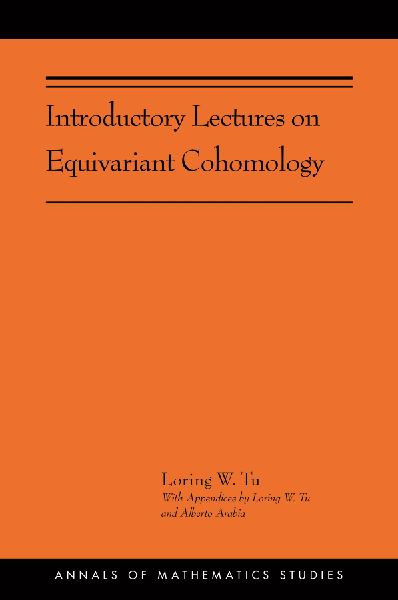
Introductory Lectures on Equivariant Cohomology
Loring W. Tu
Kartoniert, Englisch, 2 Ausgaben
ab 94,50 €

Mehr aus der Reihe Graduate Texts in Mathematics
Ähnliche Titel
Bewertungen
Zu diesem Titel gibt es noch keine Bewertung. Bewerten kann, wer ihn bei uns gekauft hat.
So prüfen wir Bewertungen
Eine Bewertung kann bei uns nur abgeben, wer den Titel über sein Kundenkonto bei uns gekauft hat. Jede Bewertung ist fest mit der zugehörigen Bestellung verknüpft; anders kommt sie technisch gar nicht zustande. Deshalb trägt jede angezeigte Bewertung den Hinweis „Verifizierter Kauf". Wir zeigen positive wie negative Bewertungen und löschen nur bei Rechtsverstößen. Für Bewertungen gibt es keine Gegenleistung.
58,84 €Voraussichtlich 1. bis 3. Dez.