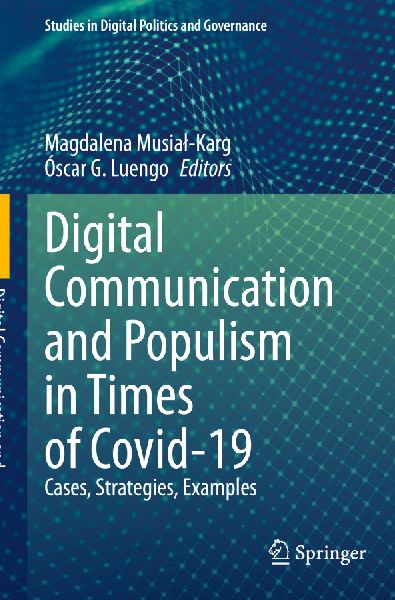
Digital Communication and Populism in Times of Covid-19
Cases, Strategies, Examples
von Magdalena Musia¿-Karg (Hrsg.)
Herausgegeben von: Magdalena Musia¿-Karg, Herausgegeben von: Óscar G. Luengo
Aus der Reihe Studies in Digital Politics and Governance
- Einband
- Kartoniert
- Seiten
- 216
- Sprache
- Englisch
- Erschienen
- September 2024
- Verlag
- Springer
Buchbeschreibung
Chapter 1. The Digital Present and the Future of Political Communication; Introduction and Prospects.
Ganze Beschreibung lesenWeniger anzeigen
- Part 1. Digital Methodologies.
- Chapter 2. New Methodological Perspectives in Political Communication Research: Machine Learning and Algorithms.
- Chapter 3. Feminist Framing in Times of Pandemic: an Analysis of the Spanish Case.
- Chapter 4. Ten Years of Immigration: Ten Years of Polarisation? Natural Language Processing Techniques for the Study of the Andalusian Case.
- Part 2. Case Studies.
- Chapter 5. Social Media as an Information and Voter Activity Tool on the Example of the 2020 Presidential Election in Poland.
- Chapter 6. Digital Disinformation During the 2020 Parliamentary Elections in Lithuania.
- Chapter 7. Mexico's Governmental Communication Strategy "Las Vespertinas" in Times of COVID-19: Crises and Strategies of a Populist Government.
- Chapter 8. Polish Deputies Support to the Anti-vaccination Movement in Social Media. The Case of Confederation Leaders.
- Chapter 9. Memory and Remembrance in Digital Populist Discourse in Times of COVID-19 Pandemic: Case Study of @TPPatriots (Tea Party Patriots) Activity on Twitter.
- Chapter 10. The Anti-feminist Agenda of the Spanish Populist Radical Right in Times of COVID-19 Crisis: a Comparative Approach.
- Chapter 11. Rise of E-citizens in Croatia - a Case Study of the Croatian Main eGovernment Platform During the Time of the Pandemic.
- Part 3. Reflections on Social Changes and Future Directions and Challenges.
- Chapter 12. Distributed, Decentralized Registries and Digital State. Are We Moving Toward a Blockchain Democracy?.
- Chapter 13. Development of Central Bank Digital Currency as a Payment Method for the SARS-COV-2 Virus Pandemic.
- Chapter 14. Populism, Political Legitimacy & Digital Communication: An Alternative Conversation.
Inhaltsverzeichnis
- Chapter 1. The Digital Present and the Future of Political Communication; Introduction and Prospects
- Part 1. Digital Methodologies
- Chapter 2. New Methodological Perspectives in Political Communication Research: Machine Learning and Algorithms
- Chapter 3. Feminist Framing in Times of Pandemic: an Analysis of the Spanish Case
- Chapter 4. Ten Years of Immigration: Ten Years of Polarisation? Natural Language Processing Techniques for the Study of the Andalusian Case
- Part 2. Case Studies
- Chapter 5. Social Media as an Information and Voter Activity Tool on the Example of the 2020 Presidential Election in Poland
- Chapter 6. Digital Disinformation During the 2020 Parliamentary Elections in Lithuania
Ganzes Inhaltsverzeichnis anzeigen (17 Einträge)Weniger anzeigen
- Chapter 7. Mexico's Governmental Communication Strategy "Las Vespertinas" in Times of COVID-19: Crises and Strategies of a Populist Government
- Chapter 8. Polish Deputies Support to the Anti-vaccination Movement in Social Media. The Case of Confederation Leaders
- Chapter 9. Memory and Remembrance in Digital Populist Discourse in Times of COVID-19 Pandemic: Case Study of @TPPatriots (Tea Party Patriots) Activity on Twitter
- Chapter 10. The Anti-feminist Agenda of the Spanish Populist Radical Right in Times of COVID-19 Crisis: a Comparative Approach
- Chapter 11. Rise of E-citizens in Croatia - a Case Study of the Croatian Main eGovernment Platform During the Time of the Pandemic
- Part 3. Reflections on Social Changes and Future Directions and Challenges
- Chapter 12. Distributed, Decentralized Registries and Digital State. Are We Moving Toward a Blockchain Democracy?
- Chapter 13. Development of Central Bank Digital Currency as a Payment Method for the SARS-COV-2 Virus Pandemic
- Chapter 14. Populism, Political Legitimacy & Digital Communication: An Alternative Conversation
Details
- Erscheinungstermin
- September 2024
- Kategorie
- Fremdsprachige Bücher
- Einband
- Kartoniert
- Seiten
- 216
- Sprache
- Englisch
- Verlag
- Springer
- Reihe
- Studies in Digital Politics and Governance
- Format
- 23,5 × 15,5 cm
- Dicke
- 1,2 cm
- Gewicht
- 335 g
- EAN / ISBN-13
- 9783031337185
Über Magdalena Musia¿-Karg (Hrsg.)
Magdalena Musiä-Karg is a full professor of political science. She works at the Department of Political Systems, Faculty of Political Science and Journalism, Adam Mickiewicz University in Poznä, Poland.
Mehr über Magdalena Musia¿-Karg (Hrsg.)Weniger anzeigen
She is the Vice-Dean for Research and Scientific Cooperation at the Faculty of Political Science and Journalism, Adam Mickiewicz University in Poznä, and a former Vice-Dean for Research and Development (2016-2020). She is also the President of the Polish Political Science Association, Vice-Chair of the Research Committee on Political Communication (RC22) of the International Political Science Association (IPSA), member of the Political Sciences Committee of the Polish Academy of Sciences (2020-2023), and the President of the Center for European Research and Education.
She was a holder of a PhD scholarship under the "Europa Fellows II" Programme financed by the German Federal Ministry of Education and Research and under the Osteuropa Programme financed by KAAD. In2014, she was awarded with a 3-year stipend for young distinguished scientists funded by the Polish Minister of Science and Higher Education.
Her main research interests focus on direct democracy and the impact of modern technologies (ICT) on democratic systems, mainly on the electoral process (e-voting). She has also conducted research on the role of women in public space. M. Musiä-Karg is the author of numerous publications devoted to electronic participation, alternative voting methods, direct democracy or political communication.
Óscar G. Luengo is a full professor at the Department of Political Science and Public Administration, at the Faculty of Political Science and Sociology at the University of Granada, Spain. He is the Coordinator of the Summer Schools in Methodology of the International Political Science Association (IPSA), and former Vice-dean for International Relations at the Faculty of Political Science and Sociology. He was a distinguished visiting scholar at Florida International University, as well as a research fellow at the University of Machala (Ecuador), Amsterdam School of Communication Research (The Netherlands), University of Mainz (Germany), European University Institute (Italy) and University Tecnológica de Monterrey (México). Prof. Luengo was a visiting professor at many foreign
universities: the University of California, Berkeley (US), Ritsumeikan University (Japan), Florida International University (USA), University of Saint Louis (USA), University of Anadolu (Turkey), University of Plzen (Czech Republic), University of Buenos Aires (Argentina), and Adam Mickiewicz University in Poznä (Poland). His main research areas focus on political communication, campaigns, and electoral analysis. Further, he is researching new media impact on civic participation and democracy.
Versand und Rückgabe
Standardversand: 1 bis 3 Werktage, 3,99 €, kostenlos ab 35 €
Liefergebiet: Deutschland
Rücksendung: 14 Tage Widerrufsrecht. Bei einem Widerruf tragen Sie die Kosten der Rücksendung. Bei einer Falschlieferung oder einem Fehler von uns erstatten wir Ihnen das Rückporto. Den Widerruf erklären Sie über den Knopf „Vertrag widerrufen“ im Fuß der Seite.
Hersteller und ProduktsicherheitSpringer Nature Customer Service Center GmbH
Springer Nature Customer Service Center GmbH
Europaplatz 3
69115 Heidelberg
Deutschland
ProductSafety@springernature.com
Mehr aus der Reihe Studies in Digital Politics and Governance

Digitalization of Democratic Processes in Europe
Magdalena Musia¿-Karg (Hrsg.)
Gebunden, Englisch, 2 Ausgaben
ab 139,09 €
Ähnliche Titel




Bewertungen
Zu diesem Titel gibt es noch keine Bewertung. Bewerten kann, wer ihn bei uns gekauft hat.
So prüfen wir Bewertungen
Eine Bewertung kann bei uns nur abgeben, wer den Titel über sein Kundenkonto bei uns gekauft hat. Jede Bewertung ist fest mit der zugehörigen Bestellung verknüpft; anders kommt sie technisch gar nicht zustande. Deshalb trägt jede angezeigte Bewertung den Hinweis „Verifizierter Kauf". Wir zeigen positive wie negative Bewertungen und löschen nur bei Rechtsverstößen. Für Bewertungen gibt es keine Gegenleistung.
149,79 €Voraussichtlich 2. bis 4. Dez.