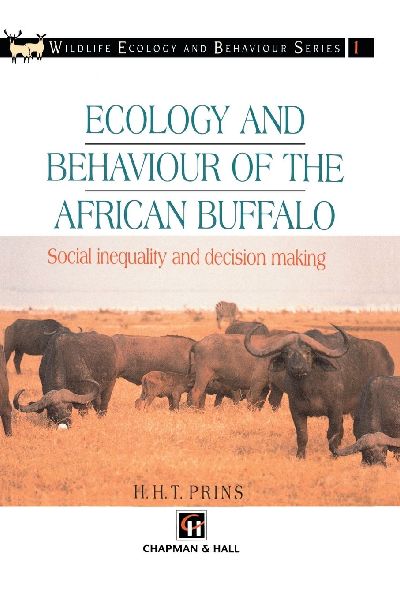
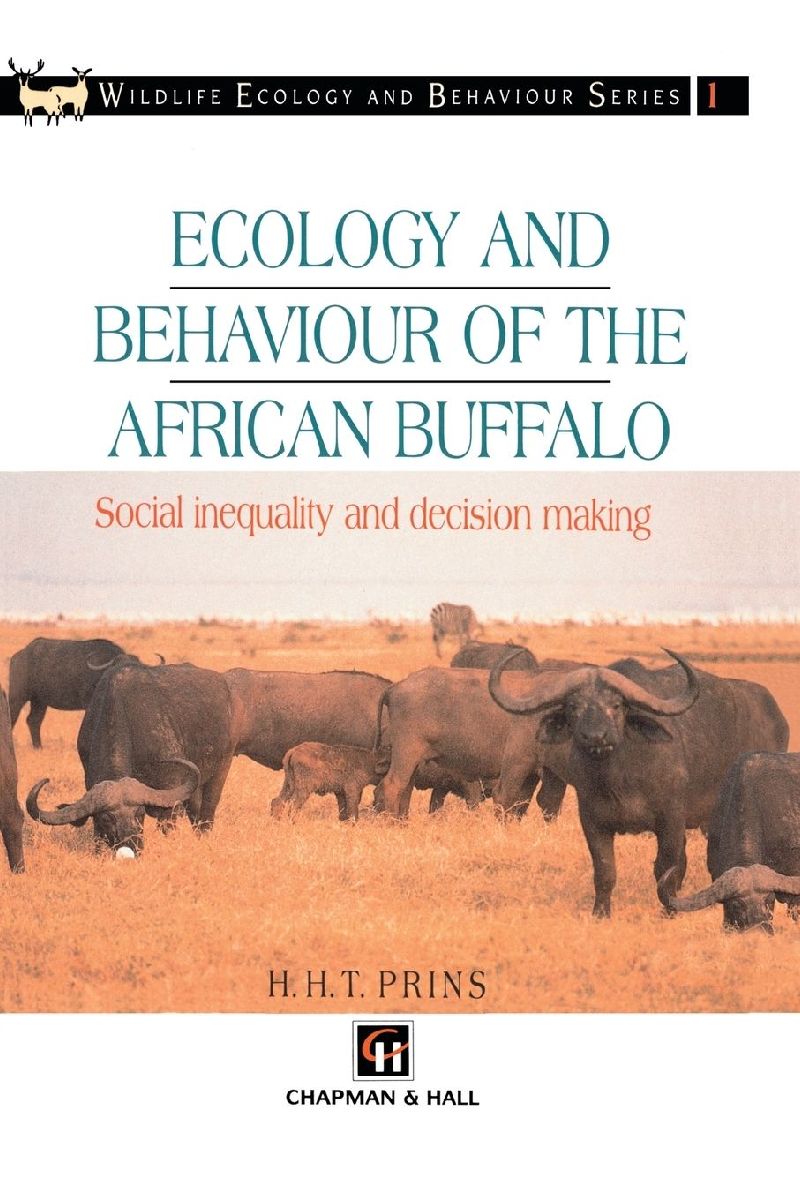
Ecology and Behaviour of the African Buffalo
Social inequality and decision making
von H. H. T Prins
Aus der Reihe Chapman & Hall Wildlife Ecology and Behaviour Series
- Einband
- Kartoniert
- Seiten
- 328
- Sprache
- Englisch
- Erschienen
- November 1995
- Verlag
- Springer
Buchbeschreibung
Over the past 30 years or so, research effort in behaviour and ecology has progressed from simple documentation of the habits or habitats of differ ent species to asking more searching questions about the adaptiveness of the patterns of behaviour observed; moved from documenting simply what occurs, to trying to understand why.
Ganze Beschreibung lesenWeniger anzeigen
Increasingly, studies of behav iour or ecology explore the function of particular responses or patterns of behaviour in individuals or populations - looking for the adaptiveness that has led to the adoption of such patterns either at a proximate level (what environmental circumstances have favoured the adoption of some particular strategy or response from within the animal's repertoire at that specific time) or at an evolutionary level (speculating upon what pres sures have led to the inclusion of a particular pattern of behaviour within the repertoire in the first place).
Many common principles have been established - common to a wide diversity of animal groups, yet showing some precise relationship between a given aspect of behaviour or population dynamics and some particular ecological factor.
In particular, tremendous advances have been made in understanding the foraging behaviour of animals - and the 'decision rules' by which they seek and select from the various resources on offer - and patterns of social organization and behaviour: the adap tiveness of different social structures, group sizes or reproductive tactics.
Inhaltsverzeichnis
- 1 Distribution of resources in time and space
- 1.1 General background
- 1.2 Ecology of the landscape
- 1.3 Water requirements and distribution of water
- 1.4 Waxing and waning of food resources
- 1.5 Buffalo diet composition
- 1.6 Grass and sedge production
- 1.7 Grass and sedge consumption
Ganzes Inhaltsverzeichnis anzeigen (73 Einträge)Weniger anzeigen
- 1.8 Food quality
- 2 Food for the buffalo
- 2.1 Energy and protein requirements for buffalo
- 2.2 Food intake and sward density
- 2.3 Buffalo feeding activity
- 2.4 Buffalo as mixed feeders?
- 2.5 Are buffalo time limited or resource limited?
- 3 Social organization of buffalo cows
- 3.1 Distinguishing sex and age categories and assessing condition
- 3.2 Fitness and social inequality
- 3.3 The buffalo herd as a discrete unit
- 3.4 Fusion-fission society
- 4 Social organization of buffalo bulls
- 4.1 Bull movements on a macro-scale
- 4.2 Bull movements between social environments
- 4.3 Dominance interactions between adult bulls
- 4.4 Re-entrant consecutive polygyny
- 5 Population dynamics, catastrophes and stability
- 5.1 Are buffalo the preferred prey of lions?
- 5.2 Different causes of death
- 5.3 Risk, sex and age
- 5.4 Annual mortality
- 5.5 Rinderpest
- 5.6 The rinderpest outbreak of 1959
- 5.7 Catastrophic diseases
- 5.8 Risk of disease and social inequality
- 5.9 The Manyara censuses
- 5.10 Functional stability
- 5.11 Compensation
- 5.12 Condition and reproduction
- 5.13 Herd size and growth rate: the effects of poaching
- 6 Competition for food
- 6.1 The four major grazers
- 6.2 Wildebeest and zebra grazing activity
- 6.3 Elephant feeding activity
- 6.4 Similarities and differences in adaptation between the four species
- 6.5 Zebra and wildebeest: minor competitors with buffalo
- 6.6 Elephant: the major competitor
- 7 Patch selection: predators and grazing by 'rule ofthumb'
- 7.1 Zones of danger
- 7.2 Vigilance and predator detection
- 7.3 Buffalo ignore predation risk when deciding where to graze
- 7.4 Patch selection and regrazing
- 7.5 Changing patch utilization
- 7.6 Preventing wrong decisions
- 7.7 Cognition, intelligence and decision-making
- 7.8 Collecting information
- 8 Selecting grazing grounds: a case of voting
- 8.1 Key findings to understand communal decision-taking
- 8.2 A difficult task: individual judgement
- 8.3 First evidence for communal decision-taking
- 8.4 Orientations of buffalo when grazing or resting
- 8.5 Which of the sexes or age classes show 'Voting' behaviour?
- 8.6 Voting
- 8.7 Election or consensus?
- 8.8 Pooled expert opinion
- 8.9 A remarkable adaptation: sociality in optimal form
- 9 The effects of ecology on social organization
- 9.1 Phylogeny and social organization of buffalo
- 9.2 Intraspecific variation in social organization
- 9.3 Buffalo of Manyara as compared with those of the Serengeti
- 9.4 Social inequality
- 9.5 The evolution of sociality and information sharing
- Appendix: Protein and energy requirements
- References
Details
- Erscheinungstermin
- November 1995
- Kategorie
- Fremdsprachige Bücher
- Einband
- Kartoniert
- Seiten
- 328
- Sprache
- Englisch
- Verlag
- Springer
- Reihe
- Chapman & Hall Wildlife Ecology and Behaviour Series
- Format
- 23,5 × 15,5 cm
- Dicke
- 1,8 cm
- Gewicht
- 499 g
- EAN / ISBN-13
- 9780412725203
Versand und Rückgabe
Standardversand: 1 bis 3 Werktage, 3,99 €, kostenlos ab 35 €
Liefergebiet: Deutschland
Rücksendung: 14 Tage Widerrufsrecht. Bei einem Widerruf tragen Sie die Kosten der Rücksendung. Bei einer Falschlieferung oder einem Fehler von uns erstatten wir Ihnen das Rückporto. Den Widerruf erklären Sie über den Knopf „Vertrag widerrufen“ im Fuß der Seite.
Hersteller und ProduktsicherheitSpringer Nature Customer Service Center GmbH
Springer Nature Customer Service Center GmbH
Europaplatz 3
69115 Heidelberg
Deutschland
ProductSafety@springernature.com
Mehr aus der Reihe Chapman & Hall Wildlife Ecology and Behaviour Series


Competition and Resource Partitioning in Temperate Ungulate Assemblies
R. J. Putman
Kartoniert, Englisch
106,99 €
Ähnliche Titel

Perspectives on the Marine Animal Forests of the World
Sergio Rossi (Hrsg.)
Gebunden, Englisch, 2 Ausgaben
ab 235,39 €



Bewertungen
Zu diesem Titel gibt es noch keine Bewertung. Bewerten kann, wer ihn bei uns gekauft hat.
So prüfen wir Bewertungen
Eine Bewertung kann bei uns nur abgeben, wer den Titel über sein Kundenkonto bei uns gekauft hat. Jede Bewertung ist fest mit der zugehörigen Bestellung verknüpft; anders kommt sie technisch gar nicht zustande. Deshalb trägt jede angezeigte Bewertung den Hinweis „Verifizierter Kauf". Wir zeigen positive wie negative Bewertungen und löschen nur bei Rechtsverstößen. Für Bewertungen gibt es keine Gegenleistung.
106,99 €Voraussichtlich 2. bis 4. Dez.