
Condition Monitoring Using Computational Intelligence Methods
Tshilidzi Marwala
Gebunden, Englisch, 2 Ausgaben
ab 106,99 €
Aus der Reihe Advanced Information and Knowledge Processing
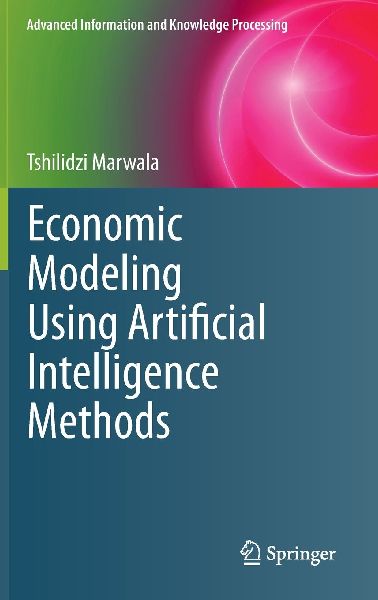
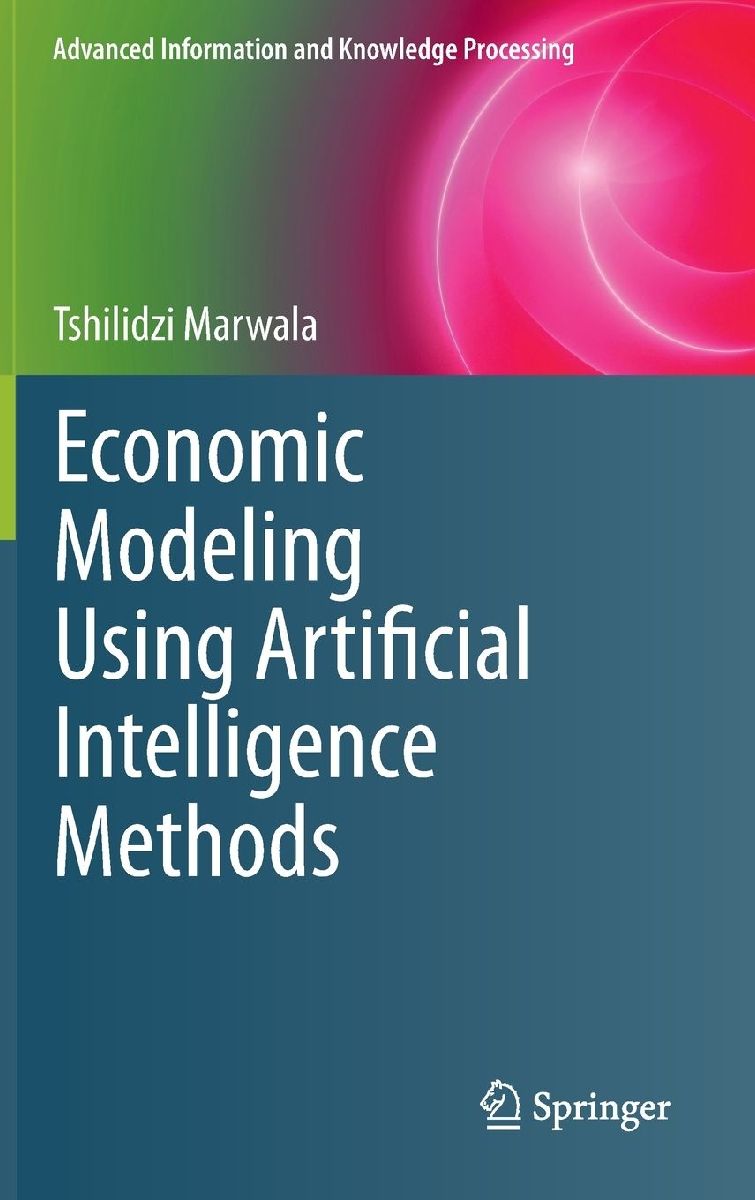
Economic Modeling Using Artificial Intelligence Methods examines the application of artificial intelligence methods to model economic data.
Traditionally, economic modeling has been modeled in the linear domain where the principles of superposition are valid. The application of artificial intelligence for economic modeling allows for a flexible multi-order non-linear modeling. In addition, game theory has largely been applied in economic modeling.
However, the inherent limitation of game theory when dealing with many player games encourages the use of multi-agent systems for modeling economic phenomena.
The artificial intelligence techniques used to model economic data include:multi-layer perceptron neural networks radial basis functions support vector machines rough sets genetic algorithm particle swarm optimization simulated annealing multi-agent system incremental learning fuzzy networks Signal processing techniques are explored to analyze economic data, and these techniques are the time domain methods, time-frequency domain methods and fractals dimension approaches.
Interesting economic problems such as causality versus correlation, simulating the stock market, modeling and controling inflation, option pricing, modeling economic growth as well as portfolio optimization are examined. The relationship between economic dependency and interstate conflict is explored, and knowledge on how economics is useful to foster peace - and vice versa - is investigated.
Economic Modeling Using Artificial Intelligence Methods deals with the issue of causality in the non-linear domain and applies the automatic relevance determination, the evidence framework, Bayesian approach and Granger causality to understand causality and correlation.
Economic Modeling Using Artificial Intelligence Methods makes an important contribution to the area of econometrics, and is a valuable source of reference for graduate students, researchers and financial practitioners.
Tshilidzi Marwala is the Vice-Chancellor and Principal of the University of Johannesburg. He was previously the Deputy Vice Chancellor: Research and Internationalization and a Dean of the Faculty of Engineering at the University of Johannesburg.
He was previously a full Professor of Electrical Engineering, the Carl and Emily Fuchs Chair of Systems and Control Engineering as well as the SARChI chair of Systems Engineering at the University of the Witwatersrand. Prior to this, he was an executive assistant to the technical director at the South African Breweries. He holds a Bachelor of Science in Mechanical Engineering (magna cum laude) from Case Western Reserve University (USA), a Master of Mechanical Engineering from the University of Pretoria, a PhD in Engineering from Cambridge University and was a post-doctoral research associate at the Imperial College (London). He is a registered professional engineer, a Fellow of TWAS, the World Academy of Sciences, the Academy of Science of South Africa (ASSAf), the African Academy of Sciences and the South African Academy of Engineering. He is a Senior Member of the IEEE (Institute of Electrical and Electronics Engineering) and a distinguished member of the ACM (Association for Computing Machinery). His research interests are multi-disciplinary and they include the theory and application of computational intelligence to engineering, computer science, finance, social science and medicine. He has supervised 47 Masters and 21 PhD students to completion. He has published 9 books (one translated into Mandarin), over 280 papers and holds three international patents. He is an associate editor of the International Journal of Systems Science (Taylor and Francis Publishers).Evan Hurwitz is a South African computer scientist. He obtained his BSc Engineering (Electrical) (2004), his MSc Engineering (2006) from the University of the Witwatersrand and PhD from the University of Johannesburg in 2014 supervized by Tshilidzi Marwala. He is known for his work on teaching a computer how to bluff which was widely covered by the magazine New Scientist. Hurwitz together with Tshilidzi Marwala proposed that there is less level of information asymmetry between two artificial intelligent agents than between two human agents and that the more artificial intelligent there is in the market the less is the volume of trades in the market.
Standardversand: 1 bis 3 Werktage, 3,99 €, kostenlos ab 35 €
Liefergebiet: Deutschland
Rücksendung: 14 Tage Widerrufsrecht. Bei einem Widerruf tragen Sie die Kosten der Rücksendung. Bei einer Falschlieferung oder einem Fehler von uns erstatten wir Ihnen das Rückporto. Den Widerruf erklären Sie über den Knopf „Vertrag widerrufen“ im Fuß der Seite.
Tshilidzi Marwala
Gebunden, Englisch, 2 Ausgaben
ab 106,99 €
Tshilidzi Marwala
Gebunden, Englisch
168,30 €
Tshilidzi Marwala
Gebunden, Englisch, 2 Ausgaben
ab 106,99 €
Tshilidzi Marwala
Gebunden, Englisch, 2 Ausgaben
ab 53,49 €
Israël César Lerman
Gebunden, Englisch, 2 Ausgaben
ab 171,19 €
Shu-Heng Chen
Gebunden, Englisch, 2 Ausgaben
ab 160,49 €
Zu diesem Titel gibt es noch keine Bewertung. Bewerten kann, wer ihn bei uns gekauft hat.