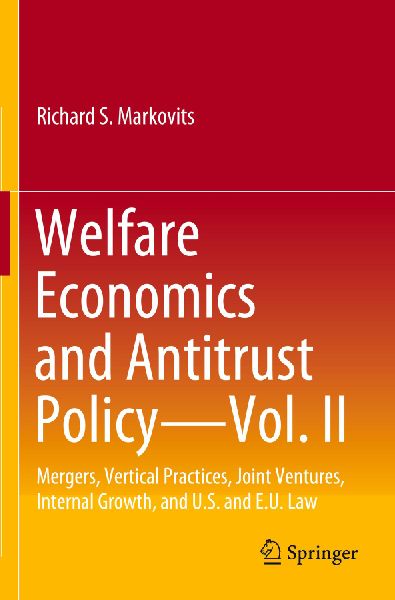

Welfare Economics and Antitrust Policy - Vol. I
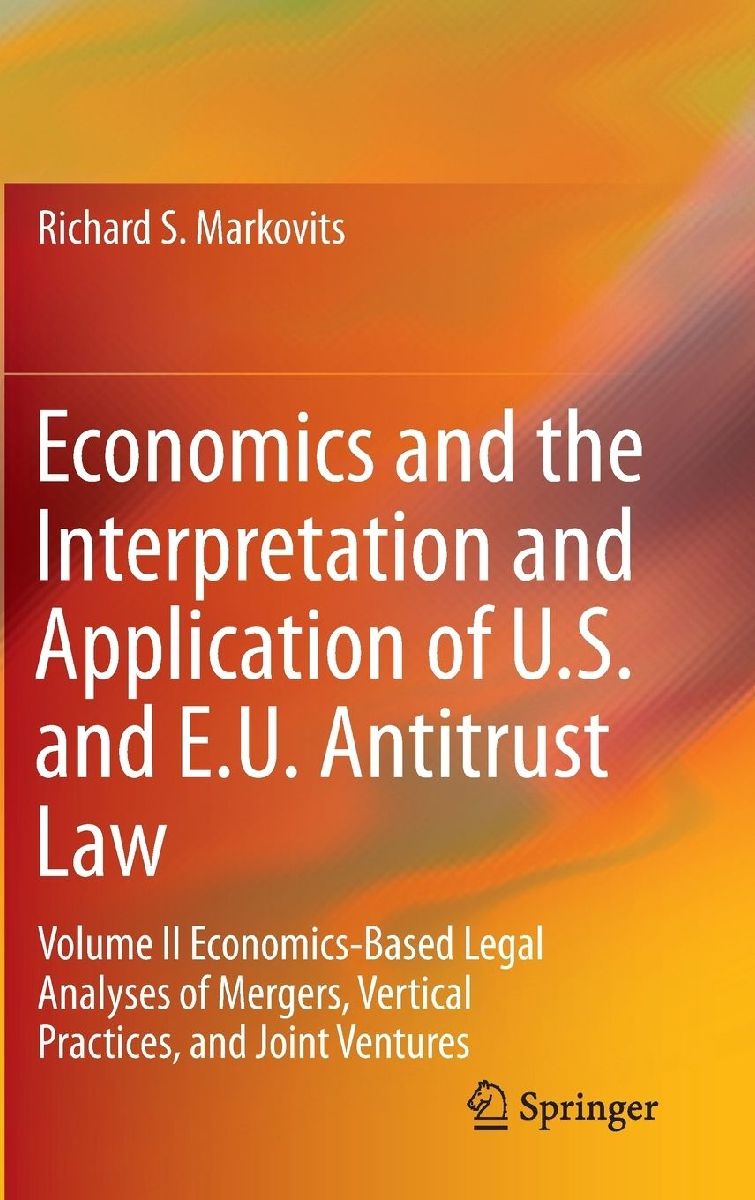
Richard S. Markovits
Kartoniert, Englisch, 2 Ausgaben
ab 85,59 €
Volume II Economics-Based Legal Analyses of Mergers, Vertical Practices, and Joint Ventures
Volume 2 uses the economic and legal concepts/theories of Volume 1 to (1) analyze the U.S. and E.U. antitrust legality of mergers, joint ventures, and the pricing-technique and contractual/sales-policy distributor-control surrogates for vertical integration and (2) assess related positions of scholars and U.S. and E.U. antitrust officials.
Its analysis of horizontal mergers (1) delineates non-market-oriented protocols for determining whether they manifest specific anticompetitive intent, would lessen competition, or are rendered lawful by the efficiencies they would generate, (2) criticizes the U.S. courts' traditional market-share/market-concentration protocol, the HHI-oriented protocols of the 1992 U.S. DOJ/FTC Guidelines and the European Commission (EC) Guidelines, and the various non-market-oriented protocols the DOJ/FTC have increasingly been using, (3) argues that, although the 2010 U.S. Guidelines and DOJ/FTC officials discuss market definition as if it matters, those Guidelines actually reject market-oriented approaches, and (4) reviews the relevant U.S. and E.U. case-law.
Its analysis of conglomerate mergers (1) shows that they can perform the same legitimate and competition-increasing functions as horizontal mergers and can yield illegitimate profits and lessen competition by increasing contrived oligopolistic pricing and retaliation barriers to investment, (2) analyzes the determinants of all these effects, and (3) assesses limit-price theory, the toe-hold-merger doctrine, and U.S. and E.U. case-law.
Its analysis of vertical conduct (1) examines the legitimate functions of each type of such conduct, (2) delineates the conditions under which each manifests specific anticompetitive intent and/or lessens competition, and (3) assesses related U.S. and E.U. case-law and DOJ/FTC and EC positions.
Its analysis of joint ventures (1) explains that they violate U.S. law only when they manifest specificanticompetitive intent while they violate E.U. law either for this reason or because they lessen competition, (2) discusses the meaning of an "ancillary restraint" and demonstrates that whether a joint-venture agreement would be illegal if it imposed no restraints and whether any restraints imposed are ancillary can be determined only through case-by-case analysis, (3) explains why scholars and officials overestimate the economic efficiency of R&D joint ventures, and (4) discusses related U.S. and E.U. case-law and DOJ/FTC and EC positions.
The study's Conclusion (1) reviews how its analyses justify its innovative conceptual systems and (2) compares U.S. and E.U. antitrust law as written and as applied.
Richard Markovits has a Ph. D. in economics from the London School of Economics and an L.L.B. from Yale Law School (USA).
His research covers competition theory, pricing theory, the theory of vertical integration and its contractual surrogates, economics and the interpretation and application of US and EU antitrust law, the definition and moral and legal relevance of the impact of a choice on economic efficiency, second-best theory (the third-best-economically-efficient protocol for analyzing economic efficiency), the economic efficiency of various specific judicial doctrines and pieces of legislation, jurisprudence, constitutional law, and the abstract definition and concrete moral and legal entailments of liberalism. He currently holds the John B. Connally Chair in Law at the University of Texas Law School (Austin, USA). He has taught in several other law schools and economics faculties in both the United States and Germany. From 1981-1983, he was Co-Director of the Centrefor Socio-Legal Studies at Wolfson College, Oxford. He has been a Fellow of the Wissenschaftskolleg zu Berlin and a Guddenhein Fellow, has served on panels of the US National Science Foundation and the UK Social Science Research Council, and has been a Trustee of the Law & Society Association.
Standardversand: 1 bis 3 Werktage, 3,99 €, kostenlos ab 35 €
Liefergebiet: Deutschland
Rücksendung: 14 Tage Widerrufsrecht. Bei einem Widerruf tragen Sie die Kosten der Rücksendung. Bei einer Falschlieferung oder einem Fehler von uns erstatten wir Ihnen das Rückporto. Den Widerruf erklären Sie über den Knopf „Vertrag widerrufen“ im Fuß der Seite.
Richard S. Markovits
Kartoniert, Englisch, 2 Ausgaben
ab 85,59 €
Richard S. Markovits
Kartoniert, Englisch, 2 Ausgaben
ab 90,94 €
Richard S. Markovits
Kartoniert, Englisch, 2 Ausgaben
ab 64,19 €
Zu diesem Titel gibt es noch keine Bewertung. Bewerten kann, wer ihn bei uns gekauft hat.