El Gobierno Representativo (1865)
von John Stuart Mill
- Einband
- Kartoniert
- Seiten
- 336
- Sprache
- Spanisch
- Erschienen
- April 2010
- Verlag
- Kessinger Publishing, LLC
Buchbeschreibung
El libro ""El Gobierno Representativo"" fue escrito en 1865 por John Stuart Mill y es una obra fundamental en la teor¿¿¿¿¿¿a pol¿¿¿¿¿¿tica moderna.
En este libro, Mill argumenta que el gobierno debe ser representativo y que los ciudadanos deben tener una voz en la toma de decisiones pol¿¿¿¿¿¿ticas. Mill tambi¿¿¿¿¿n defiende la idea de que el gobierno debe ser limitado y que debe haber una separaci¿¿¿¿¿¿n clara de poderes para evitar el abuso de poder.
Ganze Beschreibung lesenWeniger anzeigen
Adem¿¿¿¿¿s, Mill aborda temas como la libertad de expresi¿¿¿¿¿¿n y la importancia de la educaci¿¿¿¿¿¿n en la formaci¿¿¿¿¿¿n de ciudadanos responsables y comprometidos. En resumen, ""El Gobierno Representativo"" es una obra esencial para entender la teor¿¿¿¿¿¿a pol¿¿¿¿¿¿tica moderna y la importancia de la participaci¿¿¿¿¿¿n ciudadana en la democracia.
This Book Is In Spanish. This scarce antiquarian book is a facsimile reprint of the old original and may contain some imperfections such as library marks and notations. Because we believe this work is culturally important, we have made it available as part of our commitment for protecting, preserving, and promoting the world's literature in affordable, high quality, modern editions, that are true to their original work.
Details
- Erscheinungstermin
- April 2010
- Kategorie
- Fremdsprachige Bücher
- Einband
- Kartoniert
- Seiten
- 336
- Sprache
- Spanisch
- Verlag
- Kessinger Publishing, LLC
- Format
- 22,9 × 15,2 cm
- Dicke
- 1,8 cm
- Gewicht
- 488 g
- EAN / ISBN-13
- 9781161152401
Über John Stuart Mill
John Stuart Mill (20 May 1806 - 8 May 1873), usually cited as J. S. Mill, was a British philosopher, political economist, and civil servant.
Mehr über John Stuart MillWeniger anzeigen
One of the most influential thinkers in the history of classical liberalism, he contributed widely to social theory, political theory, and political economy. Dubbed "the most influential English-speaking philosopher of the nineteenth century",[8] Mill's conception of liberty justified the freedom of the individual in opposition to unlimited state and social control.[9]Mill was a proponent of utilitarianism, an ethical theory developed by his predecessor Jeremy Bentham. He contributed to the investigation of scientific methodology, though his knowledge of the topic was based on the writings of others, notably William Whewell, John Herschel, and Auguste Comte, and research carried out for Mill by Alexander Bain. Mill engaged in written debate with Whewell.[10]A member of the Liberal Party, he was also the second Member of Parliament to call for women's suffrage after Henry Hunt in 1832 John Stuart Mill was born at 13 Rodney Street in Pentonville, Middlesex, the eldest son of the Scottish philosopher, historian and economist James Mill, and Harriet Barrow. John Stuart was educated by his father, with the advice and assistance of Jeremy Benthamand Francis Place. He was given an extremely rigorous upbringing, and was deliberately shielded from association with children his own age other than his siblings. His father, a follower of Bentham and an adherent of associationism, had as his explicit aim to create a genius intellect that would carry on the cause of utilitarianism and its implementation after he and Bentham had died. Mill was a notably precocious child. He describes his education in his autobiography. At the age of three he was taught Greek.[14] By the age of eight, he had read Aesop's Fables, Xenophon's Anabasis,[14] and the whole of Herodotus,[14] and was acquainted with Lucian, Diogenes Laërtius, Isocrates and six dialogues of Plato.[14] He had also read a great deal of history in English and had been taught arithmetic, physics and astronomy. At the age of eight, Mill began studying Latin, the works of Euclid, and algebra, and was appointed schoolmaster to the younger children of the family. His main reading was still history, but he went through all the commonly taught Latin and Greek authors and by the age of ten could read Plato and Demosthenes with ease. His father also thought that it was important for Mill to study and compose poetry. One of Mill's earliest poetic compositions was a continuation of the Iliad. In his spare time he also enjoyed reading about natural sciences and popular novels, such as Don Quixote and Robinson Crusoe.
Versand und Rückgabe
Standardversand: 1 bis 3 Werktage, 3,99 €, kostenlos ab 35 €
Liefergebiet: Deutschland
Rücksendung: 14 Tage Widerrufsrecht. Bei einem Widerruf tragen Sie die Kosten der Rücksendung. Bei einer Falschlieferung oder einem Fehler von uns erstatten wir Ihnen das Rückporto. Den Widerruf erklären Sie über den Knopf „Vertrag widerrufen“ im Fuß der Seite.
Hersteller und ProduktsicherheitKessinger Publishing, LLC
Kessinger Publishing, LLC
Europaallee 1
36244 Bad Hersfeld
Deutschland
gpsr@libri.de
Verantwortliche Person in der EU
Libri GmbHEuropaallee 1
36244 Bad Hersfeld
Deutschland
gpsr@libri.de
Mehr von John Stuart Mill
Ähnliche Titel
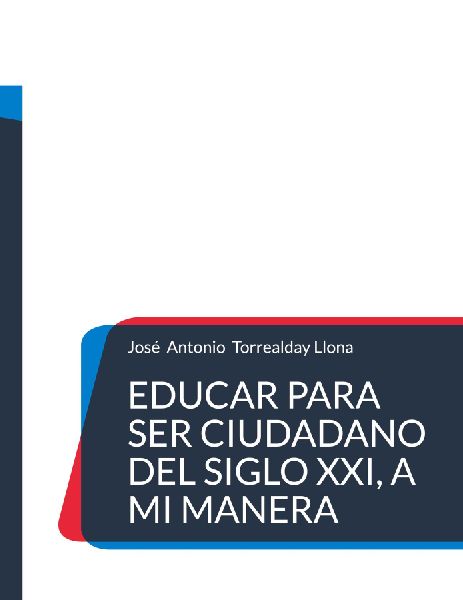
Educar para ser ciudadano del siglo XXI, a mi manera
José Antonio Torrealday Llona
Kartoniert, Spanisch
14,40 €
Bewertungen
Zu diesem Titel gibt es noch keine Bewertung. Bewerten kann, wer ihn bei uns gekauft hat.
So prüfen wir Bewertungen
Eine Bewertung kann bei uns nur abgeben, wer den Titel über sein Kundenkonto bei uns gekauft hat. Jede Bewertung ist fest mit der zugehörigen Bestellung verknüpft; anders kommt sie technisch gar nicht zustande. Deshalb trägt jede angezeigte Bewertung den Hinweis „Verifizierter Kauf". Wir zeigen positive wie negative Bewertungen und löschen nur bei Rechtsverstößen. Für Bewertungen gibt es keine Gegenleistung.
34,50 €Voraussichtlich 2. bis 4. Dez.