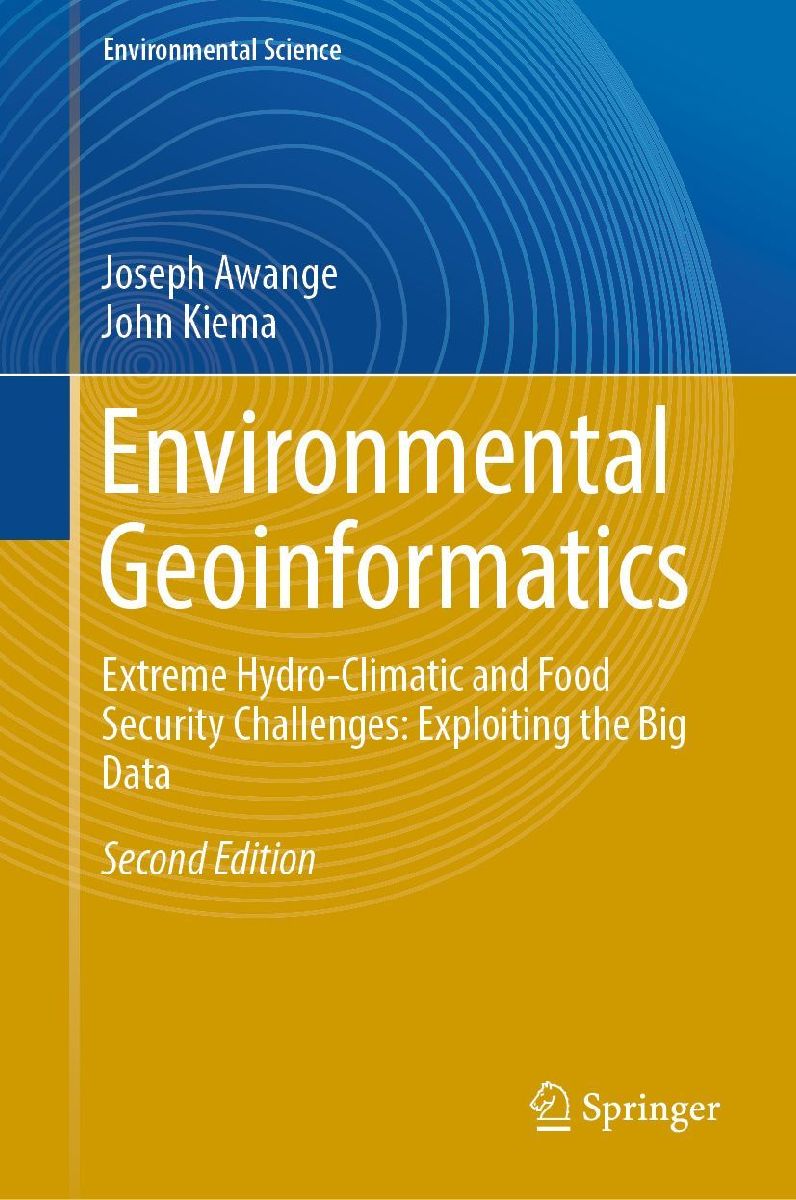
Environmental Geoinformatics
Extreme Hydro-Climatic and Food Security Challenges: Exploiting the Big Data
von Joseph Awange und John Kiema
Aus der Reihe Environmental Science and Engineering
- Einband
- Gebunden
- Seiten
- 660
- Sprache
- Englisch
- Erschienen
- Januar 2019
- Verlag
- Springer
Buchbeschreibung
This second edition includes updated chapters from the first edition as well as five additional new chapters (Light detection and ranging (LiDAR), CORONA historical de-classified products, Unmanned Aircraft Vehicles (UAVs), GNSS-reflectometry and GNSS applications to climate variability), shifting the main focus from monitoring and management to extreme hydro-climatic and food security challenges and exploiting big data.
Ganze Beschreibung lesenWeniger anzeigen
Since the publication of first edition, much has changed in terms of technology, and the demand for geospatial data has increased with the advent of the big data era. For instance, the use of laser scanning has advanced so much that it is unavoidable in most environmental monitoring tasks, whereas unmanned aircraft vehicles (UAVs)/drones are emerging as efficient tools that address food security issues as well as many other contemporary challenges.
Furthermore, global navigation satellite systems (GNSS) are now responding to challenges posed by climate change by unravelling the impacts of teleconnection (e.g., ENSO) as well as advancing the use of reflected signals (GNSS-reflectometry) to monitor, e.g., soil moisture variations. Indeed all these rely on the explosive use of "big data" in many fields of human endeavour.
Moreover, with the ever-increasing global population, intense pressure is being exerted on the Earth's resources, leading to significant changes in its land cover (e.g., deforestation), diminishing biodiversity and natural habitats, dwindling fresh water supplies, and changing weather and climatic patterns (e.g., global warming, changing sea level).
Environmental monitoring techniques that provide information on these are under scrutiny from an increasingly environmentally conscious society that demands the efficient delivery of such information at a minimal cost. Environmental changes vary both spatially and temporally, thereby putting pressure on traditional methods of data acquisition, some of which are highly labour intensive, such as animal tracking for conservation purposes.
With these challenges, conventional monitoring techniques, particularly those that record spatial changes call for more sophisticated approaches that deliver the necessary information at an affordable cost. One direction being pursued in the development of such techniques involves environmental geoinformatics, which can act as a stand-alone method or complement traditional methods.
Inhaltsverzeichnis
- Environmental Monitoring and Management
- Geodata and Geoinformatics
- Fundamentals of Surveying and Geodesy
- Modernization of GNSS
- The Global Positioning System
- Environmental Surveying and Surveillance
- Fundamentals of Remote Sensing
- Optical Remote Sensing
Ganzes Inhaltsverzeichnis anzeigen (33 Einträge)Weniger anzeigen
- Microwave Remote Sensing
- Image Interpretation and Analysis
- Fundamentals of Photogrammetry
- Digital Photogrammetry
- CORONA Historical De-classi¿ed Products
- Fundamentals of GIS
- Data Models and Structure
- Input of GIS Data
- GIS Database
- Spatial Analysis
- Web GIS and Mapping
- Unmanned Aircraft Vehicles
- Light Detection And Ranging (LiDAR)
- Maps in Environmental Monitoring
- Satellite Environmental Sensing
- GNSS Re¿ectometry and Applications
- Weather, Climate and Global Warming
- GNSS Sensing of Climate Variability
- Water Resources
- Land Management
- Marine and Coastal Resources
- Protection and Conservation of Animals and Vegetation
- Disaster Monitoring and Management
- Environmental Pollution
- Environmental Impact Assessment
Details
- Erscheinungstermin
- Januar 2019
- Kategorie
- Fremdsprachige Bücher
- Einband
- Gebunden
- Seiten
- 660
- Sprache
- Englisch
- Verlag
- Springer
- Reihe
- Environmental Science and Engineering
- Format
- 24,1 × 16,0 cm
- Dicke
- 4,1 cm
- Gewicht
- 1.093 g
- EAN / ISBN-13
- 9783030030162
Versand und Rückgabe
Standardversand: 1 bis 3 Werktage, 3,99 €, kostenlos ab 35 €
Liefergebiet: Deutschland
Rücksendung: 14 Tage Widerrufsrecht. Bei einem Widerruf tragen Sie die Kosten der Rücksendung. Bei einer Falschlieferung oder einem Fehler von uns erstatten wir Ihnen das Rückporto. Den Widerruf erklären Sie über den Knopf „Vertrag widerrufen“ im Fuß der Seite.
Hersteller und ProduktsicherheitSpringer Nature Customer Service Center GmbH
Springer Nature Customer Service Center GmbH
Europaplatz 3
69115 Heidelberg
Deutschland
ProductSafety@springernature.com
Mehr von Joseph Awange




Food Insecurity & Hydroclimate in Greater Horn of Africa
Joseph Awange
Gebunden, Englisch, 2 Ausgaben
ab 171,19 €
Mehr aus der Reihe Environmental Science and Engineering

Eco-Friendly Solutions for Water Pollution Control and Resource Management
Zhanhong Wan (Hrsg.)
Gebunden, Englisch
235,39 €
Towards Sustainable Geographies with Net Zero Carbon Economy
Nídia Caetano (Hrsg.)
Gebunden, Englisch
353,09 €

Proceedings of the 12th International Conference on Energy Engineering and Environmental Engineering
Zuoyu Sun (Hrsg.)
Gebunden, Englisch
374,49 €

Ähnliche Titel


Water Management in Developing Countries and Sustainable Development
S. Suriyanarayanan (Hrsg.)
Gebunden, Englisch, 2 Ausgaben
ab 117,69 €


Environmental History and Tribals in Modern India
Velayutham Saravanan
Kartoniert, Englisch, 2 Ausgaben
ab 96,29 €
Bewertungen
Zu diesem Titel gibt es noch keine Bewertung. Bewerten kann, wer ihn bei uns gekauft hat.
So prüfen wir Bewertungen
Eine Bewertung kann bei uns nur abgeben, wer den Titel über sein Kundenkonto bei uns gekauft hat. Jede Bewertung ist fest mit der zugehörigen Bestellung verknüpft; anders kommt sie technisch gar nicht zustande. Deshalb trägt jede angezeigte Bewertung den Hinweis „Verifizierter Kauf". Wir zeigen positive wie negative Bewertungen und löschen nur bei Rechtsverstößen. Für Bewertungen gibt es keine Gegenleistung.
171,19 €Voraussichtlich 4. bis 8. Dez.