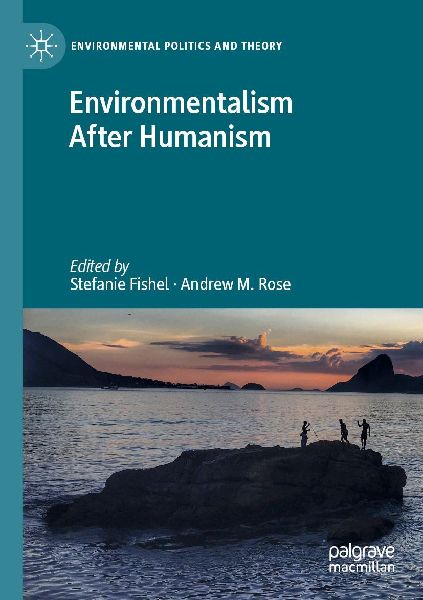
Environmentalism After Humanism
Herausgegeben von: Stefanie Fishel, Herausgegeben von: Andrew M. Rose
Aus der Reihe Environmental Politics and Theory
- Einband
- Kartoniert
- Seiten
- 256
- Sprache
- Englisch
- Erschienen
- Januar 2026
- Verlag
- Springer
Buchbeschreibung
This book explores the ways in which one might come to recognize and better theorize the political actor, and the political ‘act,’ or ‘event,’ in a post-anthropocentric context.
The challenge to contemporary ideas of citizenship, activism, and the state stems not only from the realization that the natural world is inseparable from the social, but that both are the product of hybridized human and nonhuman agencies.
Ganze Beschreibung lesenWeniger anzeigen
As a result, one must be skeptical of any notion of an environmental fix that bases itself upon an exclusively human agency.
What new types of citizenship might emerge from posthuman cultures and artforms? What do effective post-anthropocentric organizing strategies look like? As the relevance of the liberal humanist political subject and the conceptual norms of political realism recede, theories of national and international politics are now tasked with rethinking a contemporary environmental politics beyond humanism.
To better theorize these destabilizations, this collection puts forth the value of thinking across disciplines, wherein a conversation unfolds between political theory and literary theory that meets at the crossroads of environmental humanities and ecopolitical theory.
Inhaltsverzeichnis
- Chapter 1: What Comes After Humanism?
- Chapter 2: Speculative Worlds and Terrestrial Politics: Reframing Fictional Disasters with Latour's Down to Earth
- Chapter 3: Posthuman Geopolitical Culture(s): Decentering the State in the Anthropocene Epoch
- Chapter 4: Environmental Activism and Ecological Citizenship: An Examination of Vibrant Matter and Distributed Agency
- Chapter 5: Working With Uncertainty
- Chapter 6: Post-Citizens at the Ends of Poetry: Bruno Latour's Gaia faces Carol Ann Duffy's The Bees
- Chapter 7: Suffering, Monstrosity, Exceptionality
- Chapter 8: The Trapped Elephant in the Humanitarian's Room: Ensuring ecological justice amidst a refugee crisis
- Chapter 9: Other-worldly experiences of protected area adaptive management
Details
- Erscheinungstermin
- Januar 2026
- Kategorie
- Fremdsprachige Bücher
- Einband
- Kartoniert
- Seiten
- 256
- Sprache
- Englisch
- Verlag
- Springer
- Reihe
- Environmental Politics and Theory
- Format
- 21,0 × 14,8 cm
- Dicke
- 1,5 cm
- Gewicht
- 336 g
- EAN / ISBN-13
- 9783031758935
Über Stefanie Fishel (Hrsg.)
Stefanie Fishel is Senior Lecturer in Politics and International Relations at the University of the Sunshine Coast, Australia Andrew M. Rose is Assistant Professor in English at Christopher Newport University, USA.
Versand und Rückgabe
Standardversand: 1 bis 3 Werktage, 3,99 €, kostenlos ab 35 €
Liefergebiet: Deutschland
Rücksendung: 14 Tage Widerrufsrecht. Bei einem Widerruf tragen Sie die Kosten der Rücksendung. Bei einer Falschlieferung oder einem Fehler von uns erstatten wir Ihnen das Rückporto. Den Widerruf erklären Sie über den Knopf „Vertrag widerrufen“ im Fuß der Seite.
Hersteller und ProduktsicherheitSpringer Nature Customer Service Center GmbH
Springer Nature Customer Service Center GmbH
Europaplatz 3
69115 Heidelberg
Deutschland
ProductSafety@springernature.com
Mehr aus der Reihe Environmental Politics and Theory


Internal Environmental Displacement in Latin America and the Caribbean
Andrea Pacheco Pacifico (Hrsg.)
Gebunden, Englisch, 2 Ausgaben
ab 149,79 €
Ähnliche Titel


Refugees and the Transformation of Societies
Philomena Essed (Hrsg.)
Kartoniert, Englisch, 2 Ausgaben
ab 42,30 €

Involving Methods in Youth Research
Trine Wulf-Andersen (Hrsg.)
Gebunden, Englisch, 2 Ausgaben
ab 160,49 €

Bewertungen
Zu diesem Titel gibt es noch keine Bewertung. Bewerten kann, wer ihn bei uns gekauft hat.
So prüfen wir Bewertungen
Eine Bewertung kann bei uns nur abgeben, wer den Titel über sein Kundenkonto bei uns gekauft hat. Jede Bewertung ist fest mit der zugehörigen Bestellung verknüpft; anders kommt sie technisch gar nicht zustande. Deshalb trägt jede angezeigte Bewertung den Hinweis „Verifizierter Kauf". Wir zeigen positive wie negative Bewertungen und löschen nur bei Rechtsverstößen. Für Bewertungen gibt es keine Gegenleistung.
85,59 €Voraussichtlich 1. bis 3. Dez.