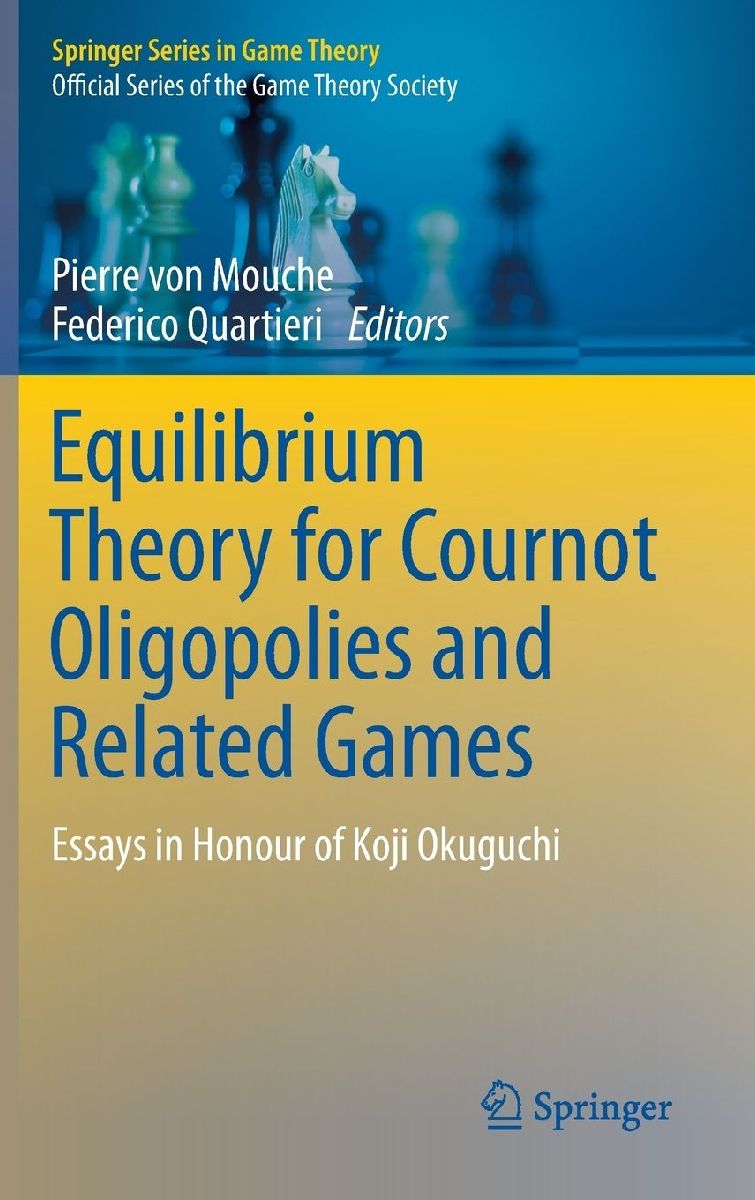
Equilibrium Theory for Cournot Oligopolies and Related Games
Essays in Honour of Koji Okuguchi
Herausgegeben von: Pierre von Mouche, Herausgegeben von: Federico Quartieri
Aus der Reihe Springer Series in Game Theory
- Einband
- Gebunden
- Seiten
- 308
- Sprache
- Englisch
- Erschienen
- Mai 2016
- Verlag
- Springer
Buchbeschreibung
This state-of-the-art collection of papers on the theory of Cournotian competition focuses on two main subjects: oligopolistic Cournot competition and contests.
The contributors present various applications of the Cournotian Equilibrium Theory, addressing topics such as equilibrium existence and uniqueness, equilibrium structure, dynamic processes, coalitional behavior and welfare. Special emphasis is placed on the aggregative nature of the games that are relevant to such theory.
Ganze Beschreibung lesenWeniger anzeigen
This contributed volume was written to celebrate the 80th birthday of Prof. Koji Okuguchi, a pioneer in oligopoly theory.
Inhaltsverzeichnis
- Introduction
- On the Works of Professor Koji Okuguchi
- Cournot, aNon-strategic Economist.-Cournot Tatonnement in Aggregative Games with Monotone
- Best Responses
- Existence and Uniqueness of Nash Equilibrium in Aggregative
- Games: an Expository Treatment
- On the Geometric Structure of the Cournot
- Equilibrium Set: the Case of Concave Industry Revenue and Convex Costs
Ganzes Inhaltsverzeichnis anzeigen (20 Einträge)Weniger anzeigen
- Pure
- Strategy Equilibria in Finite Symmetric Concave Games and an Application toSymmetric Discrete Cournot Games
- On a Discontinuous Cournot Oligopoly.-Interpreting Markups in Spanish Manufacturing: the Exponential Model.-Privatization Neutrality Theorem and Discriminatory Subsidy Policy
- Cournot
- Oligopoly Theory for Simple Electricity Markets
- Kant-Nash Equilibria in a Quantity-Setting Oligopoly.-Evolutionary
- Oligopoly Models of Commercial Fishing with Heterogeneities
- Existence, Uniqueness, and Comparative Statics in Contests
- Two-Group Contests with Communication Within and Between Groups
- On the Nash Equilibrium of Asymmetric
- Public-Good Contests
- Heterogeneity and Number of Players in Rent-Seeking, Innovation, and Patent-Race Games
Details
- Erscheinungstermin
- Mai 2016
- Kategorie
- Fremdsprachige Bücher
- Einband
- Gebunden
- Seiten
- 308
- Sprache
- Englisch
- Verlag
- Springer
- Reihe
- Springer Series in Game Theory
- Format
- 24,1 × 16,0 cm
- Dicke
- 2,3 cm
- Gewicht
- 577 g
- EAN / ISBN-13
- 9783319292533
Über Pierre von Mouche (Hrsg.)
Pierre von Mouche (1959) studied theoretical physics, mathematics and astronomy at the University of Nijmegen. He received his PhD in mathematics from the University of Utrecht under the supervision of Hans Duistermaat.
Mehr über Pierre von Mouche (Hrsg.)Weniger anzeigen
Since1989 he holds a position in economics at Wageningen University. His scientific interest include mathematical economics and in particular the equilibrium structure of games in strategic form.
Federico Quartieri (1979) studied economics at the University of Florence. He received his PhD in economics from the University of Siena.
Since 2014 he holds a position in mathematical economics at the University Federico II of Naples. His scientific interest include mathematical economics and game theory.
Versand und Rückgabe
Standardversand: 1 bis 3 Werktage, 3,99 €, kostenlos ab 35 €
Liefergebiet: Deutschland
Rücksendung: 14 Tage Widerrufsrecht. Bei einem Widerruf tragen Sie die Kosten der Rücksendung. Bei einer Falschlieferung oder einem Fehler von uns erstatten wir Ihnen das Rückporto. Den Widerruf erklären Sie über den Knopf „Vertrag widerrufen“ im Fuß der Seite.
Hersteller und ProduktsicherheitSpringer Nature Customer Service Center GmbH
Springer Nature Customer Service Center GmbH
Europaplatz 3
69115 Heidelberg
Deutschland
ProductSafety@springernature.com
Mehr aus der Reihe Springer Series in Game Theory


Ähnliche Titel


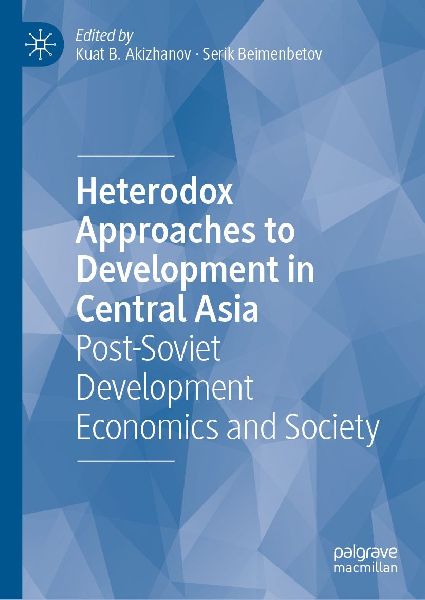
Heterodox Approaches to Development in Central Asia
Kuat B. Akizhanov (Hrsg.)
Gebunden, Englisch
128,39 €
Bewertungen
Zu diesem Titel gibt es noch keine Bewertung. Bewerten kann, wer ihn bei uns gekauft hat.
So prüfen wir Bewertungen
Eine Bewertung kann bei uns nur abgeben, wer den Titel über sein Kundenkonto bei uns gekauft hat. Jede Bewertung ist fest mit der zugehörigen Bestellung verknüpft; anders kommt sie technisch gar nicht zustande. Deshalb trägt jede angezeigte Bewertung den Hinweis „Verifizierter Kauf". Wir zeigen positive wie negative Bewertungen und löschen nur bei Rechtsverstößen. Für Bewertungen gibt es keine Gegenleistung.
106,99 €Voraussichtlich 7. bis 9. Dez.