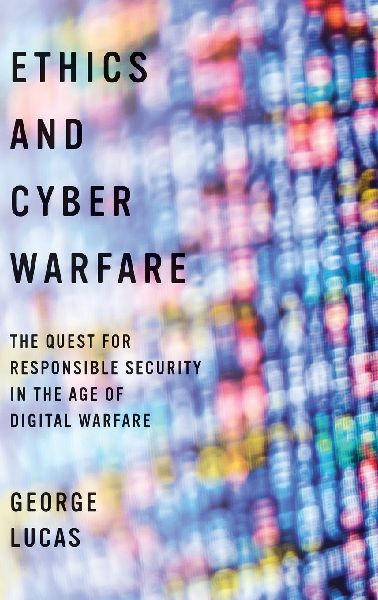
Ethics and Cyber Warfare
The Quest for Responsible Security in the Age of Digital Warfare
von George Lucas
- Einband
- Gebunden
- Seiten
- 202
- Sprache
- Englisch
- Erschienen
- Dezember 2016
- Verlag
- OXFORD UNIV PR
Buchbeschreibung
From North Korea's recent attacks on Sony to perpetual news reports of successful hackings and criminal theft, cyber conflict has emerged as a major topic of public concern.
Yet even as attacks on military, civilian, and commercial targets have escalated, there is not yet a clear set of ethical guidelines that apply to cyber warfare. Indeed, like terrorism, cyber warfare is commonly believed to be a war without rules.
Ganze Beschreibung lesenWeniger anzeigen
Given the prevalence cyber warfare, developing a practical moral code for this new form of conflict is more important than ever.
In Ethics and Cyber Warfare, internationally-respected ethicist George Lucas delves into the confounding realm of cyber conflict. Comparing "state-sponsored hacktivism" to the transformative impact of "irregular warfare" in conventional armed conflict, Lucas offers a critique of legal approaches to governance, and outlines a new approach to ethics and "just war" reasoning.
Lucas draws upon the political philosophies of Alasdair MacIntyre, John Rawls, and J�rgen Habermas to provide a framework for understanding these newly-emerging standards for cyber conflict, and ultimately presents a professional code of ethics for a new generation of "cyber warriors." Lucas concludes with a discussion of whether preemptive self-defense efforts - such as the massive government surveillance programs revealed by Edward Snowden - can ever be justified, addressing controversial topics such as privacy, anonymity, and public trust.
Well-reasoned and timely, Ethics and Cyber Warfare is a must-read for anyone with an interest in philosophy, ethics, or cybercrime.
Inhaltsverzeichnis
- CONTENTS- Preface ix- Acknowledgments xiii- Introduction: Crime or Warfare?--1-
- 1. Cyber (In)security: Threat Assessment in the Cyber Domain--16- What, When, and Where?--16- How?--18- Why?--19- Three Ways of Being a Hacktivist--21- Conventional Warfare--22- Unrestricted Warfare--24- State- Sponsored Hacktivism as a New Form of Warfare--27-
- 2. Is There a Role for Ethics or Law in Cyber Conflict?--33- Irregular War and Cyberwar--33- Ethics and "Folk Morality"--35- Ethics and the Law--40- Ethics and Just War Theory--42- Strategic Plan of the Book--45- Applying Moral Theories in the Cyber Domain--48-
- 3. The Tallinn Manual: International Law in the Aftermath of Estonia--57- International Law Applicable to Stuxnet--58- International Law and State- Sponsored Hacktivism--61- The Tallinn Manual--64- International Law and the Estonian Cyber attacks--68- "There Oughta' Be a Law!"--73- Why the Tallinn Manual Failed--76-
- 4. Genuine Ethics versus "Folk Morality" in Cyberspace--85- The Advantages of Taking "the Moral Point of View"--86- The Challenge of Folk Morality for Authentic Ethics--88- The Origins of Universal Moral Norms--91- Thinking Ethically about Conflict in the Cyber Domain--96- Just War Theory and the Morality of Exceptions--98- Jus in Bello and Professional Military Ethics--101- Jus in Silico: Ethics and Just War Theory in the Cyber Domain--102-
- 5. If Aristotle Waged Cyberwar: How Norms Emerge from Practice--109- Distinguishing between Laws and Norms--112- The Methodology of Uncertainty: How Do Norms "Emerge?"--113- Do Emergent Moral Norms Provide Effective Governance?--119-
- 6. Privacy, Anonymity, and the Rise of State- Sponsored Hacktivism--125- Emergent Norms and the Rise of State- Sponsored Hacktivism--126- The Cunning of History--128- Permissible Preemptive Cyber Self- Defense--129- Privacy, Anonymity, and the Sectors of Vulnerability--130- Cyber security Measures for Individuals--131- Privacy versus Anonymity--133- A Limited Justification for Anonymity--135- Restricting Anonymity while Preserving Privacy--137- New "Rules of the Road" for Cyber Navigation--138-
- 7. NSA Management Directive #424: Anticipatory National Self- Defense--142- Preventive War--143- Initial Public Response--147- The Dilemma of Edward Snowden--148- Government Deception and Public Trust--150- Defending National Boundaries And Personal Liberties--151- State Norms for Respecting Sovereignty and Attaining Security--153- Conclusion: Toward a Code of Ethics for Cyber Warriors--157- References--167- Index--175
Details
- Erscheinungstermin
- Dezember 2016
- Kategorie
- Fremdsprachige Bücher
- Einband
- Gebunden
- Seiten
- 202
- Sprache
- Englisch
- Verlag
- OXFORD UNIV PR
- Format
- 24,0 × 16,1 cm
- Dicke
- 1,6 cm
- Gewicht
- 423 g
- EAN / ISBN-13
- 9780190276522
Über George Lucas
George Lucas is currently a Visiting Distinguished Research Professor at the John J. Reilly Center for Science, Technology & Values at Notre Dame University.
Mehr über George LucasWeniger anzeigen
He is an internationally recognized authority in the field of military and applied ethics, focusing in particular upon ethics and emerging military technologies. Recent books include Anthropologists in Arms (2009) and Military Ethics: What Everyone Needs to Know (OUP, 2015). He is editor of the Routledge Handbook of Military Ethics (2015).
Versand und Rückgabe
Standardversand: 1 bis 3 Werktage, 3,99 €, kostenlos ab 35 €
Liefergebiet: Deutschland
Rücksendung: 14 Tage Widerrufsrecht. Bei einem Widerruf tragen Sie die Kosten der Rücksendung. Bei einer Falschlieferung oder einem Fehler von uns erstatten wir Ihnen das Rückporto. Den Widerruf erklären Sie über den Knopf „Vertrag widerrufen“ im Fuß der Seite.
Hersteller und ProduktsicherheitOXFORD UNIV PR
OXFORD UNIV PR
Europaallee 1
36244 Bad Hersfeld
Deutschland
gpsr@libri.de
Verantwortliche Person in der EU
Libri GmbHEuropaallee 1
36244 Bad Hersfeld
Deutschland
gpsr@libri.de
Mehr von George Lucas



Bewertungen
Zu diesem Titel gibt es noch keine Bewertung. Bewerten kann, wer ihn bei uns gekauft hat.
So prüfen wir Bewertungen
Eine Bewertung kann bei uns nur abgeben, wer den Titel über sein Kundenkonto bei uns gekauft hat. Jede Bewertung ist fest mit der zugehörigen Bestellung verknüpft; anders kommt sie technisch gar nicht zustande. Deshalb trägt jede angezeigte Bewertung den Hinweis „Verifizierter Kauf". Wir zeigen positive wie negative Bewertungen und löschen nur bei Rechtsverstößen. Für Bewertungen gibt es keine Gegenleistung.
53,90 €Voraussichtlich 4. bis 8. Dez.