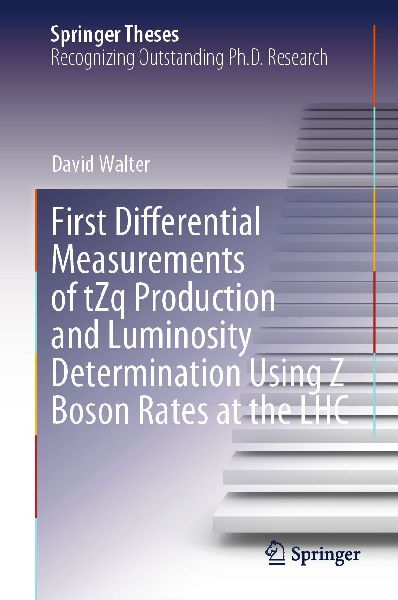
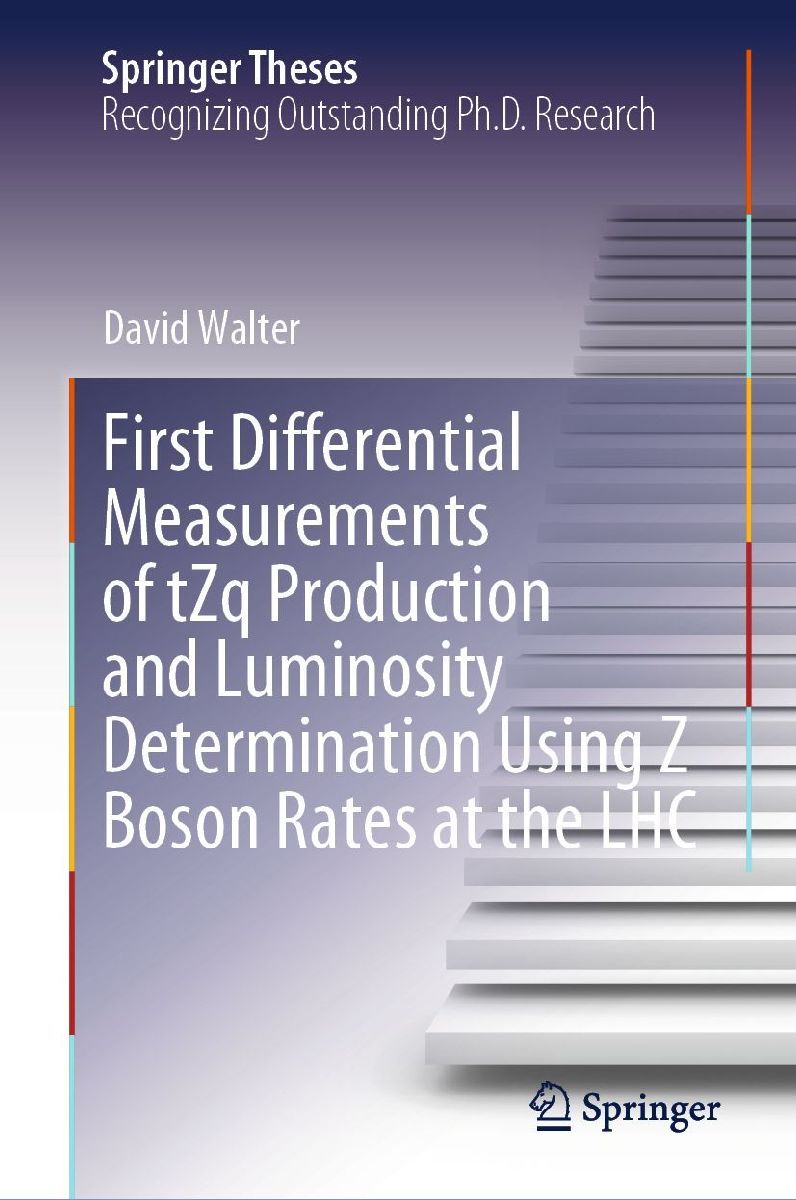
First Differential Measurements of tZq Production and Luminosity Determination Using Z Boson Rates at the LHC
von David Walter
Aus der Reihe Springer Theses
- Einband
- Gebunden
- Seiten
- 212
- Sprache
- Englisch
- Erschienen
- Februar 2024
- Verlag
- Springer
Buchbeschreibung
This thesis describes two groundbreaking measurements in the precision frontier at the LHC: the first ever differential measurement of the Z-associated single top quark (tZq) production, and the luminosity measurement using Z boson production rate for the first time in CMS. Observed only in 2018, the tZq process is of great importance in probing top quark electroweak couplings.
Ganze Beschreibung lesenWeniger anzeigen
These couplings are natural places for new phenomena to happen in the top quark sector of the standard model. Yet, they are the least explored directly. One has to obtain a firm understanding of the modeling of sensitive distributions to new top-Z interactions. The present analysis marks a major milestone in this long-term effort.
All distributions relevant for new phenomena, and/or modeling of tZq, are studied in full depth using advanced Machine Learning techniques.
The luminosity and its uncertainty contributes to every physics result of the experiment. The method minutely developed in this thesis provides a complementary measurement that results in a significant overall reduction of uncertainties.
Inhaltsverzeichnis
- Introduction
- Theoretical Foundations of Single Top Quark Physics at the LHC
- The CMS Experiment at the LHC
- Luminosity Determination Using Z Boson Production
- Measurements of Single Top Quark Production in Association With a Z Boson. Summary and conclusions
Details
- Erscheinungstermin
- Februar 2024
- Kategorie
- Fremdsprachige Bücher
- Einband
- Gebunden
- Seiten
- 212
- Sprache
- Englisch
- Verlag
- Springer
- Reihe
- Springer Theses
- Format
- 24,1 × 16,0 cm
- Dicke
- 1,7 cm
- Gewicht
- 475 g
- EAN / ISBN-13
- 9783031509308
Über David Walter
I studied physics at KIT in Karlsruhe, Germany with the main subjects on theoretical particle physics, experimental particle physics, and data analysis.
Mehr über David WalterWeniger anzeigen
In summer 2017 I joined the CMS experiment to work for my master's thesis project on improvements in deep neural network algorithms for the identification of jets with b quarks. I showed that by using novel machine learning techniques based on domain adaptation the difference between data and simulation can be mitigated. Afterward, I moved to Hamburg where I started my PhD at the DESY research center. My main project was the analysis of proton-proton collision data recorded by the CMS experiment, where I studied the production of a single top quark in association with a Z boson (tZq). During this time, I also co-supervised a graduate student on a related project. Today, I am a level 3 tX convener for CMS and organize by-weekly meetings and support and review analyses from the early stages. As the HepData contact person, I organize thedata preservation of analysis results. In the past and present, I contribute to the CMS experiment in the group responsible for luminosity determination. I developed a novel technique of measuring the luminosity using Z bosons decaying into muons. The approach requires a deep understanding of the reconstruction, identification, triggering, and efficiency determination of munos. The method is also used to validate the luminosity recorded in the just-started LHC Run 3 data acquisition, where I take a supervising role. In my current position as a postdoctoral scientific researcher, I joined the effort for a precision measurement of the W boson mass, a parameter of the standard model that was recently measured with tension to theory predictions. To cope with the demanding conditions for the planned High-Luminosity LHC, new innovative and cutting-edge technology will be needed. In the context of the Phase-2 upgrade of the CMS experiment, I'm performing test measurements of silicon sensors for the new High Granularity Calorimeter (HGCAL).
Versand und Rückgabe
Standardversand: 1 bis 3 Werktage, 3,99 €, kostenlos ab 35 €
Liefergebiet: Deutschland
Rücksendung: 14 Tage Widerrufsrecht. Bei einem Widerruf tragen Sie die Kosten der Rücksendung. Bei einer Falschlieferung oder einem Fehler von uns erstatten wir Ihnen das Rückporto. Den Widerruf erklären Sie über den Knopf „Vertrag widerrufen“ im Fuß der Seite.
Hersteller und ProduktsicherheitSpringer Nature Customer Service Center GmbH
Springer Nature Customer Service Center GmbH
Europaplatz 3
69115 Heidelberg
Deutschland
ProductSafety@springernature.com
Mehr von David Walter




Mehr aus der Reihe Springer Theses
Origin, Symmetry and Elastic Tuneability of Charge Density Waves in the Superconductor BaNi¿(As¿¿¿P¿)¿
Tom Laurin Lacmann
Gebunden, Englisch
171,19 €

Molecular Manipulation by Plasmonic Nanostructures at Electrified Interfaces
Nobuaki Oyamada
Gebunden, Englisch
160,49 €
Investigating Tau Lepton Pair Production with the ATLAS Experiment
Giovanni Padovano
Gebunden, Englisch
160,49 €
Probing the Giant Dipole Resonance Using Nuclear Resonance Fluorescence
Jörn Kleemann
Gebunden, Englisch
160,49 €
Ähnliche Titel




Bewertungen
Zu diesem Titel gibt es noch keine Bewertung. Bewerten kann, wer ihn bei uns gekauft hat.
So prüfen wir Bewertungen
Eine Bewertung kann bei uns nur abgeben, wer den Titel über sein Kundenkonto bei uns gekauft hat. Jede Bewertung ist fest mit der zugehörigen Bestellung verknüpft; anders kommt sie technisch gar nicht zustande. Deshalb trägt jede angezeigte Bewertung den Hinweis „Verifizierter Kauf". Wir zeigen positive wie negative Bewertungen und löschen nur bei Rechtsverstößen. Für Bewertungen gibt es keine Gegenleistung.
160,49 €Voraussichtlich 7. bis 9. Dez.