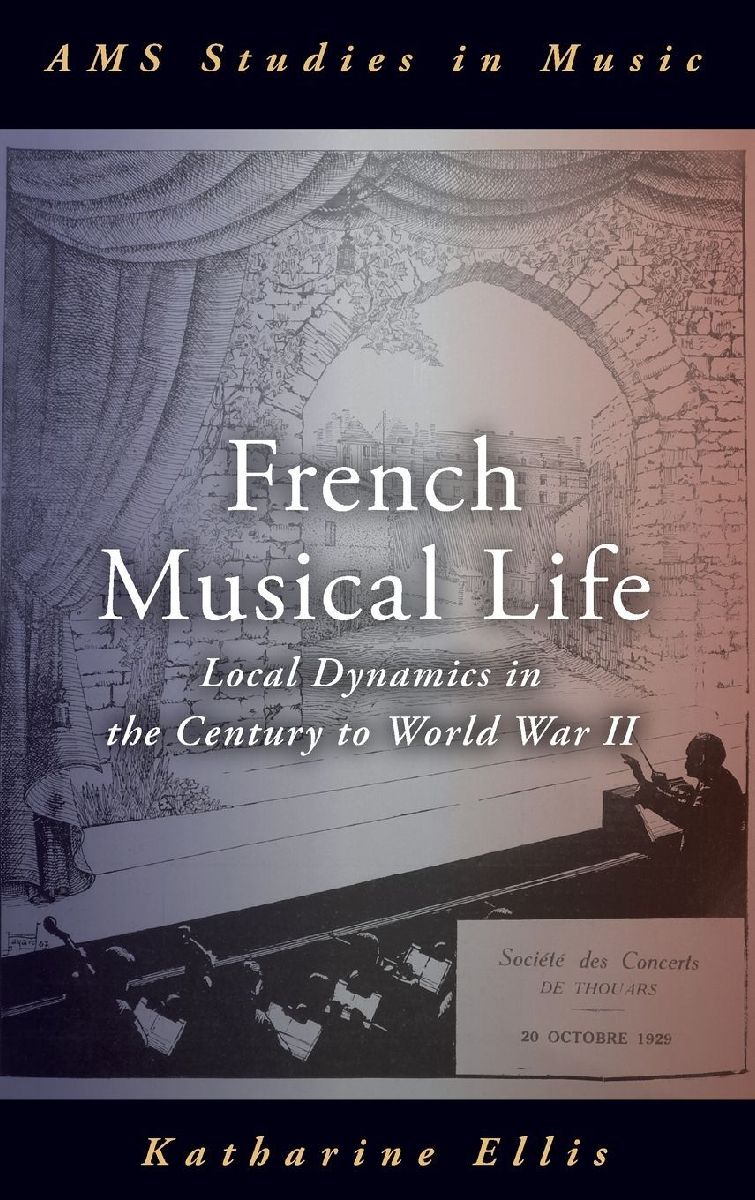
French Musical Life
Local Dynamics in the Century to World War II
von Katharine Ellis
- Einband
- Gebunden
- Seiten
- 438
- Sprache
- Englisch
- Erschienen
- November 2021
- Verlag
- Oxford University Press
Buchbeschreibung
Explicitly or not, the historical musicology of post-Revolutionary France has focused on Paris as a proxy for the rest of the country.
This distorting lens is the legacy of political and cultural struggle during the long nineteenth century, indicating a French Revolution unresolved both then and now.
Ganze Beschreibung lesenWeniger anzeigen
In light of the capital's power as the seat of a centralizing French state (which provincials found 'colonizing') and as a cosmopolitan musical crossroads of nineteenth-century Europe, the struggles inherent in creating sustainable musical cultures outside Paris, and in composing local and regionalist music, are ripe for analysis.
Replacement of 'France' with Paris has encouraged normative history-writing articulated by the capital's opera and concert life. Regional practices have been ignored, disparaged or treated piecemeal. This book is a study of French musical centralization and its discontents during the period leading up to and beyond the "provincial awakening" of the Belle Époque.
The book explains how different kinds of artistic decentralization and regionalism were hard won (or not) across a politically turbulent century from the 1830s to World War II. In doing so it redraws the historical map of musical power relations in mainland France.
Based on work in over 70 archives, chapters on conservatoires, concert life, stage music, folk music and composition reveal how tensions of State and locality played out differently depending on the structures and funding mechanisms in place, the musical priorities of different communities, and the presence or absence of galvanizing musicians.
Progressively, the book shifts from musical contexts to musical content, exploring the pressure point of folk music and its translation into "local color" for officials who perpetually feared national division. Control overcomposition on the one hand, and the emotional intensity of folk-based musical experience on the other, emerges as a matter of consistent official praxis.
In terms of "French music" and its compositional styles, what results is a surprising new historiography of French neoclassicism, bound into and growing out of a study of diversity and its limits in daily musical life.
Inhaltsverzeichnis
- Introduction
- -Centralization and its discontents-
- Decentralization, deconcentration, regionalism-
- Politics, then and now-
- A Study in four Parts-
- Approaches- Part I Education
- Introduction
- Chapter 1: The National Conservatoire System
Ganzes Inhaltsverzeichnis anzeigen (54 Einträge)Weniger anzeigen
- -Class and access: working-class men-
- Class and status: young bourgeoises-
- Power, hard and soft-
- Directorial discretion: curricula-
- The 1930s: towards reform- Chapter 2: Educational Independence
- -Pedagogical Difference c.1900-
- The Schola's ghostly presences I: Montpellier-
- The Schola's ghostly presences II: Séverac's vision, Le Havre and Nancy-
- Strasbourg-
- Bordeaux-
- Composition: the final frontier- Part II Concert Rites- Introduction
- Chapter 3: Choral Voices
- -Orphéons: uniformity and regional identity-
- Cathedral maîtrises-
- Mixed choirs: Poitou-Charentes and Strasbourg-
- Belle Époque ambition: Bordes, Witkowski and Lyon- Chapter 4: Instrumental Music and Urban Gravitas
- -Private, public, "populaire"-
- The Symphony orchestra as musical hub-
- Amateur to professional-
- Provincial programming: orchestral, chamber and specialist ensembles-
- Local vs. (inter)national- Part III Stage Musics- Introduction- Chapter 5: Opera Against the Odds
- -The 1864 liberté des théâtres-
- Municipal perspectives-
- Industry perspectives- Chapter 6: Operatic Competition
- -The Café-Concert-
- Operetta-
- Touring: individual and collective-
- Technology- Chapter 7: Opera Inside and Out
- -Wagner's "tour de France"-
- Couleur locale in Paris and at home-
- Open-air opera- Part IV Folk, Region, Nation- Introduction
- Chapter 8: Folk Musics
- -The French folk-music problem-
- Politics of collection, transcription, and classification-
- Soundscapes of popular Catholicism-
- Folk music, the peasant, and the bourgeoisie-
- Display, domestication, tourism-
- Coda- Chapter 9: Composition-
- A View from 1937-
- Provincial career paths-
- Rethinking the Schola's regionalism-
- The Allure of the Russian Five-
- Back to opera: regionalism and nation-
- Mode, multi-regionalism, and patrimoine- Conclusions- -"Decentralization" through the lens of Lyon-
- Musical localism-
- Repositioning the rural- Bibliography- Index
Details
- Erscheinungstermin
- November 2021
- Kategorie
- Fremdsprachige Bücher
- Einband
- Gebunden
- Seiten
- 438
- Sprache
- Englisch
- Verlag
- Oxford University Press
- Format
- 24,0 × 16,1 cm
- Dicke
- 2,8 cm
- Gewicht
- 769 g
- EAN / ISBN-13
- 9780197600160
Über Katharine Ellis
Katharine Ellis is 1684 Professor of Music at the University of Cambridge. She is widely published on the history of musical France in the nineteenth and early twentieth centuries.
Mehr über Katharine EllisWeniger anzeigen
Her previous monographs cover canon-formation and the press, the early music revival, and Benedictine musical politics c.1900. She has been elected to the Academia Europaea, the British Academy, and the American Philosophical Society.
Versand und Rückgabe
Standardversand: 1 bis 3 Werktage, 3,99 €, kostenlos ab 35 €
Liefergebiet: Deutschland
Rücksendung: 14 Tage Widerrufsrecht. Bei einem Widerruf tragen Sie die Kosten der Rücksendung. Bei einer Falschlieferung oder einem Fehler von uns erstatten wir Ihnen das Rückporto. Den Widerruf erklären Sie über den Knopf „Vertrag widerrufen“ im Fuß der Seite.
Hersteller und ProduktsicherheitOxford University Press
Oxford University Press
Europaallee 1
36244 Bad Hersfeld
Deutschland
gpsr@libri.de
Verantwortliche Person in der EU
Libri GmbHEuropaallee 1
36244 Bad Hersfeld
Deutschland
gpsr@libri.de
Mehr von Katharine Ellis




Ähnliche Titel




Bewertungen
Zu diesem Titel gibt es noch keine Bewertung. Bewerten kann, wer ihn bei uns gekauft hat.
So prüfen wir Bewertungen
Eine Bewertung kann bei uns nur abgeben, wer den Titel über sein Kundenkonto bei uns gekauft hat. Jede Bewertung ist fest mit der zugehörigen Bestellung verknüpft; anders kommt sie technisch gar nicht zustande. Deshalb trägt jede angezeigte Bewertung den Hinweis „Verifizierter Kauf". Wir zeigen positive wie negative Bewertungen und löschen nur bei Rechtsverstößen. Für Bewertungen gibt es keine Gegenleistung.
126,50 €Voraussichtlich 7. bis 9. Dez.