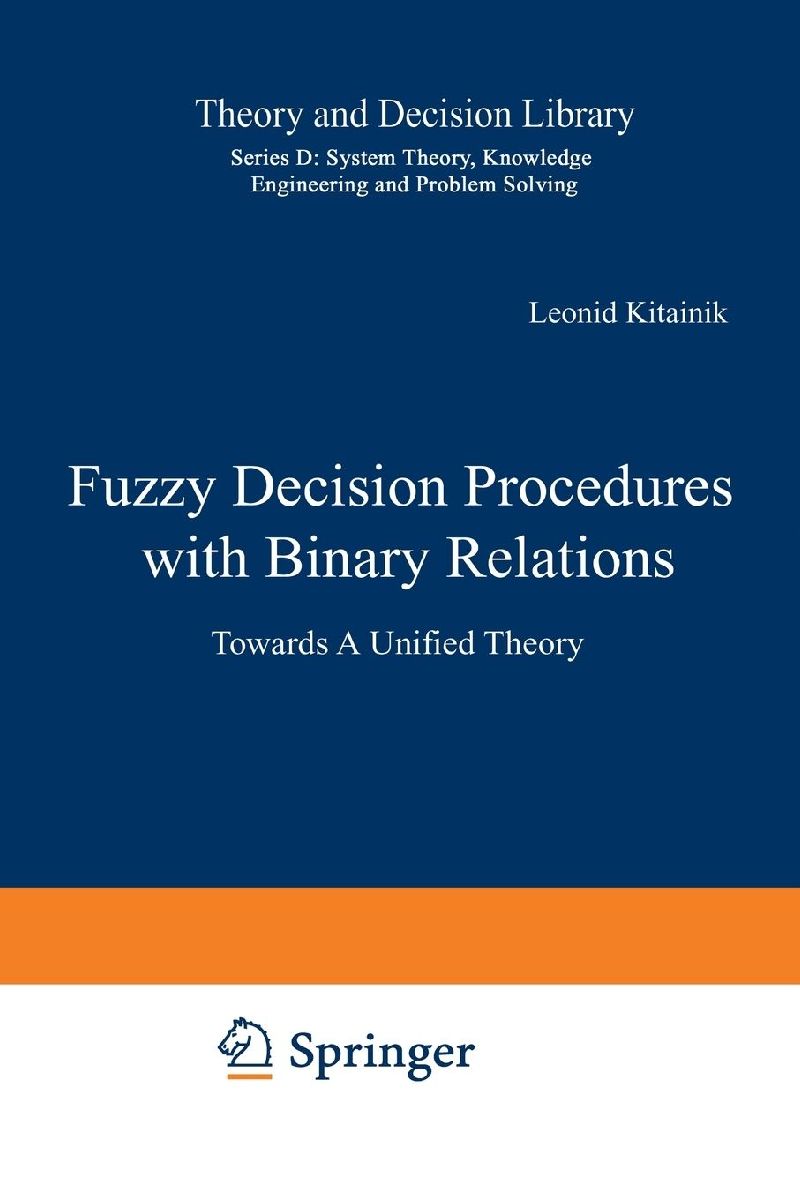
Fuzzy Decision Procedures with Binary Relations
Towards a Unified Theory
von Leonid Kitainik
- Einband
- Kartoniert
- Seiten
- 255
- Sprache
- Englisch
- Erschienen
- Oktober 2012
- Verlag
- Springer
Buchbeschreibung
In decision theory there are basically two appr~hes to the modeling of individual choice: one is based on an absolute representation of preferences leading to a ntDnerical expression of preference intensity.
This is utility theory. Another approach is based on binary relations that encode pairwise preference. While the former has mainly blossomed in the Anglo-Saxon academic world, the latter is mostly advocated in continental Europe, including Russia.
Ganze Beschreibung lesenWeniger anzeigen
The advantage of the utility theory approach is that it integrates uncertainty about the state of nature, that may affect the consequences of decision.
Then, the problems of choice and ranking from the knowledge of preferences become trivial once the utility function is known. In the case of the relational approach, the model does not explicitly accounts for uncertainty, hence it looks less sophisticated. On the other hand it is more descriptive than normative in the first stand because it takes the pairwise preference pattern expressed by the decision-maker as it is and tries to make the best out of it.
Especially the preference relation is not supposed to have any property. The main problem with the utility theory approach is the gap between what decision-makers are and can express, and what the theory would like them to be and to be capable of expressing. With the relational approach this gap does not exist, but the main difficulty is now to build up convincing choice rules and ranking rules that may help the decision process.
Inhaltsverzeichnis
- 1. Introduction
- 2. Common Notations
- 3. Systematization Of Choice Rules With Binary Relations
- 3.1. Rationality Concept
- Multifold Choice
- 3.2. Basic Diohdtomies: Invariant Description
- 3.3. Composition Laws
- 3.4. Synthesis Of Rationality (X)Ncepts
Ganzes Inhaltsverzeichnis anzeigen (57 Einträge)Weniger anzeigen
- 4. Fuzzy Decision Procedures
- 4.1. Fuzzy Rationality Concept
- 4.2. Multifold Fuzzy Choice
- 4.3. Families Of Fuzzy Dichotomous Decision Procedures
- 5. Contensiveness Criteria
- 5.1. Motivations And Postulates For Multifold Fuzzy Choice
- 5.2. Dichotomousness And δ-Contensiveness Of Multifold Fuzzy Choice, Procedures, And Relations
- 5.3. Ranking Alternatives Using Multifold Fuzzy Choice
- 6. Fuzzy Inclusions
- 6.1. Motivations, Fuzzy Inclusion And Fuzzy Implication
- 6.2. Axiomatics
- 6.3. Representation Theorem
- 6.4. Properties Of Fuzzy Inclusions
- 6.5. Binary Operations With Fuzzy Inclusions
- 6.6. Characteristic Fuzzy Inclusions (Polynomial And Piecewise-Polynomial Models)
- 6.7. Comparative Study Of Fuzzy Inclusions
- 7. Contensiveness Of Fuzzy Dichotomous Decision Procedures In Universal Environment
- 8. Choice With Fuzzy Relations
- 8.1. Basic Technique
- Elements Of Multifold Fuzzy Choice
- 8.2. α-Cuts, And Multifold Fuzzy Choice With Basic Dichotomies
- 8.3. The Core Is Unfit
- 8.4. Fuzzy Von Neumann — Morgenstern Solution
- Fuzzy Stable Core
- 8.5. Procedures Based On The Dual Composition Law
- 9. Ranking And C-Spectral Properties Of Fuzzy Relations (Fuzzy Von Neumann - Morgenstern - Zadeh Solutions)
- 9.1. Basic Characteristics
- Ͱ-Mapping
- 9.2. Bounds Of Multifold Fuzzy Choice
- 9.3. Connected Spectrum, And Spectral Properties Of A Fuzzy Relation
- 9.4. Classification Of Multifold Fuzzy Choices
- 9.5. Fuzzy L.Zadeh' Stable Core
- 9.6. Incontensive Procedures Based
- On L.Zadeh' Inclusion
- 10. Invariant, Antiinvariant And Eigen Fuzzy Subsets
- Mainsprings Of Cut Technique In Fuzzy Relational Systems
- 11. Contenstveness Of Fuzzy Decision Procedures In Restricted Environment
- 12. Efficiency Of Fuzzy Decision Procedures
- 13. Decision-Making With Special Classes Of Fuzzy Binary Relations
- 13.1. Fuzzy Preorderings
- 13.2. Reciprocal Relations
- 14. Applications To Crisp Choice Rules
- 14.1. Adjusting Crisp Choice
- 14.2. Producing New Choice Rules (Fnmzs And Dipole Decomposition)
- 15. Applications To Decision Support Systems And To Multipurpose Decision-Making
- 15.1. General Applications To Decision Support Systems
- 15.2. Applications To Multipurpose Decision-Making
- 15.3. Expert Assistant Ficckas (In Collaboration With S.Orlovski)
- Literature
Details
- Erscheinungstermin
- Oktober 2012
- Kategorie
- Fremdsprachige Bücher
- Einband
- Kartoniert
- Seiten
- 255
- Sprache
- Englisch
- Verlag
- Springer
- Format
- 24,0 × 16,0 cm
- Dicke
- 1,6 cm
- Gewicht
- 458 g
- EAN / ISBN-13
- 9789401048668
Versand und Rückgabe
Standardversand: 1 bis 3 Werktage, 3,99 €, kostenlos ab 35 €
Liefergebiet: Deutschland
Rücksendung: 14 Tage Widerrufsrecht. Bei einem Widerruf tragen Sie die Kosten der Rücksendung. Bei einer Falschlieferung oder einem Fehler von uns erstatten wir Ihnen das Rückporto. Den Widerruf erklären Sie über den Knopf „Vertrag widerrufen“ im Fuß der Seite.
Hersteller und ProduktsicherheitSpringer Nature Customer Service Center GmbH
Europaplatz 3
69115 Heidelberg
Deutschland
ProductSafety@springernature.com
Bewertungen
Zu diesem Titel gibt es noch keine Bewertung. Bewerten kann, wer ihn bei uns gekauft hat.