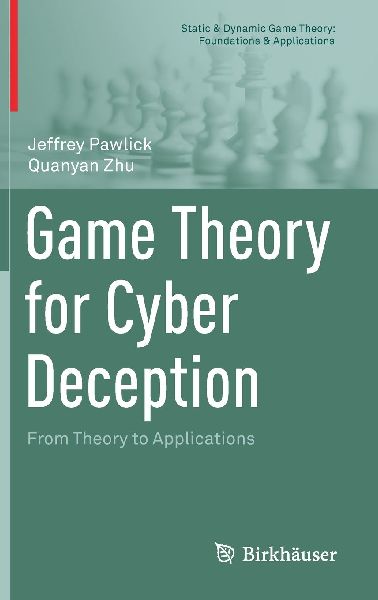
Game Theory for Cyber Deception
From Theory to Applications
von Jeffrey Pawlick und Quanyan Zhu
Aus der Reihe Static & Dynamic Game Theory: Foundations & Applications
- Einband
- Gebunden
- Seiten
- 204
- Sprache
- Englisch
- Erschienen
- Januar 2021
- Verlag
- Springer
Buchbeschreibung
This book introduces game theory as a means to conceptualize, model, and analyze cyber deception.
Drawing upon a collection of deception research from the past 10 years, the authors develop a taxonomy of six species of defensive cyber deception.
Ganze Beschreibung lesenWeniger anzeigen
Three of these six species are highlighted in the context of emerging problems such as privacy against ubiquitous tracking in the Internet of things (IoT), dynamic honeynets for the observation of advanced persistent threats (APTs), and active defense against physical denial-of-service (PDoS) attacks.
Because of its uniquely thorough treatment of cyber deception, this book will serve as a timely contribution and valuable resource in this active field.
The opening chapters introduce both cybersecurity in a manner suitable for game theorists and game theory as appropriate for cybersecurity professionals. Chapter Four then guides readers through the specific field of defensive cyber deception.
A key feature of the remaining chapters is the development of a signaling game model for the species of leaky deception featured in honeypots and honeyfiles. This model is expanded to study interactions between multiple agents with varying abilities to detect deception.
Game Theory for Cyber Deception will appeal to advanced undergraduates, graduate students, and researchers interested in applying game theory to cybersecurity. It will also be of value to researchers and professionals working on cybersecurity who seek an introduction to game theory.
Inhaltsverzeichnis
- Part I Fundamentals
- Introduction
- Nash and Stackelberg Games
- Introduction to Incomplete Information
- Part II Defensive Deception
- A Taxonomy of Defensive Deception
- Obfuscation
- Honey-X
Ganzes Inhaltsverzeichnis anzeigen (15 Einträge)Weniger anzeigen
- Attacker Engagement
- Part III Mitigation of Malicious Deception
- Strategic Trust
- Active Crowd Defense
- Part IV Challenges and Opportunities in Cyber Deception
- Insights and Future Directions
- Current Challenges in Cyber Deception
Details
- Erscheinungstermin
- Januar 2021
- Kategorie
- Fremdsprachige Bücher
- Einband
- Gebunden
- Seiten
- 204
- Sprache
- Englisch
- Verlag
- Springer
- Reihe
- Static & Dynamic Game Theory: Foundations & Applications
- Format
- 24,1 × 16,0 cm
- Dicke
- 1,7 cm
- Gewicht
- 425 g
- EAN / ISBN-13
- 9783030660642
Versand und Rückgabe
Standardversand: 1 bis 3 Werktage, 3,99 €, kostenlos ab 35 €
Liefergebiet: Deutschland
Rücksendung: 14 Tage Widerrufsrecht. Bei einem Widerruf tragen Sie die Kosten der Rücksendung. Bei einer Falschlieferung oder einem Fehler von uns erstatten wir Ihnen das Rückporto. Den Widerruf erklären Sie über den Knopf „Vertrag widerrufen“ im Fuß der Seite.
Hersteller und ProduktsicherheitSpringer Nature Customer Service Center GmbH
Springer Nature Customer Service Center GmbH
Europaplatz 3
69115 Heidelberg
Deutschland
ProductSafety@springernature.com
Mehr aus der Reihe Static & Dynamic Game Theory: Foundations & Applications




The Berge Equilibrium: A Game-Theoretic Framework for the Golden Rule of Ethics
Mindia E. Salukvadze
Gebunden, Englisch, 2 Ausgaben
ab 128,39 €
Bewertungen
Zu diesem Titel gibt es noch keine Bewertung. Bewerten kann, wer ihn bei uns gekauft hat.
So prüfen wir Bewertungen
Eine Bewertung kann bei uns nur abgeben, wer den Titel über sein Kundenkonto bei uns gekauft hat. Jede Bewertung ist fest mit der zugehörigen Bestellung verknüpft; anders kommt sie technisch gar nicht zustande. Deshalb trägt jede angezeigte Bewertung den Hinweis „Verifizierter Kauf". Wir zeigen positive wie negative Bewertungen und löschen nur bei Rechtsverstößen. Für Bewertungen gibt es keine Gegenleistung.
117,69 €Voraussichtlich 4. bis 8. Dez.