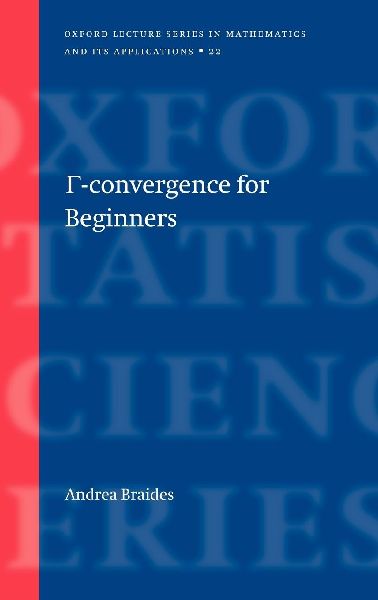
Gamma-Convergence for Beginners
von Andrea Braides
- Einband
- Gebunden
- Seiten
- 232
- Sprache
- Englisch
- Erschienen
- Juli 2002
- Verlag
- OUP Oxford
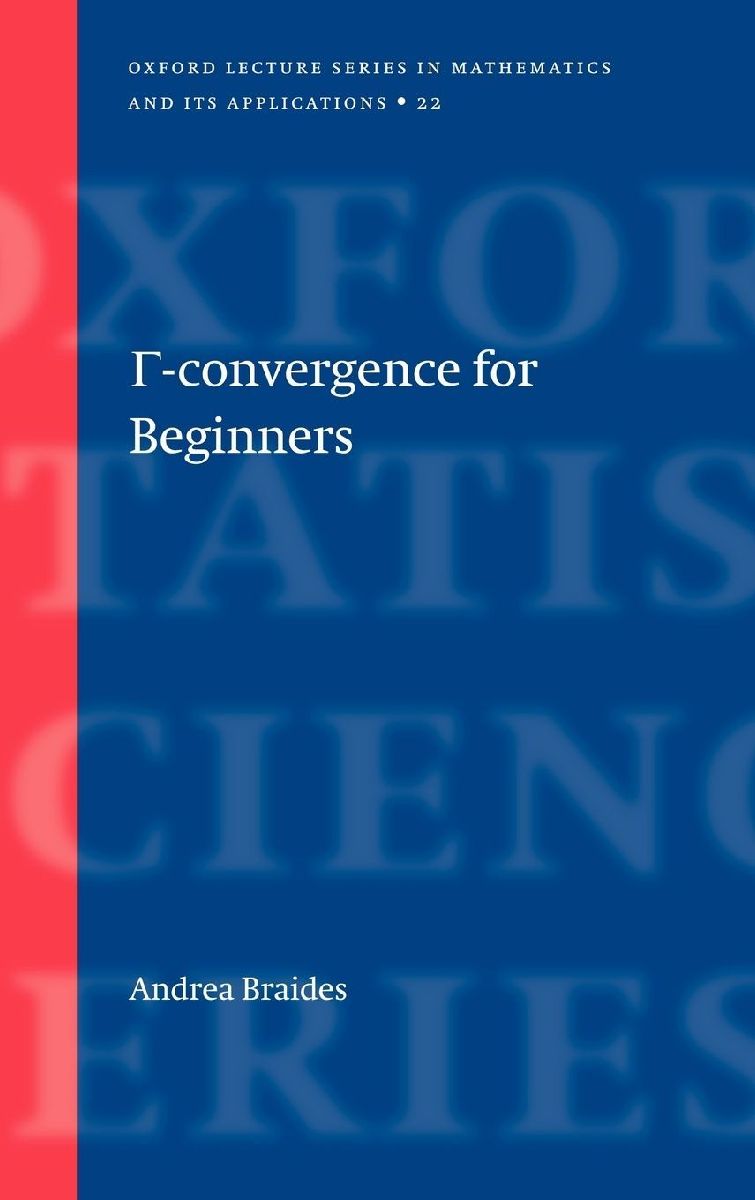
Buchbeschreibung
The theory of Gamma-convergence is commonly recognized as an ideal and flexible tool for the description of the asymptotic behaviour of variational problems.
Its applications range from the mathematical analysis of composites to the theory of phase transitions, from Image Processing to Fracture Mechanics.
Ganze Beschreibung lesenWeniger anzeigen
This text, written by an expert in the field, provides a brief and simple introduction to this subject, based on the treatment of a series of fundamental problems that illustrate the main features and techniques of Gamma-convergence and at the same time provide a stimulating starting point for further studies.
The main part is set in a one-dimensional framework that highlights the main issues of Gamma-convergence without the burden of higher-dimensional technicalities. The text deals in sequence with increasingly complex problems, first treating integral functionals, then homogenisation, segmentation problems, phase transitions, free-discontinuity problems and their discrete and continuous approximation, making stimulating connections among those problems and with applications.
The final part is devoted to an introduction to higher-dimensional problems, where more technical tools are usually needed, but the main techniques of Gamma-convergence illustrated in the previous section may be applied unchanged. The book and its structure originate from the author's experience in teaching courses on this subject to students at PhD level in all fields of Applied Analysis, and from the interaction with many specialists in Mechanics and Computer Vision, which have helped in making the text addressed also to a non-mathematical audience.
The material of the book is almost self-contained, requiring only some basic notion of Measure Theory and Functional Analysis.
Inhaltsverzeichnis
- Preface- Introduction-
- 1: Gamma-convergence by numbers-
- 2: Integral problems-
- 3: Some homogenization problems-
- 4: From discrete systems to integral functionals-
- 5: Segmentation problems-
- 6: Phase-transition problems-
- 7: Free-discontinuity problems-
Ganzes Inhaltsverzeichnis anzeigen (12 Einträge)Weniger anzeigen
- 8: Approximation of free-discontinuity problems-
- 9: More homogenization problems-
- 10: Interaction between elliptic problems and partition problems-
- 11: Discrete systems and free-discontinuity problems- 12: *Some comments on vectorial problems- 13: *Dirichlet problems in perforated domains- 14: *Dimension-reduction problems- 15: *The 'slicing' method- 16: *An introduction to the localization method of Gamma-convergence- Appendices- B: Characterization of Gamma-convergence for 1D(italic 'D') integral problems- List of symbols- References- Index
Details
- Erscheinungstermin
- Juli 2002
- Kategorie
- Fremdsprachige Bücher
- Einband
- Gebunden
- Seiten
- 232
- Sprache
- Englisch
- Verlag
- OUP Oxford
- Format
- 24,0 × 16,1 cm
- Dicke
- 1,7 cm
- Gewicht
- 467 g
- EAN / ISBN-13
- 9780198507840
Über Andrea Braides
Prof. Andrea BraidesAddress
Via Balilla 22, 00185 Roma, ITALY
Tel(+39)0670452392 (home) (+39)0672594688 (office) Fax(+39)0672594699Emailbraides@mat.uniroma2.itItalian, Udine (Italy), April 12,1961
Versand und Rückgabe
Standardversand: 1 bis 3 Werktage, 3,99 €, kostenlos ab 35 €
Liefergebiet: Deutschland
Rücksendung: 14 Tage Widerrufsrecht. Bei einem Widerruf tragen Sie die Kosten der Rücksendung. Bei einer Falschlieferung oder einem Fehler von uns erstatten wir Ihnen das Rückporto. Den Widerruf erklären Sie über den Knopf „Vertrag widerrufen“ im Fuß der Seite.
Hersteller und ProduktsicherheitOUP Oxford
OUP Oxford
Europaallee 1
36244 Bad Hersfeld
Deutschland
gpsr@libri.de
Verantwortliche Person in der EU
Libri GmbHEuropaallee 1
36244 Bad Hersfeld
Deutschland
gpsr@libri.de
Mehr von Andrea Braides
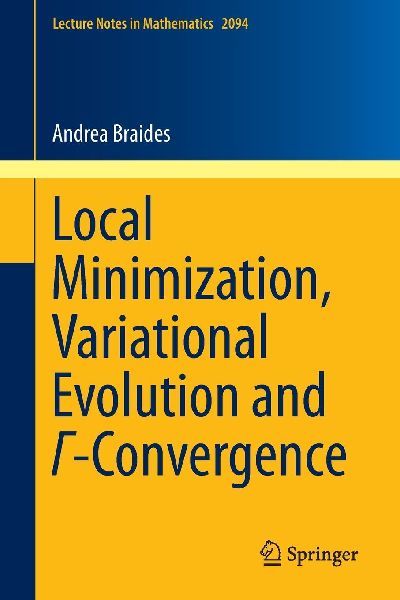
Local Minimization, Variational Evolution and ¿-Convergence
Andrea Braides
Kartoniert, Englisch
40,65 €
Bewertungen
Zu diesem Titel gibt es noch keine Bewertung. Bewerten kann, wer ihn bei uns gekauft hat.
So prüfen wir Bewertungen
Eine Bewertung kann bei uns nur abgeben, wer den Titel über sein Kundenkonto bei uns gekauft hat. Jede Bewertung ist fest mit der zugehörigen Bestellung verknüpft; anders kommt sie technisch gar nicht zustande. Deshalb trägt jede angezeigte Bewertung den Hinweis „Verifizierter Kauf". Wir zeigen positive wie negative Bewertungen und löschen nur bei Rechtsverstößen. Für Bewertungen gibt es keine Gegenleistung.
211,50 €Voraussichtlich 4. bis 8. Dez.