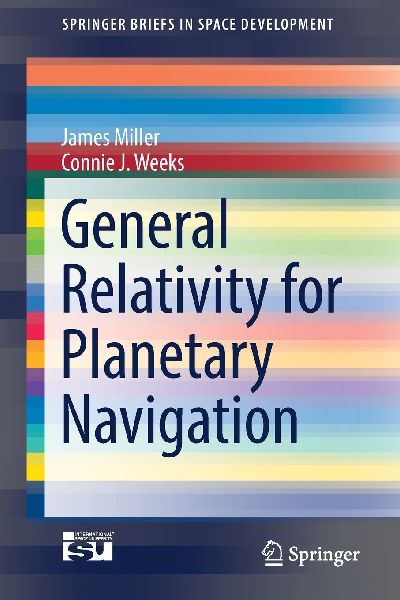
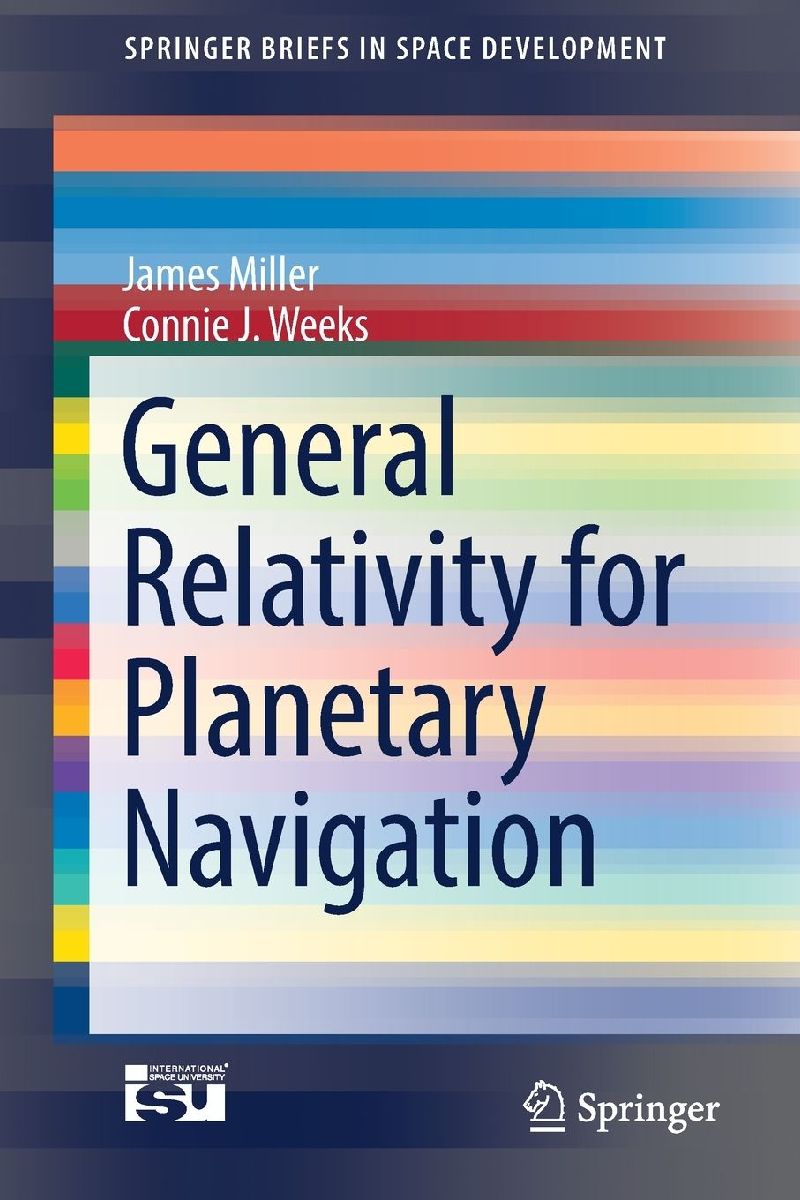
General Relativity for Planetary Navigation
von James Miller und Connie J. Weeks
Aus der Reihe SpringerBriefs in Space Development
- Einband
- Kartoniert
- Seiten
- 112
- Sprache
- Englisch
- Erschienen
- September 2021
- Verlag
- Springer
Buchbeschreibung
This brief approaches General Relativity from a planetary navigation perspective, delving into the unconventional mathematical methods required to produce computer software for space missions.
It provides a derivation of the Einstein field equations and describes experiments performed on the Near Earth Asteroid Rendezvous mission, spanning General Relativity Theory from the fundamental assumptions to experimental verification.
Ganze Beschreibung lesenWeniger anzeigen
The software used for planetary missions is derived from mathematics that use matrix notation. An alternative is to use Einstein summation notation, which enables the mathematics to be presented in a compact form but makes the geometry difficult to understand. In this book, the relationship of matrix notation to summation notation is shown.
The purpose is to enable the reader to derive the mathematics used in the software in either matrix notation or summation notation. This brief is a useful tool for advanced students andyoung professionals embarking on careers in planetary navigation.
Inhaltsverzeichnis
- Chapter 1: Einstein Field Equations
- Chapter 2: Schwarzschild Solution for Metric Tensor
- Chapter 3: Comparison of Numerical Integration and Analytic Solutions
- Chapter 4: General Relativity Time Delay Experiment Experimental Results
Details
- Erscheinungstermin
- September 2021
- Kategorie
- Fremdsprachige Bücher
- Einband
- Kartoniert
- Seiten
- 112
- Sprache
- Englisch
- Verlag
- Springer
- Reihe
- SpringerBriefs in Space Development
- Format
- 23,5 × 15,5 cm
- Dicke
- 0,7 cm
- Gewicht
- 184 g
- EAN / ISBN-13
- 9783030775452
Über James Miller
James Miller worked as the assistant Navigation Team Chief on the Viking Mission to Mars in 1976. In 2000, he received the Mechanics and Control of Flight medal from the AIAA for his design of the …
Mehr über James MillerWeniger anzeigen
In 2000, he received the Mechanics and Control of Flight medal from the AIAA for his design of the navigation system for the first orbiting and landing on the asteroid Eros. Further, he designed a trajectory to leave Earth and orbit the Moon with no propulsive maneuvers. This was the first practical solution of the four-body problem, and it has since been used on the missions Hiten, Genesis, and Grail.
Versand und Rückgabe
Standardversand: 1 bis 3 Werktage, 3,99 €, kostenlos ab 35 €
Liefergebiet: Deutschland
Rücksendung: 14 Tage Widerrufsrecht. Bei einem Widerruf tragen Sie die Kosten der Rücksendung. Bei einer Falschlieferung oder einem Fehler von uns erstatten wir Ihnen das Rückporto. Den Widerruf erklären Sie über den Knopf „Vertrag widerrufen“ im Fuß der Seite.
Hersteller und ProduktsicherheitSpringer Nature Customer Service Center GmbH
Springer Nature Customer Service Center GmbH
Europaplatz 3
69115 Heidelberg
Deutschland
ProductSafety@springernature.com
Mehr von James Miller




Mehr aus der Reihe SpringerBriefs in Space Development

Ähnliche Titel
Proceedings of the 10th International Seminar on Aerospace Science and Technology; ISAST 2024; 17 September, Bali, Indonesia
Ery Fitrianingsih (Hrsg.)
Kartoniert, Englisch, 2 Ausgaben
ab 139,09 €


Bewertungen
Zu diesem Titel gibt es noch keine Bewertung. Bewerten kann, wer ihn bei uns gekauft hat.
So prüfen wir Bewertungen
Eine Bewertung kann bei uns nur abgeben, wer den Titel über sein Kundenkonto bei uns gekauft hat. Jede Bewertung ist fest mit der zugehörigen Bestellung verknüpft; anders kommt sie technisch gar nicht zustande. Deshalb trägt jede angezeigte Bewertung den Hinweis „Verifizierter Kauf". Wir zeigen positive wie negative Bewertungen und löschen nur bei Rechtsverstößen. Für Bewertungen gibt es keine Gegenleistung.
69,54 €Voraussichtlich 1. bis 3. Dez.