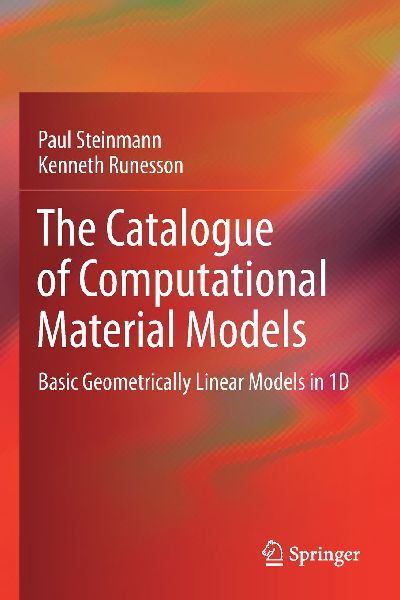
The Catalogue of Computational Material Models
Paul Steinmann
Kartoniert, Englisch, 2 Ausgaben
ab 128,39 €
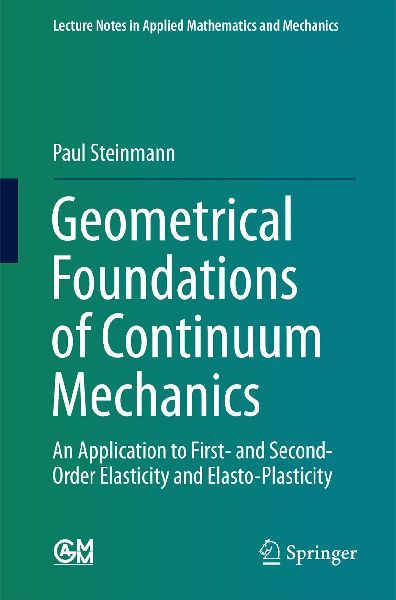
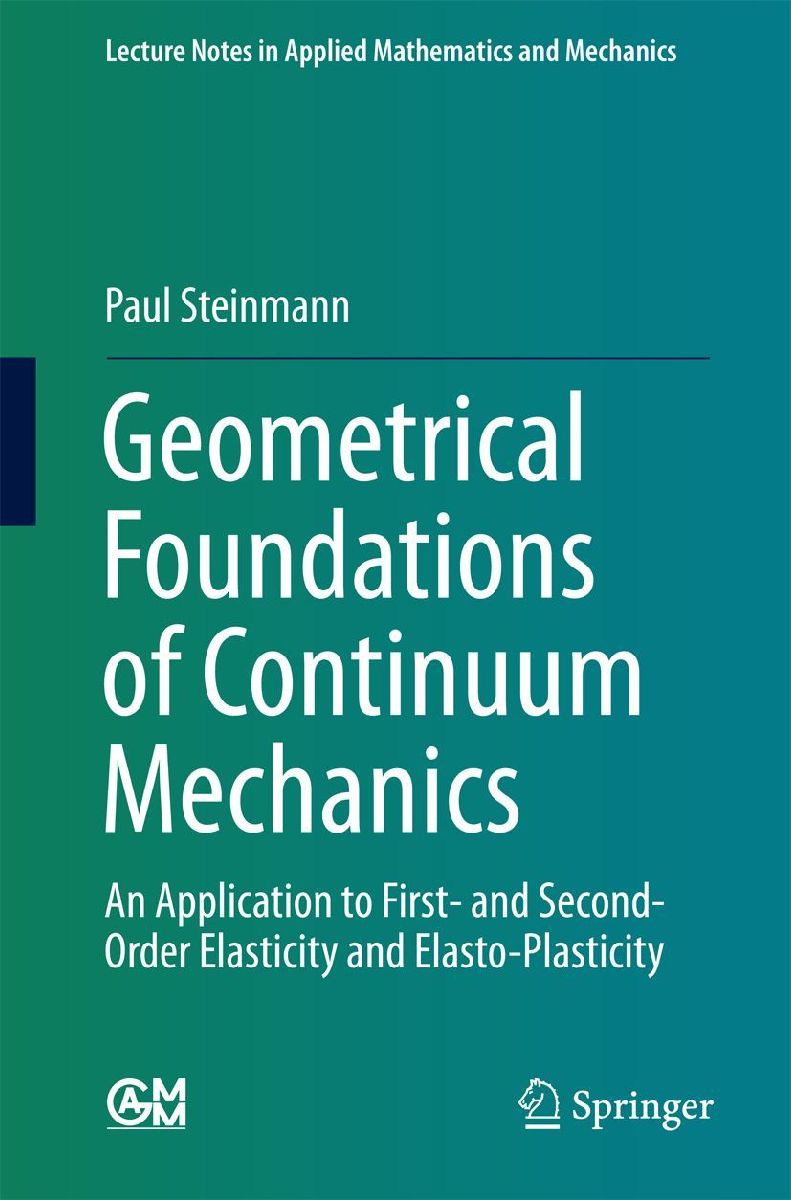
An Application to First- and Second-Order Elasticity and Elasto-Plasticity
von Paul Steinmann
Aus der Reihe Lecture Notes in Applied Mathematics and Mechanics
This book illustrates the deep roots of the geometrically nonlinear kinematics of generalized continuum mechanics in differential geometry.
Besides applications to first-order elasticity and elasto-plasticity an appreciation thereof is particularly illuminating for generalized models of continuum mechanics such as second-order (gradient-type)elasticity and elasto-plasticity.
After a motivation that arises from considering geometrically linear first- and second-order crystal plasticity in Part I several concepts from differential geometry, relevant for what follows, such as connection, parallel transport, torsion, curvature, and metric for holonomic and anholonomic coordinate transformations are reiterated in Part II.Then, in Part III, the kinematics of geometrically nonlinear continuum mechanics are considered.
There various concepts of differential geometry, in particular aspects related to compatibility, are generically applied to the kinematics of first- and second-order geometrically nonlinear continuum mechanics. Together with the discussion onthe integrability conditions for the distortions and double-distortions, the concepts of dislocation, disclination and point-defect density tensors are introduced.
Forconcreteness, after touching on nonlinear first- and second-order elasticity, a detailed discussion of the kinematics of (multiplicative) first- and second-order elasto-plasticity is given. The discussion naturally culminates in a comprehensive set of different types of dislocation, disclination and point-defect density tensors.
It is argued, that these can potentially be used to model densities of geometrically necessary defects and the accompanying hardening in crystalline materials. Eventually Part IV summarizes the above findings on integrability whereby distinction is made between the straightforward conditions for the distortion and the double-distortion being integrable and the more involved conditions for the strain (metric) and the double-strain (connection) being integrable.
The book addresses readers with an interest in continuum modelling of solids from engineering and the sciences alike, whereby a sound knowledge of tensor calculus and continuum mechanics is required as a prerequisite.
Paul Steinmann is Professor for Mechanics at the Friedrich-Alexander-Universität Erlangen-Nürnberg (FAU), Germany, where he heads the Institute of Applied Mechanics in the Department of Mechanical Engineering within FAU's Faculty of Engineering.
He is also Director of the Glasgow Computational Engineering Centre (GCEC) in the School of Engineering at the University of Glasgow, UK. His research interests include nonlinear continuum mechanics, material modelling, coupled and multiscale problems and corresponding computational methods both for engineering as well as for biomechanical applications. Kenneth Runesson is Professor Emeritus of Material and Structural Mechanics at Chalmers University of Technology, Gothenburg, Sweden. His research interests include the computational modelling of coupled problems for porous media including inelasticity, damage and fracture. A trademark is control of discretization and modelling errors via space-time adaptivity.
Computational homogenization and scale-bridging strategies are another major research field.
Standardversand: 1 bis 3 Werktage, 3,99 €, kostenlos ab 35 €
Liefergebiet: Deutschland
Rücksendung: 14 Tage Widerrufsrecht. Bei einem Widerruf tragen Sie die Kosten der Rücksendung. Bei einer Falschlieferung oder einem Fehler von uns erstatten wir Ihnen das Rückporto. Den Widerruf erklären Sie über den Knopf „Vertrag widerrufen“ im Fuß der Seite.
Paul Steinmann
Kartoniert, Englisch, 2 Ausgaben
ab 128,39 €
Paul Steinmann (Hrsg.)
Kartoniert, Englisch, 2 Ausgaben
ab 106,99 €
Paul Steinmann
Gebunden, Englisch
181,89 €
Volodymyr Govorukha
Gebunden, Englisch
106,99 €
Andreas Öchsner (Hrsg.)
Gebunden, Englisch
106,99 €
Zu diesem Titel gibt es noch keine Bewertung. Bewerten kann, wer ihn bei uns gekauft hat.